
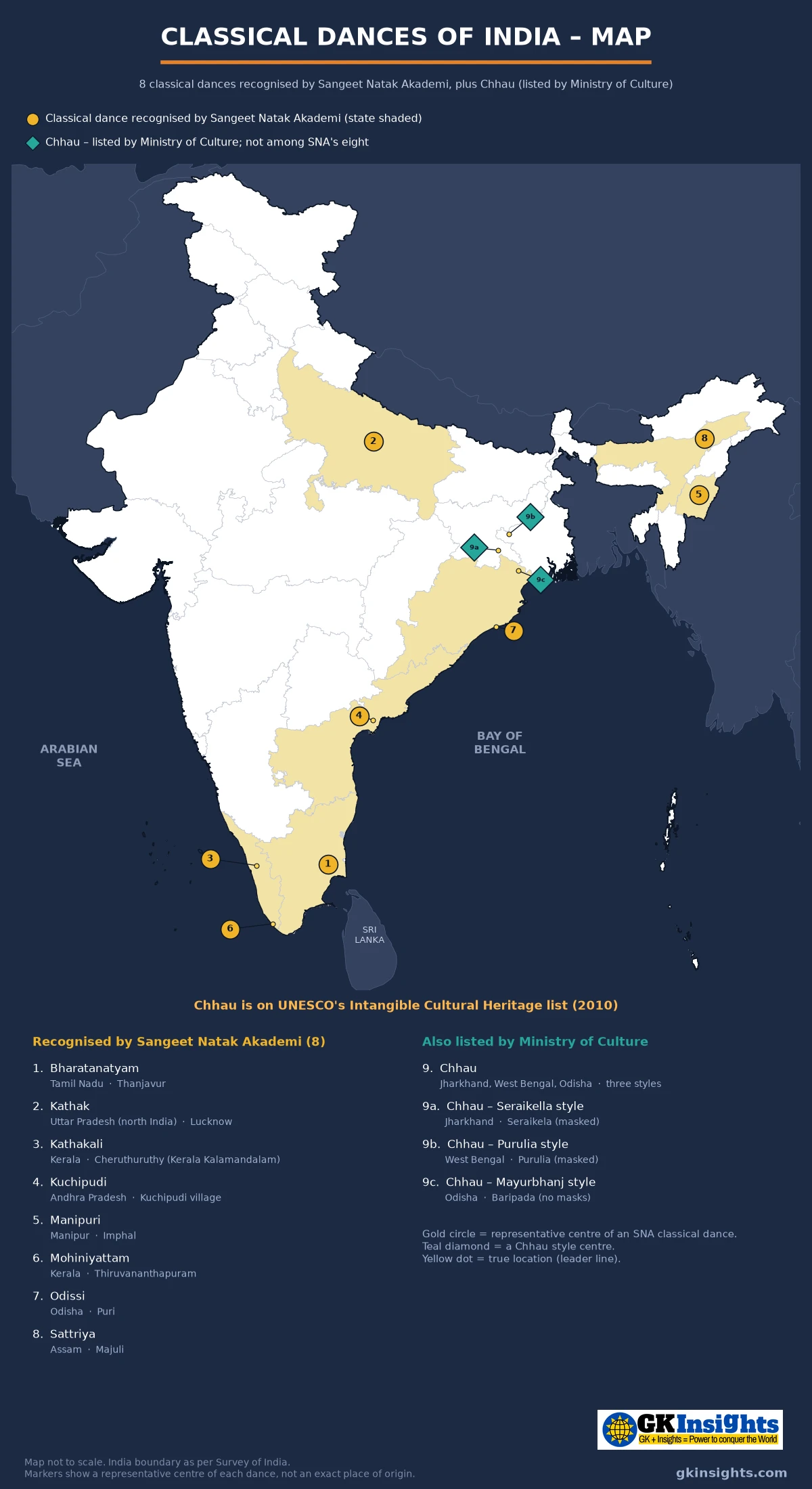
This post explains the classical dances of India map one dance at a time. The map marks the eight classical dances recognised by the Sangeet Natak Akademi (SNA) – Bharatanatyam, Kathak, Kathakali, Kuchipudi, Manipuri, Mohiniyattam, Odissi and Sattriya – at a representative centre in the state each one comes from, and shades those states. It also marks Chhau dance, the masked and martial tradition of eastern India, in a different colour, because the Ministry of Culture describes it alongside the eight but the SNA does not count it among them. The numbers on the map (1–8 in alphabetical order, and 9a–9c for the three Chhau styles) are used in every table below.
Questions on Indian dance in Prelims are almost always of three kinds: match the dance with its state, pick the correct statements about one dance, or tell two similar dances apart. To answer them you need the state, the roots of each dance and two or three features that belong only to it. That is how this post is arranged. The descriptions here come from the Ministry of Culture’s page on Indian dance, the Sangeet Natak Akademi and its Intangible Cultural Heritage site, the Centre for Cultural Resources and Training (CCRT) and the institutions that teach these dances, such as Kerala Kalamandalam and Kalakshetra.
Classical Dances of India Map
How to Read the Classical Dances of India Map
The map uses two kinds of marks:
- Gold numbered circles (1–8): the eight classical dances recognised by the Sangeet Natak Akademi. The state each dance comes from is shaded pale gold – Tamil Nadu, Uttar Pradesh, Kerala, Andhra Pradesh, Manipur, Odisha and Assam. That is seven states for eight dances, because Kerala has two: Kathakali (3) and Mohiniyattam (6).
- Teal diamonds (9a, 9b, 9c): the three styles of Chhau – Seraikella in Jharkhand, Purulia in West Bengal and Mayurbhanj (marked at Baripada) in Odisha. Chhau is not one of the SNA’s eight, so these states are not shaded for it. Odisha is shaded only because of Odissi.
Each mark stands at a representative centre of the dance, not at an exact birthplace: Thanjavur for Bharatanatyam, Lucknow for Kathak, Cheruthuruthy (the home of Kerala Kalamandalam) for Kathakali, Krishna district (for Kuchipudi village) for Kuchipudi, Imphal for Manipuri, Thiruvananthapuram for Mohiniyattam, Puri for Odissi and the river island of Majuli for Sattriya. Where a mark would crowd the coast or another mark, the circle or diamond is moved a little and joined by a thin leader line to a small yellow dot that shows the actual point. On this map that has been done for the two Kerala dances (3 and 6), whose circles are pulled west over the Arabian Sea; for Kuchipudi (4), moved slightly inland; for Puri (7), moved slightly out into the Bay of Bengal; and for the three Chhau diamonds, which are spread apart – Seraikela (9a) to the west, Purulia (9b) to the north-east and Baripada (9c) towards the Bay. Thanjavur (1), Lucknow (2), Imphal (5) and Majuli (8) sit on their points. Majuli is marked by its position in Assam; the base map does not draw the river island separately. The key at the bottom repeats the numbers with the state and the place of each mark. The map is not to scale and the India boundary follows the Survey of India.
How Many Classical Dances Are There in India?
Students meet three different answers – eight, nine and even eleven – so it is worth getting this straight before learning the dances.
- Eight is the standard answer. The Sangeet Natak Akademi, India’s national academy for music, dance and drama, set up in 1953 and an autonomous body of the Ministry of Culture, recognises eight classical dances: Bharatanatyam, Kathak, Kathakali, Kuchipudi, Manipuri, Mohiniyattam, Odissi and Sattriya. CCRT, another Ministry of Culture body, also speaks of “eight recognised Classical Dance traditions of India” on its performing arts page.
- Chhau is the usual “ninth”. The Ministry of Culture’s own Dance page (as archived in July 2024; the live page at indiaculture.gov.in was not loading when this post was written) describes the eight and then Chhau of eastern India on the same page. That is why many books say the Ministry of Culture lists nine. It is a listing, not a separate declaration that Chhau is a classical dance.
- Scheme lists are wider still. Under CCRT’s scholarships for young artistes, the field “Indian Classical Dance / Dance Music” includes Chhau, Thangta and Gaudiya Nritya along with the eight. This is a list of fields in which scholarships are given, and it does not change the SNA’s count.
For Prelims, therefore, write eight, and know that Chhau is the dance most often added as a ninth. In a descriptive answer it is safer to say: “The Sangeet Natak Akademi recognises eight classical dances; Chhau is also covered by the Ministry of Culture and is on UNESCO’s Intangible Cultural Heritage list.”
Classical Dances and the UNESCO List
Of the dances on this map, only Chhau is on UNESCO’s Representative List of the Intangible Cultural Heritage of Humanity, inscribed in 2010 for West Bengal, Jharkhand and Odisha. None of the SNA’s eight classical dances is on the list by name. Two nearby entries are easy to confuse with them:
- Sankirtana, ritual singing, drumming and dancing of Manipur (2013) is a separate element. It is the temple-centred singing and dancing of Manipur’s Vaishnava community, in which “two drummers and about ten singer-dancers” narrate the life of Krishna (SNA ICH page). It is related to Manipuri dance but is not the same thing.
- Kutiyattam (2008) and Mudiyettu (2010) are from Kerala, but they are theatre forms – Kutiyattam is Sanskrit theatre and Mudiyettu a ritual dance-drama – not Kathakali or Mohiniyattam.
The full list of 15 Indian elements is in the Ministry of Culture’s Lok Sabha reply of 8 December 2025 (PIB). For the built heritage list, see the UNESCO World Heritage Sites in India map.
List of Classical Dances of India and Their States
This is the core table of the classical dances of India map: the list of classical dances of India and their states, with the place each one is marked. Learn the first three columns well; most match-the-following questions are built on them.
| No. | Dance | State | Marker on the map | Music |
|---|---|---|---|---|
| 1 | Bharatanatyam | Tamil Nadu | Thanjavur | Carnatic |
| 2 | Kathak | Uttar Pradesh (north India) | Lucknow | Hindustani (thumri; tabla, pakhawaj, sarangi) |
| 3 | Kathakali | Kerala | Cheruthuruthy, Thrissur district | Sung by two singers; chenda and maddalam drums |
| 4 | Kuchipudi | Andhra Pradesh | Kuchipudi village, Krishna district | Carnatic |
| 5 | Manipuri | Manipur | Imphal | Pung (drum) and flute |
| 6 | Mohiniyattam | Kerala | Thiruvananthapuram | Edakka, mridangam, veena, flute |
| 7 | Odissi | Odisha | Puri | Odissi songs; pakhawaj, flute, sitar |
| 8 | Sattriya | Assam | Majuli | Sattra music; drums and cymbals |
| 9a–9c | Chhau (not among SNA’s eight) | Jharkhand, West Bengal, Odisha | Seraikela (9a), Purulia (9b), Baripada for Mayurbhanj (9c) | Drums with mohuri and shehnai; no singing |
Read the table region by region and the map becomes easy to recall. Four of the eight are from the south (Tamil Nadu, Kerala twice, Andhra Pradesh), one from the east (Odisha), two from the north-east (Manipur and Assam) and one from the north (Kathak). Kerala is the only state with two SNA classical dances. Kathak is linked with a whole region rather than one state: the Ministry of Culture calls it “the principal dance of northern India”, practised in Uttar Pradesh, Rajasthan, Delhi and Madhya Pradesh.
What Makes a Dance Classical?
All eight dances trace their grammar to the Natyashastra, the treatise on drama, dance, music and stagecraft attributed to Bharata Muni. The NIOS Indian Culture course dates its compilation to between the second century BC and the second century AD. Three terms from this tradition appear again and again in the dance descriptions and in exam questions:
- Nritta – pure dance: steps and movement patterns that do not tell a story.
- Nritya – expressive dance, where hand gestures and facial expression carry the meaning of a song.
- Natya – drama, where the dancer acts out a story, sometimes with speech.
A second pair, tandava (vigorous) and lasya (gentle, graceful), is used to describe the mood of a dance or a passage within it. The Ministry of Culture, for example, says Manipur’s two main streams of dance, cholom and jagoi, correspond to tandava and lasya. A third common thread is setting. Most of these dances grew out of temple service or temple-based devotion, and several – Kathak especially – were later shaped in royal courts. In the twentieth century all of them moved onto the public stage, and training passed to institutions such as the SNA’s units and academies like Kalakshetra and Kerala Kalamandalam.
Classical Dances of India: Dance by Dance
The numbers below are the numbers on the map.
1. Bharatanatyam (Tamil Nadu)
Bharatanatyam grew out of the art of dancers dedicated to temples in Tamil Nadu and was earlier known as Sadir or Dasi Attam. The Ministry of Culture calls it the first of India’s traditional dances to be refashioned as a theatre art and shown widely in India and abroad. Its present recital format, and much of its music, was created in the nineteenth century by the Tanjore Quartet – the brothers Ponniah, Chinnaiah, Sivanandam and Vadivelu. That is why the map marks Thanjavur.
The music is Carnatic, with songs in Telugu, Tamil and Sanskrit. A recital needs at least a vocalist, a mridangam player and a flute, violin or veena player, along with the nattuvanar (dance conductor), who recites the dance syllables and keeps time with small cymbals. Bharatanatyam combines nritta and nritya, and its themes fall broadly under shringara (love) and bhakti (devotion). In Chennai, Rukmini Devi Arundale founded the International Centre for Arts, later called Kalakshetra, on 6 January 1936; it is now an Institute of National Importance under the Ministry of Culture (Kalakshetra Foundation).
2. Kathak (Uttar Pradesh and north India)
Kathak takes its name from the kathakars, the story-tellers who narrated the epics and Puranas to ordinary people. According to the Ministry of Culture, the art moved into the courts in medieval India and reached its finest flowering under the Mughals. In the nineteenth century the courts of Lucknow, Jaipur and Raigarh became its leading centres – hence the gharanas named after them. The thumri became linked with Kathak at the court of Wajid Ali Shah in Lucknow. That is why the map marks Lucknow, although Kathak is danced across the north.
Kathak is above all a dance of rhythm. It is known for fast footwork (tatkar) and spins, and a recital moves through items such as amad, that, gat nikas and paran. The music is Hindustani: thumri and other lyrical songs, with tabla, pakhawaj and sarangi. The stories of Krishna still have a special place in its repertoire. The SNA runs the Kathak Kendra in Delhi as one of its constituent units.
3. Kathakali (Kerala)
Kathakali means “story play”. It took shape in Kerala in the seventeenth century, and it is dance-drama more than solo dance. Its first plays, the Ramanattam, were eight plays on the Ramayana composed by Kottarakkara Thampuran. Plays from the Mahabharata followed, notably those of Kottayath Thampuran, and Unnayi Warrier’s Nalacharitam is counted among its finest texts (Kerala Kalamandalam). Kathakali borrowed widely: its theatre from Kutiyattam, its make-up from the floor drawings of Bhagavathi temples and from Theyyam and Mudiyettu, and its body training from Kalaripayattu, Kerala’s martial art.
The actors never speak. The text is sung by two singers who keep time on a gong and cymbals, while drummers play the chenda and maddalam. The story is carried by hand gestures – Kalamandalam teaches 24 basic gestures taken from the Hastalakshana Deepika – and by facial expression. Characters are sorted by make-up and costume into types: pacha (green, for noble characters), kathi (anti-heroes), thadi (bearded, red, white or black), minukku (women and sages) and pazhuppu. A traditional performance starts in the evening and ends at daybreak, lit by a large oil lamp in front of the stage. The map marks Cheruthuruthy in Thrissur district, home of Kerala Kalamandalam, founded by the poet Vallathol Narayana Menon.
4. Kuchipudi (Andhra Pradesh)
Kuchipudi comes from Andhra Pradesh and takes its name from the village of Kuchipudi (Kuchelapuram) in Krishna district, about 35 km from Vijayawada; the map’s mark is an approximate point in Krishna district. The Ministry of Culture links its growth to the Bhakti movement and says scholars and artists in the village built up its repertoire and technique. Historically it was a dance-drama in which several dancers took different roles; today it is performed as a solo, duet or group piece.
What sets Kuchipudi apart is that it combines speech, mime (abhinaya) and pure dance. Its nritta is built from teermanams and jatis, its nritya from sabdams, and its natya from acting with mudras to the songs. The dancer often plays several characters in turn, switching quickly between them. The music is Carnatic. Kuchipudi is often compared with Bharatanatyam because both use Carnatic music and share much of the same technique; the clearest difference for exams is that a Kuchipudi dancer may speak or sing dialogue on stage.
5. Manipuri (Manipur)
Manipuri dance is rooted in the Vaishnava faith of the Meiteis, the people of the Manipur valley, and its main theme is devotion, especially the story of Radha and Krishna. Temples are still among its main stages. Older than the Vaishnava layer is the Lai Haraoba, the annual ritual festival of the Meiteis, which Manipur’s tourism department calls “the fountainhead of the modern Manipuri dance form”. The best-known form is the Ras Lila, performed in front of the Shree Govindajee temple in Imphal on the full-moon nights of Basanta, Sarada and Kartik Purnima (Manipur Tourism). The map marks Imphal, where the SNA’s Jawaharlal Nehru Manipur Dance Academy began as the Manipur Dance College in April 1954.
Manipuri is restrained and inward-looking. The dancer never makes eye contact with the audience, movements are circular and flow into one another, hand gestures are absorbed into the movement, and the footwork is never audible – the knees are held close and the feet land softly. Its two streams are jagoi (gentle, lasya) and cholom (vigorous, tandava). In pung cholom, drummers dance while playing the pung, and it is performed before Sankirtana and Ras Lila. The pung and the flute are the main instruments.
6. Mohiniyattam (Kerala)
Mohiniyattam, the second classical dance of Kerala, takes its name from Mohini, the mythic enchantress. It is a solo dance of feminine grace that grew out of performances linked with Kerala’s temples. Its chief architect in the nineteenth century was Swathi Thirunal, ruler of Travancore, who composed many of the songs it is still danced to; this is the reason the map marks Thiruvananthapuram. Kerala Kalamandalam notes that the dance existed before him but was brought to the centre of the stage during his reign, and that it declined after his time (Kalamandalam on Mohiniyattam). Kalamandalam, which teaches it today, is where the dance was taken up again in the twentieth century.
The Ministry of Culture describes Mohiniyattam as having “no heavy steps or rhythmic tension”: the footwork is soft and sliding, the body rises and falls gently, and the emphasis is on the torso. Restraint is its hallmark. Its rhythmic syllables are those of the maddalam, the main percussion is the edakka, and the mridangam, veena, flute and cymbals complete the ensemble. If a question pairs Kathakali and Mohiniyattam, think of them as opposites from the same state: one a vigorous all-night drama with painted faces, the other a gentle solo dance.
7. Odissi (Odisha)
Odissi began as part of temple service in Odisha, performed by maharis, female temple servants. In the middle of the twentieth century it was remoulded as a theatre art, drawing not only on the surviving dance but also on how dance is shown in Odisha’s medieval sculpture, painting and literature. The Vaishnava faith of Odisha is central to it, and love lyrics from Jayadeva’s Gita Govinda have pride of place in its repertoire, along with Odia songs by poets such as Upendra Bhanja and Banamali Das. The map marks Puri, the temple town of Jagannath.
Because it was partly rebuilt from sculpture, Odissi looks sculpturesque. Its two stances are the curving tribhangi (three bends of the body) and the firm, square chowk. Footwork (pada bheda), walks (chalis) and spins (bhramaris) are codified. The dancer is accompanied by a singer, a pakhawaj player, flute and sitar, with the dance conductor keeping time on cymbals.
8. Sattriya (Assam)
Sattriya is the dance and dance-drama developed in the sattras, the Vaishnava monasteries of Assam, from the sixteenth century, after the saint and reformer Srimanta Sankaradeva spread his Vaishnava faith across the land. Its repertoire centres on devotion to Krishna. It has its own language of hand gestures, footwork, pure dance and abhinaya. Since the later twentieth century, artists outside the sattras have also taken it up, and it is now danced on the modern stage. It was recognised as a classical dance on 15 November 2000 (The Telegraph, 2004), the last of the eight. The SNA has run a Sattriya Kendra in Guwahati since July 2008 (SNA). The map marks Majuli, the Brahmaputra river island known for its sattras.
A stage programme often begins with an invocation to Krishna or Rama and the dance of the sutradhar, the conductor of performances in the sattra. Items such as ramdani, chali, mela nach and jhumura are pure dance, while geetar nach gives scope for abhinaya. Group dances may be preceded by gayan bayan, a drum interlude by a group of musicians (Ministry of Culture).
9. Chhau Dance (Jharkhand, West Bengal and Odisha) – not among the SNA’s eight
Chhau dance is a tradition of eastern India that enacts episodes from the Mahabharata and Ramayana, local folklore and abstract themes. It has three styles, named after the regions they come from: Seraikella (Jharkhand, 9a), Purulia (West Bengal, 9b) and Mayurbhanj (Odisha, 9c). The first two use masks; Mayurbhanj Chhau does not. Its origins lie in local dance and martial practices, and its movements include mock combat, the gaits of birds and animals, and actions modelled on the chores of village women. It is closely tied to the spring festival Chaitra Parva (SNA ICH page).
Chhau is taught to male dancers and performed at night in an open space. There is no singing: the melody comes from reed pipes such as the mohuri and shehnai, and drums – dhol, dhumsa, nagara and others – dominate the music. It was inscribed on UNESCO’s Intangible Cultural Heritage list in 2010. The SNA opened a Chhau Kendra at Chandankiyari in Bokaro district, Jharkhand, on 8 October 2018 to work on all three styles (SNA).
Comparison of Classical Dances of India
Use this table to separate dances that look alike in a question. “Solo or group” describes how the dance is usually performed today, with its traditional form in brackets where it differs.
| Dance (map no.) | State | Origin and roots | Solo or group | Key features |
|---|---|---|---|---|
| Bharatanatyam (1) | Tamil Nadu | Temple dancers’ art (Sadir, Dasi Attam); recital format by the Tanjore Quartet, 19th century | Mainly solo | Nritta and nritya; Carnatic music; nattuvanar keeps time with cymbals |
| Kathak (2) | Uttar Pradesh, north India | Kathakars (story-tellers); Mughal and 19th-century courts of Lucknow, Jaipur, Raigarh | Solo; group choreography grew in the 20th century | Tatkar footwork and spins; Hindustani music, thumri; tabla, pakhawaj, sarangi |
| Kathakali (3) | Kerala | 17th-century Kerala; Ramanattam plays; Kutiyattam and Kalaripayattu influences | Group dance-drama | Actors do not speak; painted make-up types (pacha, kathi, thadi, minukku); chenda and maddalam; dusk to dawn |
| Kuchipudi (4) | Andhra Pradesh | Kuchipudi village, Krishna district; Bhakti-era dance-drama | Solo, duet or group (dance-drama in origin) | Speech, mime and pure dance combined; dancer plays several roles; Carnatic music |
| Manipuri (5) | Manipur | Lai Haraoba; Vaishnava faith of the Meiteis | Solo, duet and group (Ras Lila) | No eye contact, soft silent footwork; jagoi and cholom; pung cholom |
| Mohiniyattam (6) | Kerala | Kerala temple performance; Swathi Thirunal of Travancore, 19th century | Solo, by women | Gentle sliding steps, torso movement; edakka; lasya |
| Odissi (7) | Odisha | Mahari temple service; remoulded mid-20th century from sculpture and texts | Mainly solo | Tribhangi and chowk stances; Gita Govinda; pakhawaj |
| Sattriya (8) | Assam | Sattras of Assam from the 16th century; Srimanta Sankaradeva | Solo and group | Krishna devotion; sutradhar dance; ramdani, chali, jhumura; recognised 2000 |
| Chhau (9a–9c) | Jharkhand, West Bengal, Odisha | Local dance and martial practices; Chaitra Parva | Group, male dancers | Masks in Seraikella and Purulia only; no singing; UNESCO ICH 2010 |
Classical Dances of India Map: Points to Check Before the Exam
When you revise the classical dances of India map, check yourself on these, because they are where options are usually twisted:
- States: Mohiniyattam and Kathakali are both from Kerala; Kuchipudi is from Andhra Pradesh, not Karnataka or Tamil Nadu; Sattriya is from Assam and Manipuri from Manipur. A pairing such as “Mohiniyattam – Odisha” is wrong.
- Chhau: three states, three styles, masks in two. It is on the UNESCO list (2010) but is not one of the SNA’s eight.
- Speech: Kuchipudi dancers may speak; Kathakali actors never do – singers carry the text.
- Music: Kathak uses Hindustani music (thumri); Bharatanatyam and Kuchipudi use Carnatic music; Manipuri, Odissi and Sattriya have their own regional music.
- Patrons and teachers: Tanjore Quartet – Bharatanatyam; Wajid Ali Shah – thumri in Kathak; Swathi Thirunal – Mohiniyattam; Kottarakkara Thampuran – Ramanattam, the early form of Kathakali; Sankaradeva – Sattriya; Vallathol – Kerala Kalamandalam; Rukmini Devi Arundale – Kalakshetra.
- Look-alikes on the UNESCO list: Sankirtana of Manipur (2013) is not “Manipuri dance”; Kutiyattam (2008) and Mudiyettu (2010) are theatre forms of Kerala.
UPSC Prelims and Mains Angle
Prelims
Indian dance comes under Art and Culture in GS Paper I of Prelims. Two past questions show the style:
- UPSC CSE Prelims 2012: “How do you distinguish between Kuchipudi and Bharatanatyam dances?” Statement 1 said Kuchipudi dancers occasionally speak dialogue but Bharatanatyam dancers do not; statement 2 said dancing on the edge of a brass plate is a feature of Bharatanatyam but not of Kuchipudi. Only statement 1 is correct – the brass-plate item belongs to Kuchipudi, not Bharatanatyam.
- UPSC CSE Prelims 2014: “With reference to the famous Sattriya dance”, the statements were that it combines music, dance and drama; that it is a centuries-old living tradition of the Vaishnavites of Assam; and that it is based on classical ragas and talas of devotional songs composed by Tulsidas, Kabir and Mirabai. The first two are correct. The third is wrong because Sattriya’s songs come from the Assamese sattra tradition of Sankaradeva, not from those north Indian saints.
Both questions test a single distinguishing feature, not a list of facts. Expect the same with the other dances: Manipuri’s silent footwork, Chhau’s masks, Odissi’s tribhangi stance, Kathak’s court history.
Mains
In GS Paper I (Indian culture), dance usually appears inside a broader question – on the Bhakti movement, temple culture, regional identity or how India safeguards its intangible heritage. Useful material from this post for such answers:
- The Bhakti link: Sattriya (Sankaradeva’s Vaishnavism in Assam), Manipuri (Meitei Vaishnavism), Odissi (Jagannath and the Gita Govinda) and Kuchipudi (Bhakti-era growth in Andhra).
- Temple to stage: Bharatanatyam (from Sadir), Odissi (from mahari temple service) and Mohiniyattam all went through a twentieth-century revival that moved them from temple or court to the public stage and to institutions.
- Institutions and policy: the Sangeet Natak Akademi’s recognition, its units (JNMDA Imphal, Kathak Kendra Delhi) and centres (Sattriya Kendra, Chhau Kendra), Guru–Shishya Parampara grants, and UNESCO inscription of Chhau.
- Recognition debate: why the official count is eight and why Chhau, despite its UNESCO status, is not on the SNA list.
For the history behind the temple sites mentioned here, the UNESCO World Heritage Sites in India map and the Ashokan Edicts map make useful companion revision; Majuli is also covered with the rivers of India map.
FAQs on Classical Dances of India Map
How many classical dances are there in India?
The Sangeet Natak Akademi recognises eight classical dances: Bharatanatyam, Kathak, Kathakali, Kuchipudi, Manipuri, Mohiniyattam, Odissi and Sattriya. The Ministry of Culture also describes Chhau with them, so some books give nine. For Prelims, eight is the standard answer.
Is Chhau a classical dance of India?
Chhau is not one of the eight classical dances recognised by the Sangeet Natak Akademi. The Ministry of Culture describes it alongside the classical dances and covers it in its schemes, which is why it is often called the ninth. It is the only dance on the classical dances of India map that is on UNESCO’s Intangible Cultural Heritage list (2010).
Which state has two classical dances?
Kerala. Both Kathakali and Mohiniyattam are from Kerala. On the classical dances of India map, Kathakali is marked at Cheruthuruthy (Kerala Kalamandalam) and Mohiniyattam at Thiruvananthapuram.
Which was the last dance to be recognised as classical?
Sattriya of Assam, recognised as a classical dance on 15 November 2000. It developed in the sattras (Vaishnava monasteries) of Assam from the sixteenth century, after Srimanta Sankaradeva spread his Vaishnava faith.
Which classical dances of India are on the UNESCO list?
None of the Sangeet Natak Akademi’s eight classical dances is on UNESCO’s Intangible Cultural Heritage list by name. Chhau was inscribed in 2010, and Sankirtana of Manipur, a related but separate tradition of ritual singing, drumming and dancing, in 2013.
What is the difference between Kuchipudi and Bharatanatyam?
Both use Carnatic music and share much of their technique, but Kuchipudi from Andhra Pradesh combines speech, mime and pure dance, and grew as a dance-drama in which the dancer may speak. Bharatanatyam from Tamil Nadu grew from the temple dance called Sadir and is mainly a solo dance of nritta and nritya.
Which classical dance is linked with Hindustani music?
Kathak. Its music is Hindustani – thumri and other lyrical songs – with tabla, pakhawaj and sarangi. Bharatanatyam and Kuchipudi use Carnatic music, while Manipuri, Odissi and Sattriya have their own regional music traditions.
In which state is Chhau performed?
In three states of eastern India: Jharkhand (Seraikella style), West Bengal (Purulia style) and Odisha (Mayurbhanj style). The Seraikella and Purulia styles use masks; the Mayurbhanj style does not.
Also Check:
– UNESCO World Heritage Sites in India Map
– Ashokan Edicts Map
– Harappan Sites Map
– Neolithic Sites in India Map
– Rivers of India Map
Sources: Ministry of Culture, “Dance” page (archived 30 July 2024); Sangeet Natak Akademi (about the Akademi; Sattriya Kendra; Chhau Kendra); SNA Intangible Cultural Heritage pages on Chhau and Sankirtana of Manipur; CCRT, Performing Arts and CCRT scholarships for young artistes; PIB, Ministry of Culture reply on the ICH list, 8 December 2025; Kerala Kalamandalam, Kathakali and Mohiniyattam; Kalakshetra Foundation, History; Manipur Tourism, Art and Culture; NIOS Indian Culture and Heritage, Lesson 12; The Telegraph (Guwahati), 9 November 2004.