
India has thousands of lakes, from glacial lakes high in Ladakh and Sikkim to salt lakes in the Thar Desert and lagoons along the coast. Questions on lakes come up often in UPSC Prelims, State PSC, SSC and banking exams, usually as “which state”, “which is the largest” or “match the lake with its feature”. This post gives a lakes in India map with 32 important lakes, the types of lakes by origin, separate lists of freshwater, saltwater and man-made lakes, the largest and other record lakes, and a state-wise table for quick revision.
Lakes of India Map
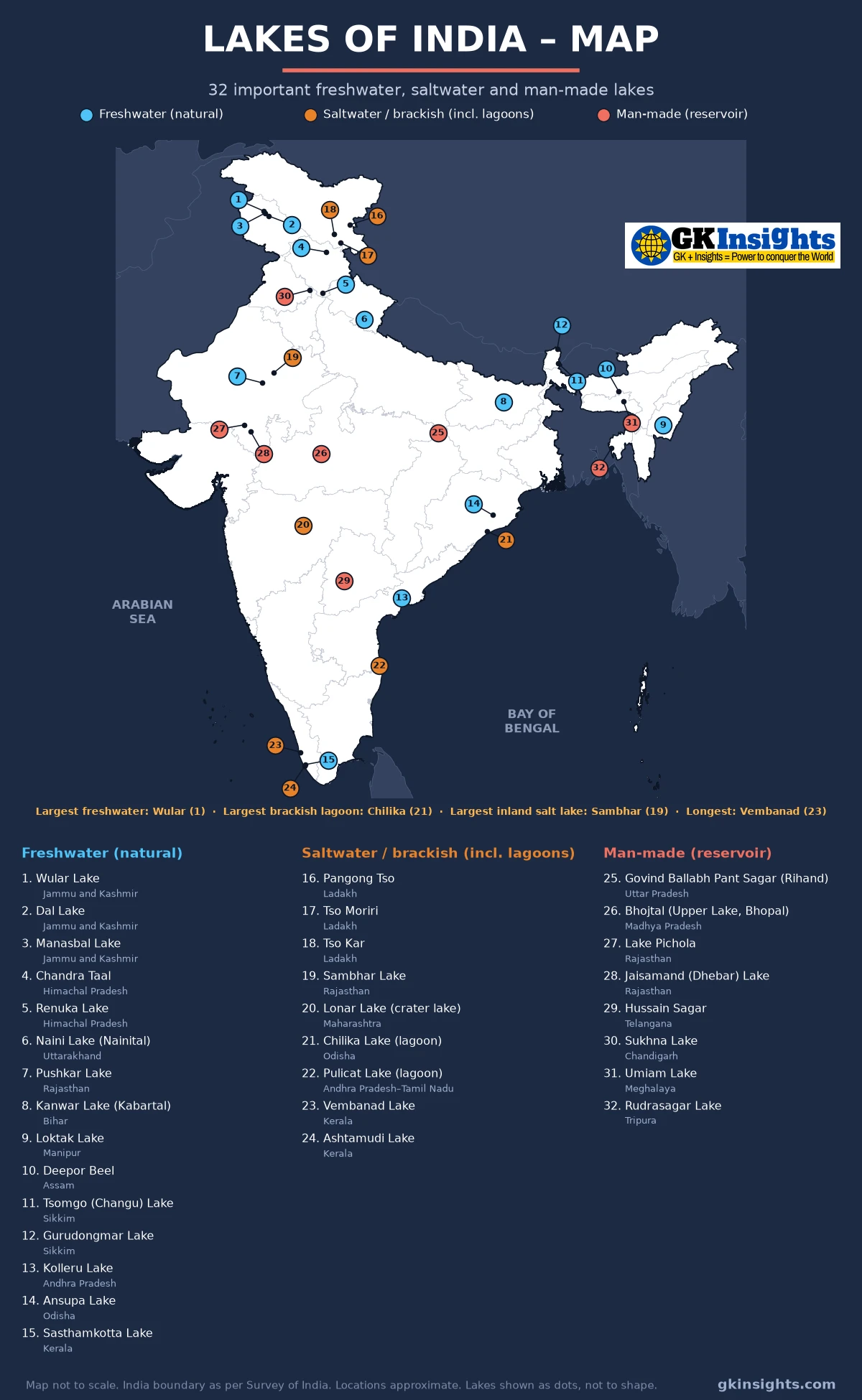
The map above marks 32 important lakes of India, coloured as natural freshwater lakes, saltwater or brackish lakes (including coastal lagoons) and man-made lakes or reservoirs.
What is a Lake?
A lake is a body of still water surrounded by land. Most lakes are fed by rivers, streams, rain or melting snow. A lake with an outlet usually stays fresh, because water keeps flowing out. A lake with no outlet loses water only by evaporation, so salts build up and the water turns saline. This is why many lakes of Ladakh and Rajasthan are salty.
Lakes are useful in many ways. They store water for drinking and irrigation, control floods, recharge groundwater, support fisheries, give shelter to migratory birds and help in tourism. Many Indian lakes are protected as Ramsar sites (wetlands of international importance).
Types of Lakes in India by Origin
Lakes in India can be grouped by the way they were formed:
- Glacial lakes: formed in hollows carved or dammed by glaciers. Examples: Chandra Taal (Himachal Pradesh), Tsomgo and Gurudongmar (Sikkim).
- Tectonic lakes: formed in depressions created by movements of the Earth’s crust. Wular Lake in Kashmir is the common example.
- Oxbow lakes: formed when a meandering river cuts off one of its loops. Examples: Kanwar Lake (Bihar) and Ansupa Lake (Odisha).
- Lagoons: coastal water bodies separated from the sea by sand bars or spits. Examples: Chilika (Odisha), Pulicat (Andhra Pradesh–Tamil Nadu) and Vembanad (Kerala).
- Crater lake: formed in a crater. Lonar Lake in Maharashtra was formed by a meteorite impact.
- Inland salt lakes: lakes with no outlet in dry areas, where evaporation leaves salt behind. Examples: Sambhar (Rajasthan), Pangong Tso and Tso Kar (Ladakh).
- Man-made lakes: created by building dams or embankments. Examples: Govind Ballabh Pant Sagar, Bhojtal (Upper Lake), Hussain Sagar and Lake Pichola.
Freshwater Lakes of India
| Lake | State / UT | Key facts |
|---|---|---|
| Wular Lake | Jammu and Kashmir | Largest freshwater lake in India; fed and drained by the Jhelum; Ramsar site (1990) |
| Dal Lake | Jammu and Kashmir | In Srinagar; known for houseboats, shikaras and floating gardens |
| Manasbal Lake | Jammu and Kashmir | Deep lake in Ganderbal district, known for lotus and water birds |
| Chandra Taal | Himachal Pradesh | High-altitude glacial lake in Lahaul and Spiti; Ramsar site (2005) |
| Renuka Lake | Himachal Pradesh | Largest natural lake of Himachal Pradesh, in Sirmaur district; Ramsar site (2005) |
| Naini Lake | Uttarakhand | Lake around which the town of Nainital grew, in the Kumaon hills |
| Pushkar Lake | Rajasthan | Sacred lake near Ajmer, with ghats and the Brahma temple |
| Kanwar Lake (Kabartal) | Bihar | Asia’s largest freshwater oxbow lake; Bihar’s first Ramsar site (2020) |
| Loktak Lake | Manipur | Largest freshwater lake in North-East India; floating phumdis; Keibul Lamjao National Park |
| Deepor Beel | Assam | Wetland near Guwahati; Ramsar site (2002) |
| Tsomgo (Changu) Lake | Sikkim | Glacial lake on the road to Nathu La |
| Gurudongmar Lake | Sikkim | One of the highest lakes in India, in North Sikkim; sacred to Buddhists and Sikhs |
| Kolleru Lake | Andhra Pradesh | Large freshwater lake between the Godavari and Krishna deltas; Ramsar site (2002) |
| Ansupa Lake | Odisha | Largest freshwater lake of Odisha, formed by the Mahanadi, in Cuttack district |
| Sasthamkotta Lake | Kerala | Largest freshwater lake of Kerala, in Kollam district; Ramsar site (2002) |
Loktak Lake needs special attention. Its floating masses of vegetation and soil are called phumdis. The largest phumdi forms Keibul Lamjao National Park, the only floating national park in the world and the home of the sangai, or brow-antlered deer. Loktak is on the Montreux Record, the list of Ramsar sites facing changes in their ecology.
Saltwater and Brackish Lakes of India
Brackish water is a mix of fresh water and sea water. Coastal lagoons are brackish because rivers bring in fresh water and the sea enters through openings in the sand bar.
| Lake | State / UT | Key facts |
|---|---|---|
| Pangong Tso | Ladakh | Long, narrow high-altitude lake; about one-third lies in India and the rest in Tibet; freezes in winter |
| Tso Moriri | Ladakh | High-altitude brackish lake in the Changthang region; Ramsar site (2002) |
| Tso Kar | Ladakh | Salt lake in Ladakh, known for salt deposits and birds; Ramsar site (2020) |
| Sambhar Lake | Rajasthan | Largest inland saltwater lake in India; major salt source; Ramsar site (1990) |
| Lonar Lake | Maharashtra | Crater lake formed by a meteorite impact in basalt rock, in Buldhana district; saline and alkaline; Ramsar site (2020) |
| Chilika Lake | Odisha | Largest brackish water lagoon in India and Asia; Irrawaddy dolphins; India’s first Ramsar site (1981) |
| Pulicat Lake | Andhra Pradesh–Tamil Nadu | Second largest brackish water lagoon in India; the island of Sriharikota separates it from the Bay of Bengal |
| Vembanad Lake | Kerala | Longest lake in India and largest lake of Kerala; part of the Vembanad-Kol wetland, Ramsar site (2002) |
| Ashtamudi Lake | Kerala | Palm-shaped estuary in Kollam with eight arms; called the gateway to the Kerala backwaters; Ramsar site (2002) |
Chilika Lake lies at the mouth of the Daya river, a branch of the Mahanadi delta, and is separated from the Bay of Bengal by a long sand bar. Nalabana Island in the lake is a bird sanctuary, and lakhs of migratory birds spend the winter here. Chilika and Keoladeo National Park were India’s first two Ramsar sites, named in 1981.
Other salt lakes of Rajasthan asked in exams are Didwana, Pachpadra, Lunkaransar and Kuchaman. These are shallow lakes in the dry west that shrink or dry up in summer.
Man-made Lakes of India
| Lake | State / UT | Key facts |
|---|---|---|
| Govind Ballabh Pant Sagar | Uttar Pradesh (extends into Madhya Pradesh) | Reservoir of the Rihand Dam in Sonbhadra district; often listed as India’s largest man-made lake |
| Bhojtal (Upper Lake) | Madhya Pradesh | Bhopal’s main lake, traditionally linked to Raja Bhoj (11th century); part of the Bhoj Wetland Ramsar site (2002) |
| Lake Pichola | Rajasthan | Lake in Udaipur with the Lake Palace (Jag Niwas) and Jag Mandir |
| Jaisamand (Dhebar) Lake | Rajasthan | Built by Maharana Jai Singh of Mewar in the late 17th century; one of the largest artificial lakes in India |
| Hussain Sagar | Telangana | Built in the time of the Qutb Shahi ruler Ibrahim Quli Qutb Shah; has a large Buddha statue on a rock in the middle |
| Sukhna Lake | Chandigarh | Made in 1958 by damming the Sukhna Choe, a seasonal stream from the Shivaliks |
| Umiam Lake | Meghalaya | Reservoir near Shillong, also called Barapani |
| Rudrasagar Lake | Tripura | Has the Neermahal water palace; Ramsar site (2005) |
In GK books, Govind Ballabh Pant Sagar is usually named as the largest man-made lake in India. If a question asks about the largest reservoir by storage capacity, the answer usually given is Indira Sagar on the Narmada in Madhya Pradesh, so read the wording of the question carefully.
Largest and Other Record Lakes of India
| Record | Lake | State / UT |
|---|---|---|
| Largest freshwater lake | Wular Lake | Jammu and Kashmir |
| Largest brackish water lagoon | Chilika Lake | Odisha |
| Second largest brackish water lagoon | Pulicat Lake | Andhra Pradesh–Tamil Nadu |
| Largest inland saltwater lake | Sambhar Lake | Rajasthan |
| Longest lake | Vembanad Lake | Kerala |
| Largest freshwater lake of North-East India | Loktak Lake | Manipur |
| Largest freshwater oxbow lake in Asia | Kanwar Lake | Bihar |
| Crater lake formed by meteorite impact | Lonar Lake | Maharashtra |
| Largest man-made lake (as usually listed) | Govind Ballabh Pant Sagar | Uttar Pradesh |
State-wise List of Important Lakes in India
| State / UT | Important lakes |
|---|---|
| Jammu and Kashmir | Wular, Dal, Manasbal |
| Ladakh | Pangong Tso, Tso Moriri, Tso Kar |
| Himachal Pradesh | Chandra Taal, Renuka |
| Uttarakhand | Naini Lake |
| Chandigarh | Sukhna |
| Rajasthan | Sambhar, Pushkar, Pichola, Jaisamand |
| Uttar Pradesh | Govind Ballabh Pant Sagar |
| Madhya Pradesh | Bhojtal (Upper Lake) |
| Bihar | Kanwar (Kabartal) |
| Maharashtra | Lonar |
| Telangana | Hussain Sagar |
| Andhra Pradesh | Kolleru, Pulicat (shared with Tamil Nadu) |
| Odisha | Chilika, Ansupa |
| Kerala | Vembanad, Ashtamudi, Sasthamkotta |
| Sikkim | Tsomgo, Gurudongmar |
| Assam | Deepor Beel |
| Meghalaya | Umiam |
| Manipur | Loktak |
| Tripura | Rudrasagar |
Threats to Lakes in India
Many Indian lakes are shrinking or getting polluted. The main causes are untreated sewage, silt from deforested catchments, encroachment for farming and buildings, the spread of weeds such as water hyacinth, and too much fishing. Wular, Dal and Loktak have all lost area to silt and weeds. The central government supports the conservation of lakes and wetlands through the National Plan for Conservation of Aquatic Ecosystems (NPCA).
FAQs on Lakes of India
Which is the largest freshwater lake in India?
Wular Lake in Jammu and Kashmir is the largest freshwater lake in India. The Jhelum river flows into it and out of it.
Which is the largest saltwater lake in India?
Chilika Lake in Odisha is the largest brackish water lake (lagoon) in India. Sambhar Lake in Rajasthan is the largest inland saltwater lake.
Which is the longest lake in India?
Vembanad Lake in Kerala is the longest lake in India. It is also the largest lake in Kerala.
Which lake has the only floating national park in the world?
Loktak Lake in Manipur. Keibul Lamjao National Park floats on its phumdis and is the home of the sangai deer.
Which lake in India was formed by a meteorite impact?
Lonar Lake in Buldhana district of Maharashtra was formed by a meteorite impact. Its water is saline and alkaline.
Which is the largest man-made lake in India?
Govind Ballabh Pant Sagar, the reservoir of the Rihand Dam in Uttar Pradesh, is usually listed as the largest man-made lake in India.
Also Check:
– Ramsar Sites in India
– Rivers of India – Map and List
– Major Dams in India – Map and List
– Waterfalls in India – Map and List
– National Parks in India – Map and List