
India has 106 national parks spread over about 44,000 sq km, which is roughly 1.35% of the country’s geographical area. This post gives a national parks in India map, a state-wise list of the important parks, and the facts that are asked most often in UPSC Prelims and other competitive exams.
National Parks in India Map
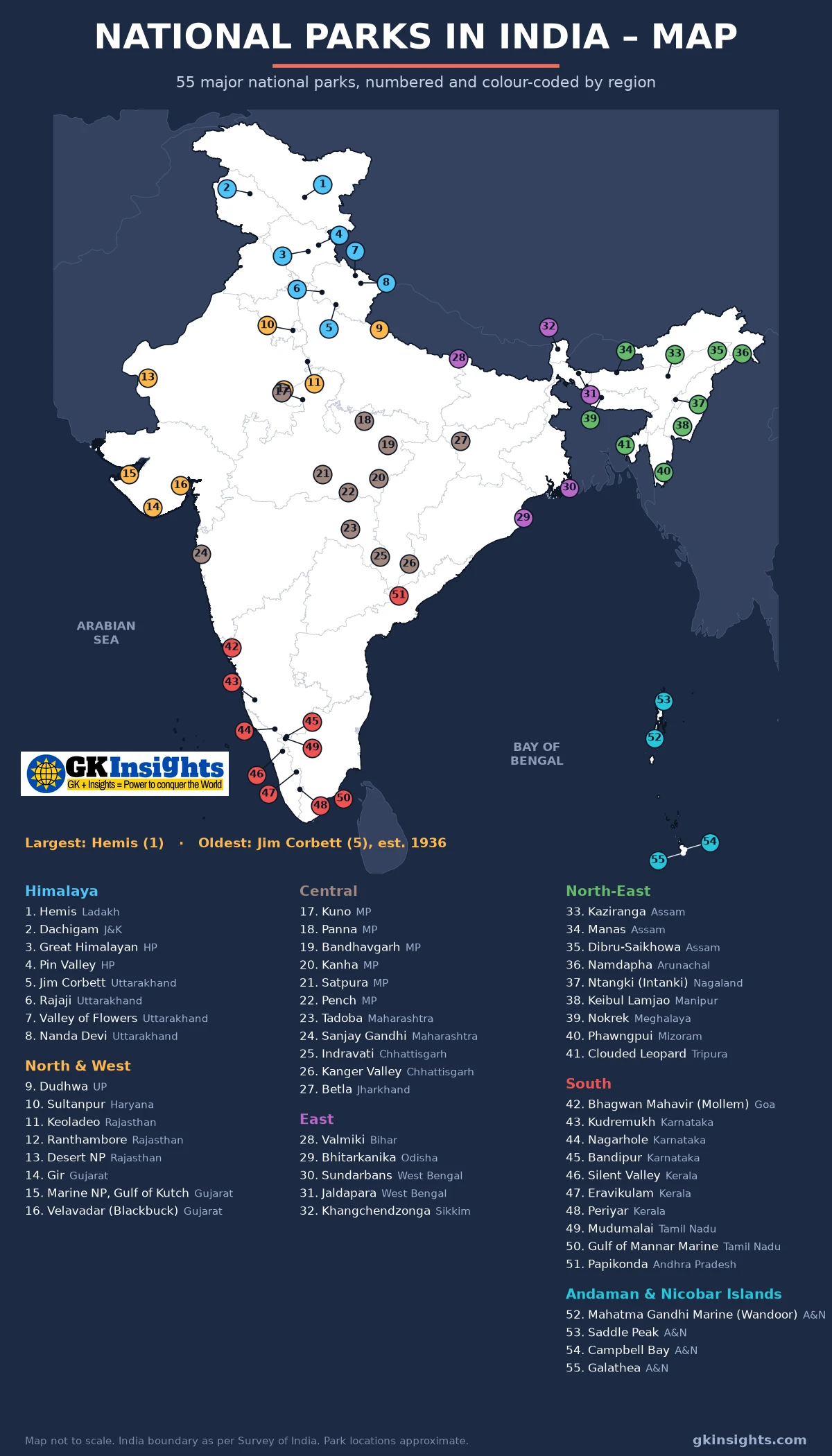
The map above marks the major national parks of India, from Hemis in Ladakh to Galathea on Great Nicobar Island. Note how the parks cluster in the Himalaya, the central Indian forests of Madhya Pradesh, the Western Ghats and the North-East.
What is a National Park?
A national park is a protected area declared by the State Government under Section 35 of the Wildlife (Protection) Act, 1972. It is set aside to protect wildlife and its habitat, and it has a higher level of protection than a wildlife sanctuary.
- No grazing of livestock is permitted inside a national park.
- No private rights (such as rights over land or forest produce) are allowed to continue once the park is finally notified.
- Hunting and the removal or destruction of any wildlife or forest produce is prohibited, except for management purposes permitted by the Chief Wildlife Warden.
- The boundary of a national park can be altered only on the recommendation of the National Board for Wildlife.
- National parks fall under IUCN Category II of protected areas.
National Park vs Wildlife Sanctuary
| Point | National Park | Wildlife Sanctuary |
|---|---|---|
| Law | Section 35, Wildlife (Protection) Act, 1972 | Section 18, Wildlife (Protection) Act, 1972 |
| Grazing | Not allowed | May be regulated and allowed |
| Private rights | Not allowed | Some rights may be allowed by the Collector |
| Boundary change | Only on recommendation of the National Board for Wildlife | Only on recommendation of the National Board for Wildlife |
| Level of protection | Higher | Lower |
| Upgrading | – | A sanctuary can be upgraded to a national park |
State-wise List of Major National Parks in India
The table below lists the important national parks in India, state-wise, along with the feature each park is known for.
| State / UT | National Park | Known For |
|---|---|---|
| Ladakh | Hemis | Largest national park in India; snow leopard |
| Jammu & Kashmir | Dachigam | Hangul (Kashmir stag) |
| Himachal Pradesh | Great Himalayan | UNESCO World Heritage Site (2014); western tragopan |
| Himachal Pradesh | Pin Valley | Cold desert park in Spiti; snow leopard, Siberian ibex |
| Uttarakhand | Jim Corbett | First national park of India (1936, as Hailey National Park); on the Ramganga river |
| Uttarakhand | Rajaji | Elephants and tigers in the Shivalik hills |
| Uttarakhand | Valley of Flowers and Nanda Devi | Together form a UNESCO World Heritage Site |
| Uttar Pradesh | Dudhwa | Swamp deer (barasingha), tiger; on the Nepal border |
| Haryana | Sultanpur | Migratory birds near Gurugram |
| Rajasthan | Keoladeo Ghana | Bird park at Bharatpur; UNESCO World Heritage Site and Ramsar site |
| Rajasthan | Ranthambore | Tiger; ruins of Ranthambore fort |
| Rajasthan | Desert National Park | Great Indian Bustard; second largest national park |
| Gujarat | Gir | Only natural home of the Asiatic lion |
| Gujarat | Marine National Park, Gulf of Kutch | First marine national park of India; coral reefs |
| Gujarat | Velavadar (Blackbuck) | Blackbuck grasslands in Bhavnagar district |
| Madhya Pradesh | Kanha | Hard-ground barasingha; tiger |
| Madhya Pradesh | Bandhavgarh | High density of tigers |
| Madhya Pradesh | Kuno | Cheetahs brought from Namibia in 2022 |
| Madhya Pradesh | Panna, Pench, Satpura | Tiger reserves; Pench is the setting of Kipling’s The Jungle Book |
| Maharashtra | Tadoba | Oldest national park of Maharashtra; tiger |
| Maharashtra | Sanjay Gandhi | Inside the city of Mumbai; Kanheri caves |
| Chhattisgarh | Indravati, Kanger Valley | Wild buffalo (Indravati); Kotumsar caves (Kanger Valley) |
| Jharkhand | Betla | Part of Palamau Tiger Reserve |
| Bihar | Valmiki | Only national park of Bihar; tiger |
| Odisha | Bhitarkanika | Saltwater crocodile; mangroves |
| West Bengal | Sundarbans | Royal Bengal tiger in mangroves; UNESCO World Heritage Site |
| West Bengal | Jaldapara, Gorumara | One-horned rhinoceros |
| Sikkim | Khangchendzonga | UNESCO mixed World Heritage Site (2016) |
| Assam | Kaziranga | One-horned rhinoceros; UNESCO World Heritage Site |
| Assam | Manas | UNESCO World Heritage Site; pygmy hog, golden langur |
| Assam | Dibru-Saikhowa, Nameri, Orang | Feral horses (Dibru-Saikhowa); tiger reserves (Nameri, Orang) |
| Arunachal Pradesh | Namdapha | Tiger, leopard, clouded leopard and snow leopard |
| Manipur | Keibul Lamjao | Only floating national park in the world, on Loktak lake; sangai deer |
| Meghalaya | Nokrek | Red panda; wild citrus (core of Nokrek Biosphere Reserve) |
| Mizoram | Phawngpui (Blue Mountain) | Highest peak of Mizoram |
| Nagaland | Ntangki | Hoolock gibbon |
| Tripura | Clouded Leopard | Clouded leopard; primates |
| Goa | Bhagwan Mahavir (Mollem) | Dudhsagar waterfalls |
| Karnataka | Bandipur, Nagarhole | Tiger and elephant; part of the Nilgiri Biosphere Reserve |
| Karnataka | Kudremukh | Shola forests and grasslands of the Western Ghats |
| Kerala | Eravikulam | Nilgiri tahr; Anamudi, the highest peak of South India |
| Kerala | Silent Valley | Lion-tailed macaque; Kunthipuzha river |
| Kerala | Periyar | Elephants around Periyar lake |
| Tamil Nadu | Mudumalai | Tiger and elephant; Nilgiri Biosphere Reserve |
| Tamil Nadu | Gulf of Mannar Marine | Coral reefs and dugong |
| Andhra Pradesh | Papikonda | Godavari gorge in the Eastern Ghats |
| Andaman & Nicobar | Mahatma Gandhi Marine (Wandoor) | Coral reefs near Port Blair |
| Andaman & Nicobar | Saddle Peak | Highest point of the Andaman Islands |
| Andaman & Nicobar | Campbell Bay, Galathea | Great Nicobar Biosphere Reserve |
Important Facts about National Parks in India
- First national park: Hailey National Park, set up in 1936 in Uttarakhand. It was renamed Ramganga National Park and later Jim Corbett National Park.
- Largest national park: Hemis National Park, Ladakh (about 4,400 sq km).
- Second largest: Desert National Park, Rajasthan.
- Smallest national park: South Button Island National Park, Andaman and Nicobar Islands (about 0.03 sq km).
- First marine national park: Marine National Park, Gulf of Kutch, Gujarat.
- Only floating national park: Keibul Lamjao, Manipur. It floats on phumdis (masses of vegetation and soil) on Loktak lake.
- Most national parks: Madhya Pradesh and the Andaman and Nicobar Islands have the highest number of national parks.
- Mount Harriet National Park in the Andaman Islands was renamed Mount Manipur National Park in 2021.
- Renamed parks: Nagarhole is also called Rajiv Gandhi National Park, and Anamalai is called Indira Gandhi National Park.
National Parks that are UNESCO World Heritage Sites
- Kaziranga National Park (Assam)
- Manas National Park (Assam)
- Keoladeo National Park (Rajasthan)
- Sundarbans National Park (West Bengal)
- Nanda Devi and Valley of Flowers National Parks (Uttarakhand)
- Great Himalayan National Park Conservation Area (Himachal Pradesh)
- Khangchendzonga National Park (Sikkim), a mixed site
Animals and the National Parks Known for Them
| Animal | National Park |
|---|---|
| Asiatic lion | Gir (Gujarat) |
| One-horned rhinoceros | Kaziranga, Manas, Orang (Assam); Jaldapara (West Bengal) |
| Hangul | Dachigam (Jammu & Kashmir) |
| Snow leopard | Hemis (Ladakh), Pin Valley (Himachal Pradesh) |
| Sangai (brow-antlered deer) | Keibul Lamjao (Manipur) |
| Nilgiri tahr | Eravikulam (Kerala) |
| Lion-tailed macaque | Silent Valley (Kerala) |
| Hard-ground barasingha | Kanha (Madhya Pradesh) |
| Great Indian Bustard | Desert National Park (Rajasthan) |
| Blackbuck | Velavadar (Gujarat) |
| Cheetah | Kuno (Madhya Pradesh) |
| Saltwater crocodile | Bhitarkanika (Odisha) |
Many national parks also form the core area of a tiger reserve or a biosphere reserve. For example, Kanha, Bandipur and Corbett are core zones of tiger reserves, while Nokrek is the core of the Nokrek Biosphere Reserve. It helps to study national parks together with tiger reserves, biosphere reserves and Ramsar sites, as UPSC often frames questions that link them. Related protected-area topics include elephant reserves and mangrove forests.
FAQs on National Parks in India
How many national parks are there in India?
India has 106 national parks covering about 44,000 sq km, roughly 1.35% of the country’s geographical area. The number changes as states notify new parks.
Which is the first national park of India?
Jim Corbett National Park in Uttarakhand. It was set up in 1936 as Hailey National Park.
Which is the largest national park in India?
Hemis National Park in Ladakh is the largest national park in India. Desert National Park in Rajasthan is the second largest.
Which is the only floating national park in India?
Keibul Lamjao National Park on Loktak lake in Manipur. It is the home of the sangai deer.
Under which law are national parks declared in India?
National parks are declared by the State Government under Section 35 of the Wildlife (Protection) Act, 1972.
Also Check:
– Tiger Reserves in India – Map and List
– Biosphere Reserves in India – Map and List
– Elephant Reserves in India – Map and List
– Ramsar Sites in India
– Mangrove Forests in India – Map
– ENVIS Centre on Wildlife and Protected Areas [External]