
India has about 5,700 large dams listed in the National Register of Large Dams kept by the Central Water Commission, the third highest number in the world after China and the USA. This post gives a major dams in India map, a region-wise list of important dams with their rivers and states, and the facts that are asked most often in UPSC Prelims and other competitive exams.
Major Dams in India Map
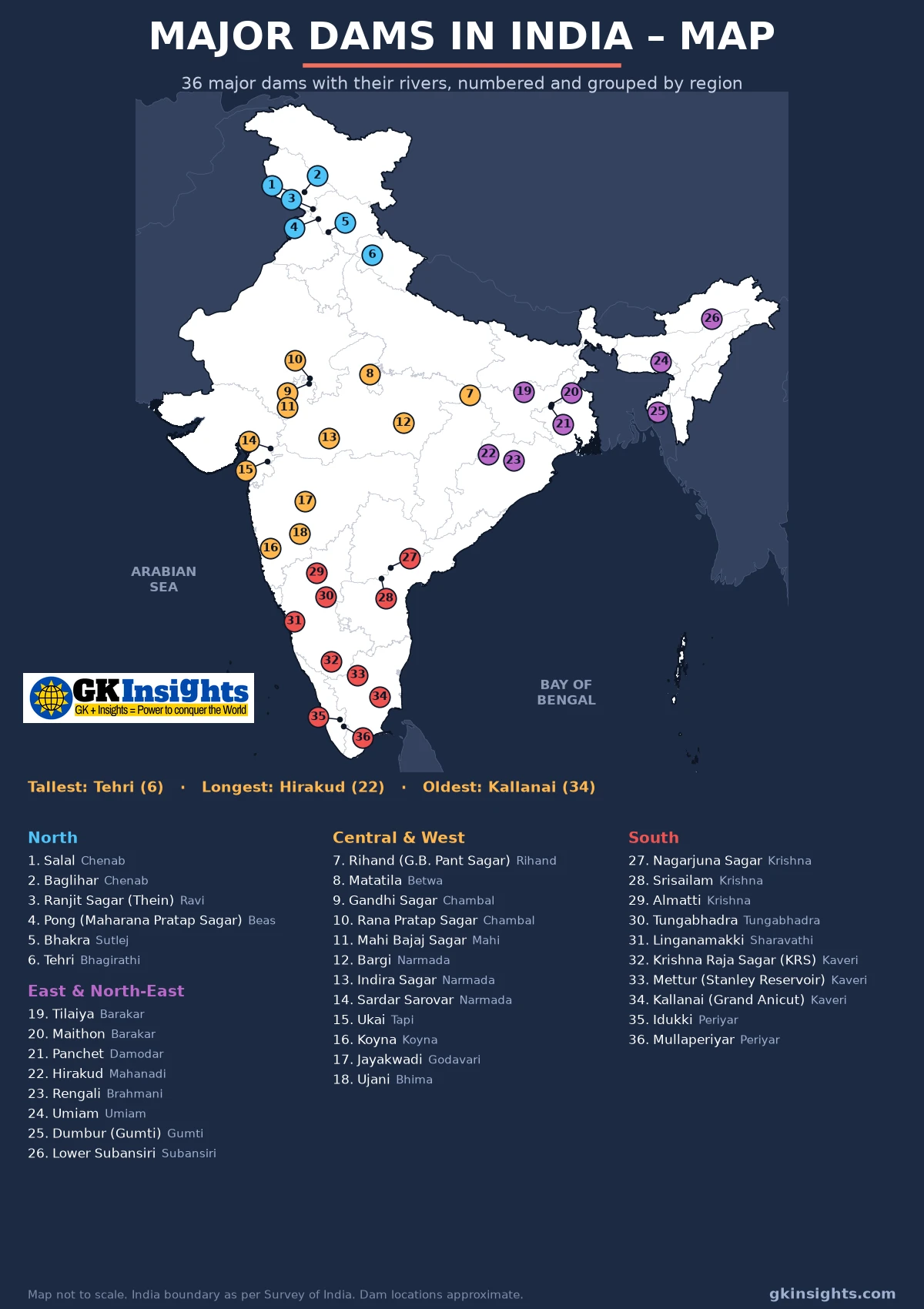
The map above marks 36 major dams of India, from Salal on the Chenab in Jammu & Kashmir to Mullaperiyar on the Periyar in Kerala. Read the map river by river: the Narmada, Krishna and Kaveri each have a chain of dams, while the Himalayan rivers have a few very tall ones.
What is a Dam?
A dam is a barrier built across a river to store water in a reservoir behind it. The stored water is used for irrigation, drinking water, hydroelectric power and flood control. When one dam serves several of these purposes, it is called a multipurpose river valley project.
A barrage is different. It is a low structure with a series of gates that raise the water level only slightly so that water can be diverted into canals. A barrage stores very little water. Farakka Barrage on the Ganga and Kota Barrage on the Chambal are examples.
Types of Dams in India
| Type | How it holds water | Examples in India |
|---|---|---|
| Gravity dam | Its own heavy weight of concrete or masonry resists the push of the water | Bhakra, Sardar Sarovar, Nagarjuna Sagar (masonry) |
| Embankment dam (earthfill or rockfill) | A wide mound of earth or rock with a watertight core | Hirakud (earthen), Tehri (earth and rockfill) |
| Arch dam | A curved wall that passes the water pressure to the rock walls of a narrow gorge | Idukki (double curvature arch) |
| Buttress dam | A sloping wall held up by a row of supports on the downstream side | Rare in India |
List of Major Dams in India (Region-wise)
North India (Himalaya and Punjab)
| Dam | River | State | Key fact |
|---|---|---|---|
| Salal | Chenab | Jammu & Kashmir | Run-of-the-river hydro project in Reasi district |
| Baglihar | Chenab | Jammu & Kashmir | Hydro project in Ramban district; its design was examined by a neutral expert under the Indus Waters Treaty |
| Ranjit Sagar (Thein) | Ravi | Punjab | On the Punjab–Jammu & Kashmir border near Pathankot |
| Pong (Maharana Pratap Sagar) | Beas | Himachal Pradesh | Its reservoir is a Ramsar site |
| Bhakra | Sutlej | Himachal Pradesh | 226 m concrete gravity dam; reservoir is Gobind Sagar |
| Tehri | Bhagirathi | Uttarakhand | Tallest dam in India (about 260 m) |
Central and West India
| Dam | River | State | Key fact |
|---|---|---|---|
| Rihand | Rihand (tributary of Son) | Uttar Pradesh | Reservoir is Govind Ballabh Pant Sagar in Sonbhadra district |
| Matatila | Betwa | Uttar Pradesh | On the Uttar Pradesh–Madhya Pradesh border in Lalitpur district |
| Gandhi Sagar | Chambal | Madhya Pradesh | First dam of the Chambal Valley Project |
| Rana Pratap Sagar | Chambal | Rajasthan | Near Rawatbhata, part of the Chambal Valley Project |
| Mahi Bajaj Sagar | Mahi | Rajasthan | In Banswara district |
| Bargi | Narmada | Madhya Pradesh | Near Jabalpur; first completed dam on the Narmada |
| Indira Sagar | Narmada | Madhya Pradesh | Largest reservoir in India by storage capacity |
| Sardar Sarovar | Narmada | Gujarat | 163 m concrete gravity dam at Kevadia; Statue of Unity stands downstream |
| Ukai | Tapi | Gujarat | Largest dam in Gujarat by reservoir area; reservoir is Vallabh Sagar |
| Koyna | Koyna (tributary of Krishna) | Maharashtra | Linked to the 1967 Koynanagar earthquake |
| Jayakwadi | Godavari | Maharashtra | At Paithan; reservoir is Nath Sagar |
| Ujani | Bhima | Maharashtra | In Solapur district |
East and North-East India
| Dam | River | State | Key fact |
|---|---|---|---|
| Tilaiya | Barakar | Jharkhand | First dam of the Damodar Valley Corporation (1953) |
| Maithon | Barakar | Jharkhand | Damodar Valley Corporation dam near Dhanbad |
| Panchet | Damodar | Jharkhand | Damodar Valley Corporation dam on the Jharkhand–West Bengal border |
| Hirakud | Mahanadi | Odisha | Longest dam in India, near Sambalpur |
| Rengali | Brahmani | Odisha | Multipurpose dam in Angul district |
| Umiam | Umiam | Meghalaya | Forms Umiam (Barapani) Lake near Shillong |
| Dumbur | Gumti | Tripura | Hydro project; reservoir is Dumbur Lake |
| Lower Subansiri | Subansiri | Assam–Arunachal Pradesh | 2,000 MW project, the largest hydroelectric project in India by planned capacity |
South India
| Dam | River | State | Key fact |
|---|---|---|---|
| Nagarjuna Sagar | Krishna | Telangana–Andhra Pradesh | One of the largest masonry dams in the world |
| Srisailam | Krishna | Andhra Pradesh–Telangana | Major hydroelectric dam in the Nallamala Hills |
| Almatti | Krishna | Karnataka | Main dam of the Upper Krishna Project |
| Tungabhadra | Tungabhadra | Karnataka | Near Hosapete; joint project of Karnataka and Andhra Pradesh |
| Linganamakki | Sharavathi | Karnataka | Feeds the Sharavathi hydroelectric project near Jog Falls |
| Krishna Raja Sagar (KRS) | Kaveri | Karnataka | Built in 1932 under Sir M. Visvesvaraya; Brindavan Gardens |
| Mettur | Kaveri | Tamil Nadu | Built in 1934; reservoir is Stanley Reservoir |
| Kallanai (Grand Anicut) | Kaveri | Tamil Nadu | Built by the Chola king Karikala around the 2nd century CE; still in use |
| Idukki | Periyar | Kerala | Arch dam between the Kuravan and Kurathi hills |
| Mullaperiyar | Periyar | Kerala | Built in 1895; operated by Tamil Nadu; long-running Kerala–Tamil Nadu dispute |
Important Facts About Dams in India
| Question | Answer |
|---|---|
| Tallest dam in India | Tehri Dam on the Bhagirathi, Uttarakhand (about 260 m) |
| Tallest concrete gravity dam | Bhakra Dam on the Sutlej, Himachal Pradesh (226 m) |
| Longest dam in India | Hirakud Dam on the Mahanadi, Odisha (about 25.8 km including its dykes) |
| Largest reservoir by storage capacity | Indira Sagar on the Narmada, Madhya Pradesh |
| Oldest dam still in use | Kallanai (Grand Anicut) on the Kaveri, Tamil Nadu |
| Well-known arch dam | Idukki on the Periyar, Kerala |
| Largest masonry dam | Nagarjuna Sagar on the Krishna |
| State with the most large dams | Maharashtra |
Jawaharlal Nehru called the big multipurpose projects of the 1950s the “temples of modern India”. Questions in UPSC often pair a dam with its river, so learn each dam together with the river it stands on.
Major Multipurpose River Valley Projects
| Project | River | States | Main dams or structures |
|---|---|---|---|
| Bhakra Nangal Project | Sutlej | Himachal Pradesh, Punjab, Haryana, Rajasthan | Bhakra Dam, Nangal Dam |
| Damodar Valley Project | Damodar and Barakar | Jharkhand, West Bengal | Tilaiya, Konar, Maithon, Panchet; run by the Damodar Valley Corporation (1948), modelled on the Tennessee Valley Authority of the USA |
| Hirakud Project | Mahanadi | Odisha | Hirakud Dam |
| Chambal Valley Project | Chambal | Madhya Pradesh, Rajasthan | Gandhi Sagar, Rana Pratap Sagar, Jawahar Sagar, Kota Barrage |
| Rihand Project | Rihand | Uttar Pradesh | Rihand Dam |
| Nagarjuna Sagar Project | Krishna | Telangana, Andhra Pradesh | Nagarjuna Sagar Dam |
| Sardar Sarovar Project | Narmada | Gujarat, Madhya Pradesh, Maharashtra, Rajasthan | Sardar Sarovar Dam |
| Tehri Project | Bhagirathi | Uttarakhand | Tehri Dam, Koteshwar Dam |
Dams and Interstate or International Issues
- Mullaperiyar: The dam lies in Kerala but is leased to and operated by Tamil Nadu under an 1886 agreement. Kerala raises safety concerns about the old dam, while Tamil Nadu depends on its water. The Supreme Court has ruled on the permitted water level more than once.
- Kaveri: KRS in Karnataka and Mettur in Tamil Nadu are at the centre of the Kaveri water dispute. The Cauvery Water Management Authority now oversees the sharing of water.
- Narmada: The Sardar Sarovar Dam faced the Narmada Bachao Andolan over the displacement of people. Water is shared as per the Narmada Water Disputes Tribunal award.
- Indus Waters Treaty, 1960: Salal and Baglihar on the Chenab are run-of-the-river projects built under the limits of this India–Pakistan treaty. India put the treaty in abeyance in April 2025.
Dam Safety Act, 2021
Parliament passed the Dam Safety Act, 2021 to make sure that large dams are watched, inspected and maintained properly. It applies to specified dams more than 15 m high, and to dams between 10 m and 15 m high that meet certain design conditions.
- National Committee on Dam Safety makes policies and regulations on dam safety.
- National Dam Safety Authority carries out these policies and settles disputes between states.
- State Committee on Dam Safety and a State Dam Safety Organisation look after the dams in each state.
- The owner of each dam must carry out safety checks before and after the monsoon and prepare an emergency action plan.
Alongside the Act, the Central Water Commission runs the Dam Rehabilitation and Improvement Project (DRIP) with World Bank support to repair and strengthen old dams.
FAQs on Major Dams in India
Which is the tallest dam in India?
Tehri Dam on the Bhagirathi river in Uttarakhand is the tallest dam in India, at about 260 m.
Which is the longest dam in India?
Hirakud Dam on the Mahanadi river in Odisha is the longest dam in India. Its total length, including the earthen dykes, is about 25.8 km.
Which is the oldest dam in India?
Kallanai, also called the Grand Anicut, on the Kaveri river in Tamil Nadu. It was built by the Chola king Karikala around the 2nd century CE and is still in use.
On which river is the Bhakra Dam built?
Bhakra Dam is built on the Sutlej river in Bilaspur district of Himachal Pradesh. Its reservoir is called Gobind Sagar.
Which dam in India has the largest reservoir?
Indira Sagar Dam on the Narmada in Madhya Pradesh has the largest reservoir in India by storage capacity.
What is the difference between a dam and a barrage?
A dam stores a large volume of water in a reservoir. A barrage is a low gated structure that raises the water level slightly to divert water into canals and stores very little water.
Also Check:
– Rivers of India – Coloured Map and List
– National Parks in India – Map and List
– Ramsar Sites in India
– Agriculture in India
– Important Mountain Passes in India – Map
– Central Water Commission [External]