
Hydroelectric power is India’s oldest and largest source of renewable electricity. It comes from the fast rivers of the Himalayas and from the dams on the rivers of the Deccan and the Western Ghats. Questions on hydro power projects come up often in UPSC Prelims, State PSC, SSC and banking exams, usually as “on which river”, “in which state” or “which is the largest”. This post gives a hydro power plants in India map with 34 major projects, explains how hydroelectric power is made and its types, and gives the projects in tables with their rivers, states and capacities, along with state-wise and river-wise lists, firsts and records, and the latest installed capacity figures.
Hydro Power Plants in India Map
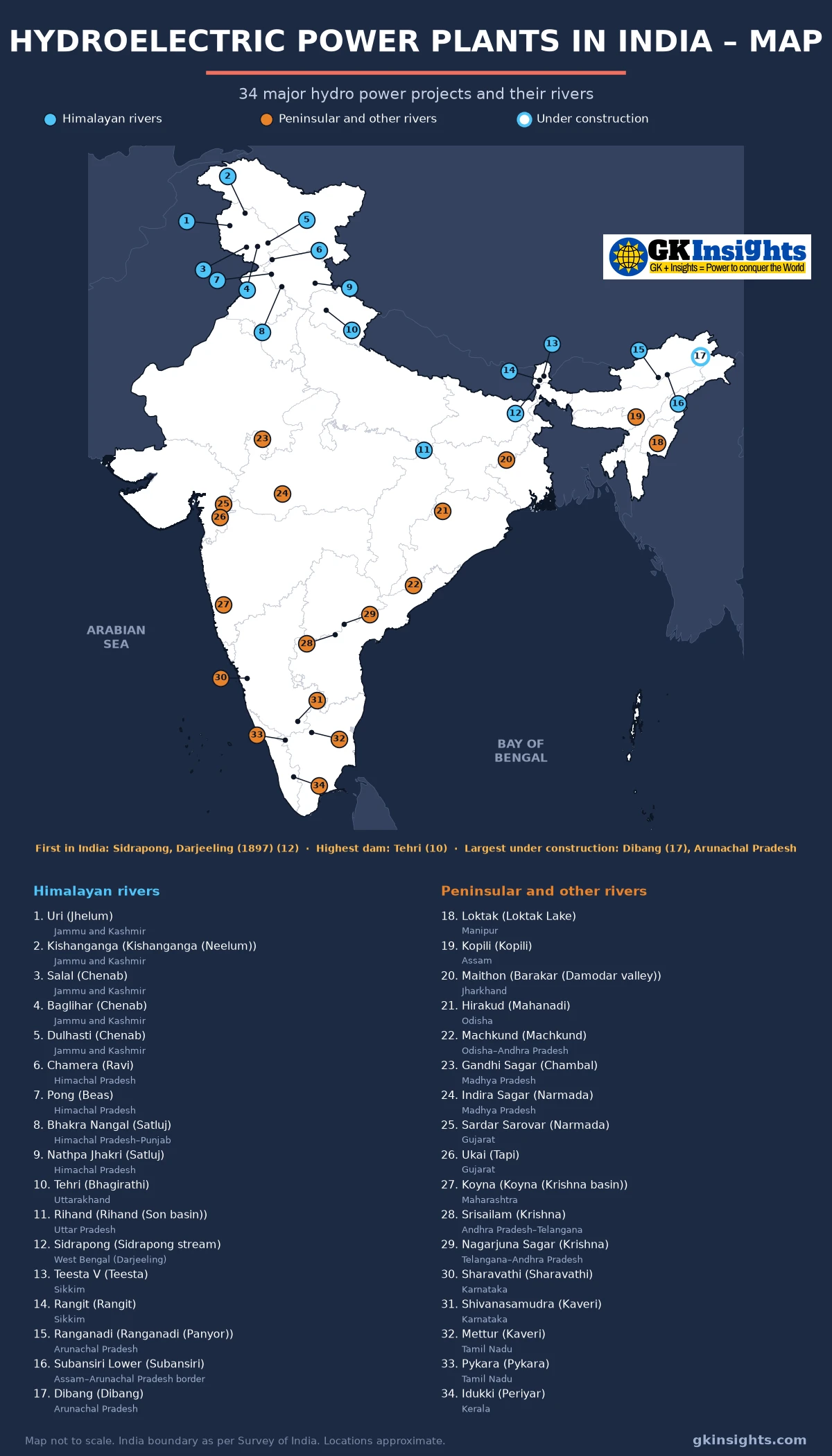
The map above marks 34 major hydroelectric power projects of India. They are coloured in two groups: projects on Himalayan rivers and projects on peninsular and other rivers. Dibang in Arunachal Pradesh is shown with a ring because it is still under construction.
What is Hydroelectric Power?
Hydroelectric power, or hydropower, is electricity produced from the energy of moving water. Water stored at a height has potential energy. When it falls or flows down through a pipe, it turns the blades of a turbine. The turbine is joined to a generator, which turns this movement into electricity. The water then goes back into the river.
The power a plant can produce depends on two things: the head, which is the height through which the water falls, and the discharge, which is the volume of water flowing through the turbine. This is why hydro projects are built in hilly areas with steep slopes and plenty of water, such as the Himalayas, the Western Ghats and the North-East.
Types of Hydroelectric Power Plants
Hydro projects are grouped by the way they use water:
- Run-of-river plants: use the natural flow of the river with little or no storage. They have a barrage or a small dam with a small pond (pondage) that stores water for a few hours. Many Himalayan projects are of this type, such as Nathpa Jhakri on the Satluj, Baglihar on the Chenab and Subansiri Lower on the Subansiri.
- Storage plants: have a large dam and reservoir that stores water from the monsoon for use through the year. They usually also serve irrigation, drinking water and flood control. Examples are Bhakra, Tehri, Indira Sagar and Idukki.
- Pumped storage plants: have an upper and a lower reservoir. When electricity demand is low, surplus power is used to pump water up to the upper reservoir. When demand is high, the water is released to produce power. Such plants work like a large battery for the grid. Examples are the Tehri Pumped Storage Plant (Uttarakhand), the Srisailam left bank power house (Telangana) and the river bed power house of Sardar Sarovar (Gujarat).
Major Hydroelectric Power Plants on Himalayan Rivers
The Himalayan rivers are fed by snow and glaciers, so they carry water even in summer. Their steep fall makes them the largest source of hydro potential in India. Capacities below are as given by the operating companies. Rihand is listed here with the Ganga-basin projects to match the map, though the Rihand river itself rises on the Chhattisgarh plateau and joins the Son.
| No. | Project | River | State / UT | Key facts |
|---|---|---|---|---|
| 1 | Uri | Jhelum | Jammu and Kashmir | NHPC run-of-river project in Baramulla district; Uri-I is 480 MW and Uri-II, further downstream, is 240 MW |
| 2 | Kishanganga | Kishanganga (Neelum) | Jammu and Kashmir | 330 MW NHPC project near Bandipora; diverts Kishanganga water through a tunnel to an underground power house, and the water joins the Jhelum system through Bonar Nallah and Wular Lake |
| 3 | Salal | Chenab | Jammu and Kashmir | 690 MW NHPC project in Reasi district; one of the first large projects on the Chenab |
| 4 | Baglihar | Chenab | Jammu and Kashmir | 900 MW run-of-river project of the J&K State Power Development Corporation in Ramban district, built in two stages of 450 MW each (2008 and 2015–16) |
| 5 | Dulhasti | Chenab | Jammu and Kashmir | 390 MW NHPC project in Kishtwar district |
| 6 | Chamera | Ravi | Himachal Pradesh | NHPC projects in Chamba district in three stages: Chamera-I (540 MW), Chamera-II (300 MW) and Chamera-III (231 MW) |
| 7 | Pong | Beas | Himachal Pradesh | 396 MW (6 × 66 MW) Bhakra Beas Management Board (BBMB) power house in Kangra district; its reservoir is Maharana Pratap Sagar |
| 8 | Bhakra Nangal | Satluj | Himachal Pradesh–Punjab | Bhakra Dam (225.55 m) is in Bilaspur district, Himachal Pradesh, and Nangal Dam is downstream in Punjab; Bhakra left bank (630 MW) and right bank (785 MW) power houses; reservoir is Gobind Sagar |
| 9 | Nathpa Jhakri | Satluj | Himachal Pradesh | 1,500 MW (6 × 250 MW) run-of-river project of SJVN; dam in Kinnaur and underground power house at Jhakri in Shimla district; commissioned in 2004 |
| 10 | Tehri | Bhagirathi | Uttarakhand | THDC complex: Tehri Dam and power plant (1,000 MW), Koteshwar (400 MW) and Tehri Pumped Storage Plant (1,000 MW); Tehri Dam (260.5 m) is the highest dam in India |
| 11 | Rihand | Rihand (Son basin) | Uttar Pradesh | 300 MW (6 × 50 MW) power house at Pipri in Sonbhadra district; its reservoir is Govind Ballabh Pant Sagar |
| 12 | Sidrapong | Sidrapong stream | West Bengal (Darjeeling) | First hydroelectric power station in India, commissioned in 1897 with two units of 65 kW (130 kW) to supply Darjeeling town |
| 13 | Teesta V | Teesta | Sikkim | 510 MW (3 × 170 MW) NHPC project; damaged in the October 2023 Sikkim flood and fully back in operation in July 2026 |
| 14 | Rangit | Rangit | Sikkim | 60 MW NHPC run-of-river project in South Sikkim on the Rangit, a tributary of the Teesta |
| 15 | Ranganadi | Ranganadi (Panyor) | Arunachal Pradesh | 405 MW project of NEEPCO; water from the Ranganadi is diverted to a power house that releases it into the Dikrong river |
| 16 | Subansiri Lower | Subansiri | Assam–Arunachal Pradesh border | 2,000 MW (8 × 250 MW) NHPC project near North Lakhimpur, NHPC’s largest; five units (1,250 MW) were in commercial operation by 23 October 2026 |
| 17 | Dibang (under construction) | Dibang | Arunachal Pradesh | 2,880 MW NHPC multipurpose project in Lower Dibang Valley district with a planned 278 m dam; due for completion in 2032 |
Major Hydroelectric Power Plants on Peninsular and Other Rivers
Peninsular rivers depend on the monsoon, so most projects here are storage projects with large reservoirs. The Western Ghats, with heavy rain and a steep fall towards the coast, have some of the oldest and largest hydro projects of India.
| No. | Project | River | State / UT | Key facts |
|---|---|---|---|---|
| 18 | Loktak | Loktak Lake (Manipur river basin) | Manipur | 105 MW NHPC project; water of Loktak Lake is carried through a tunnel to the power house at Leimatak |
| 19 | Kopili | Kopili | Assam | NEEPCO complex in the Dima Hasao area: Kopili (200 MW), Khandong (50 MW) and Kopili Stage-II (25 MW), 275 MW in all |
| 20 | Maithon | Barakar (Damodar valley) | Jharkhand | 63.2 MW hydel station of the Damodar Valley Corporation (DVC) on the Barakar, a tributary of the Damodar |
| 21 | Hirakud | Mahanadi | Odisha | Odisha Hydro Power Corporation stations at Burla (287.8 MW) and Chiplima (72 MW) below Hirakud Dam near Sambalpur; Hirakud is often cited as the longest dam in India when its dykes are included |
| 22 | Machkund | Machkund | Odisha–Andhra Pradesh | 120 MW joint project of Andhra Pradesh and Odisha, which share its power equally; the power house is in Koraput district of Odisha |
| 23 | Gandhi Sagar | Chambal | Madhya Pradesh | 115 MW (5 × 23 MW) power station in Mandsaur district; the first of the Chambal valley dams, shared by Madhya Pradesh and Rajasthan |
| 24 | Indira Sagar | Narmada | Madhya Pradesh | 1,000 MW (8 × 125 MW) project of NHDC in Khandwa district; its reservoir is the largest in India by storage capacity |
| 25 | Sardar Sarovar | Narmada | Gujarat | 1,450 MW: river bed power house (1,200 MW, reversible units) and canal head power house (250 MW); power is shared by Madhya Pradesh, Maharashtra and Gujarat in the ratio 57:27:16 |
| 26 | Ukai | Tapi | Gujarat | 300 MW (4 × 75 MW) hydro power station at Ukai Dam in Tapi district |
| 27 | Koyna | Koyna (Krishna basin) | Maharashtra | 1,956 MW Mahagenco project in Satara district, with several underground power houses in the Western Ghats; often named in GK books as the largest hydroelectric project in India |
| 28 | Srisailam | Krishna | Andhra Pradesh–Telangana | Right bank power house of APGENCO (770 MW) and left bank power house of TGGENCO (900 MW, reversible pump-turbine units), 1,670 MW in all |
| 29 | Nagarjuna Sagar | Krishna | Telangana–Andhra Pradesh | Main power house of 815.6 MW (TGGENCO), plus smaller canal power houses; one of the largest masonry dams in the world |
| 30 | Sharavathi | Sharavathi | Karnataka | 1,035 MW (10 × 103.5 MW) Karnataka Power Corporation station near Jog Falls in Shivamogga district; the Linganamakki Dam is its main reservoir |
| 31 | Shivanasamudra | Kaveri | Karnataka | Commissioned in 1902 to supply the Kolar Gold Fields; often described as the first major hydroelectric station in Asia; present capacity 42 MW |
| 32 | Mettur | Kaveri | Tamil Nadu | Mettur Dam power house (50 MW) and Mettur Tunnel power house (200 MW) in Salem district; the dam reservoir is Stanley Reservoir |
| 33 | Pykara | Pykara | Tamil Nadu | One of the oldest hydro projects of South India, in the Nilgiris; the first units ran from 1932; Pykara power house (59.2 MW) and Pykara Ultimate Stage (150 MW) |
| 34 | Idukki | Periyar | Kerala | 780 MW (6 × 130 MW) Kerala State Electricity Board project with an underground power house at Moolamattom; Idukki Dam is a 168.91 m double-curvature arch dam |
State-wise List of Hydro Power Plants in India
| State / UT | Hydro power projects on the map |
|---|---|
| Jammu and Kashmir | Uri, Kishanganga, Salal, Baglihar, Dulhasti |
| Himachal Pradesh | Chamera, Pong, Bhakra, Nathpa Jhakri |
| Punjab | Nangal (part of the Bhakra Nangal project) |
| Uttarakhand | Tehri (with Koteshwar and Tehri Pumped Storage) |
| Uttar Pradesh | Rihand |
| West Bengal | Sidrapong |
| Sikkim | Teesta V, Rangit |
| Arunachal Pradesh | Ranganadi, Dibang (under construction), Subansiri Lower (on the border with Assam) |
| Assam | Kopili, Subansiri Lower (on the border with Arunachal Pradesh) |
| Manipur | Loktak |
| Jharkhand | Maithon |
| Odisha | Hirakud, Machkund (shared with Andhra Pradesh) |
| Madhya Pradesh | Gandhi Sagar, Indira Sagar |
| Gujarat | Sardar Sarovar, Ukai |
| Maharashtra | Koyna |
| Andhra Pradesh and Telangana | Srisailam, Nagarjuna Sagar |
| Karnataka | Sharavathi, Shivanasamudra |
| Tamil Nadu | Mettur, Pykara |
| Kerala | Idukki |
Firsts and Records in Indian Hydropower
| Record | Project | State / UT |
|---|---|---|
| First hydroelectric power station in India (1897) | Sidrapong | West Bengal (Darjeeling) |
| First major hydroelectric station in Asia, as usually described (1902) | Shivanasamudra | Karnataka |
| Highest dam in India (260.5 m) | Tehri Dam | Uttarakhand |
| Largest hydro complex by installed capacity (2,400 MW) | Tehri Hydro Power Complex | Uttarakhand |
| Largest hydroelectric project as usually listed in GK books (1,956 MW) | Koyna | Maharashtra |
| Largest underground hydro power station (1,500 MW) | Nathpa Jhakri | Himachal Pradesh |
| Largest project now being commissioned (2,000 MW) | Subansiri Lower | Assam–Arunachal Pradesh |
| Largest hydro project under construction (2,880 MW); planned highest dam (278 m) | Dibang | Arunachal Pradesh |
| First variable speed pumped storage plant in India | Tehri Pumped Storage Plant | Uttarakhand |
| Largest reservoir by storage capacity | Indira Sagar | Madhya Pradesh |
Which is the largest hydro power plant in India? The answer depends on how the question is worded. Koyna (1,956 MW) is the answer given in most GK books, but it is a complex of several power houses. The Tehri Hydro Power Complex of THDC is larger in total, at 2,400 MW, after its pumped storage plant was completed in April 2026, but it is also made up of three stations. Among single power stations, Nathpa Jhakri (1,500 MW) is the largest in full operation, and Srisailam (1,670 MW) has two power houses on either bank. Subansiri Lower (2,000 MW) will become the largest single hydro station once all eight of its units are running. In an exam, choose the option that matches the wording of the question.
Dibang will also replace Tehri as the highest dam in India when it is completed. Its 278 m dam is planned as the highest concrete gravity dam in India and the highest roller compacted concrete dam in the world.
Hydropower Potential and Installed Capacity in India
According to the reassessment study of the Central Electricity Authority (CEA) carried out in 2017–23, India has an exploitable large hydro potential of about 1,33,410 MW from projects above 25 MW. As on 30 September 2026, about 44,639 MW of this (about 33%) was in operation and another 13,274 MW was under construction. Most of the untapped potential lies in the Brahmaputra basin, especially in Arunachal Pradesh, and in the Indus and Ganga basins of the Himalayas.
| Item (as on 30 September 2026) | Capacity |
|---|---|
| Large hydro installed capacity (above 25 MW), including pumped storage | 52,064.67 MW |
| of which pumped storage plants | 7,425.6 MW |
| Small hydro installed capacity (up to 25 MW) | 5,181.76 MW |
| Share of large hydro in India’s total power capacity (5,58,896 MW) | about 9.3% |
Source: CEA installed capacity report and MNRE physical progress data for September 2026. CEA has also identified more than 1,80,000 MW of pumped storage potential, and pumped storage is now being built quickly to store surplus solar and wind power.
Small Hydro and Large Hydro
India divides hydro projects by size. The Ministry of New and Renewable Energy (MNRE) looks after small hydro projects of up to 25 MW, while the Ministry of Power looks after large hydro projects above 25 MW. Small hydro has always been counted as renewable energy. Large hydro was also declared a renewable energy source in 2019.
| Feature | Small hydro | Large hydro |
|---|---|---|
| Capacity | Up to 25 MW | Above 25 MW |
| Ministry | Ministry of New and Renewable Energy | Ministry of Power |
| Estimated potential | About 21,133 MW at 7,133 sites (MNRE, 2016) | About 1,33,410 MW (CEA, 2017–23) |
| Typical sites | Hill streams, canal falls and the foot of existing dams | Large rivers with big dams or long tunnels |
| Example | Sidrapong (now about 0.6 MW) | Bhakra, Tehri, Koyna |
Advantages of Hydroelectric Power
- It is a renewable and clean source; it does not burn fuel or release smoke while running.
- Running costs are low, and a well-kept plant can work for many decades; Shivanasamudra has run since 1902.
- Hydro plants can start and stop within minutes, so they are used to meet peak demand and keep the grid stable.
- Pumped storage plants store surplus solar and wind power and release it when needed.
- Multipurpose dams also give irrigation, drinking water, flood control, fisheries and tourism.
Issues with Hydroelectric Projects
- Large dams submerge forests, farmland and villages, and displace people; Tehri and Sardar Sarovar saw long protests over resettlement.
- Building in the young Himalayas carries risks of earthquakes, landslides, flash floods and glacial lake outburst floods. The October 2023 flood in Sikkim damaged the Teesta V power station and washed away the Teesta III dam at Chungthang.
- Dams change river flow and trap silt, which affects fish, river ecology and the deltas downstream.
- Projects take many years to build and often face cost and time overruns.
- Output falls in years of weak monsoon or low snowmelt.
- Projects on shared rivers can raise disputes between states or between countries. Kishanganga went to a Court of Arbitration under the Indus Waters Treaty, which in 2013 allowed India to divert water while keeping a minimum flow in the river.
FAQs on Hydroelectric Power Plants in India
Which was the first hydroelectric power plant in India?
Sidrapong in Darjeeling, West Bengal, commissioned in 1897, was the first hydroelectric power station in India. Shivanasamudra on the Kaveri in Karnataka (1902) is often described as the first major hydroelectric station in Asia.
Which is the largest hydroelectric power plant in India?
Koyna in Maharashtra (1,956 MW) is the answer given in most GK books. The Tehri Hydro Power Complex in Uttarakhand is larger in total at 2,400 MW, and Subansiri Lower (2,000 MW) on the Assam–Arunachal Pradesh border will be the largest single station when fully commissioned.
Which is the highest dam in India?
Tehri Dam on the Bhagirathi in Uttarakhand, 260.5 m high, is the highest dam in India. The 278 m Dibang dam in Arunachal Pradesh, under construction, will be higher when completed.
On which river is the Nathpa Jhakri project?
Nathpa Jhakri (1,500 MW) of SJVN is on the Satluj river in Himachal Pradesh.
Which hydro projects are on the Chenab river?
Salal, Baglihar and Dulhasti in Jammu and Kashmir are on the Chenab river.
What is the capacity limit for small hydro in India?
In India, hydro projects of up to 25 MW are classified as small hydro and come under the Ministry of New and Renewable Energy. Projects above 25 MW are large hydro.
What is the installed hydro capacity of India?
As on 30 September 2026, India had 52,064.67 MW of large hydro capacity, including 7,425.6 MW of pumped storage, and 5,181.76 MW of small hydro capacity.
Also Check:
– Major Dams in India – Map and List
– Nuclear Power Plants in India – Map and List
– Rivers of India – Map and List
– Lakes in India – Map and List
– Waterfalls in India – Map and List