
This post explains the oil refineries in India map refinery by refinery. India has 23 working crude oil refineries, run by eleven companies, with a combined installed capacity of 267.116 million metric tonnes per annum (MMTPA) as on 1 April 2026. Each refinery has a number on the map, and the same number is used in every table below, along with its owner, state and capacity.
For the exam, refinery questions are usually of three kinds: match the refinery with its state or company, pick out the oldest or largest, or explain why a refinery stands where it does. Capacities here are from the Petroleum Planning and Analysis Cell (PPAC) table of installed capacity as on 1 April 2026, and commissioning years are from the Centre for High Technology (CHT) of the Ministry of Petroleum and Natural Gas. Where sources differ, the post says so instead of picking a number at random.
Oil Refineries in India Map
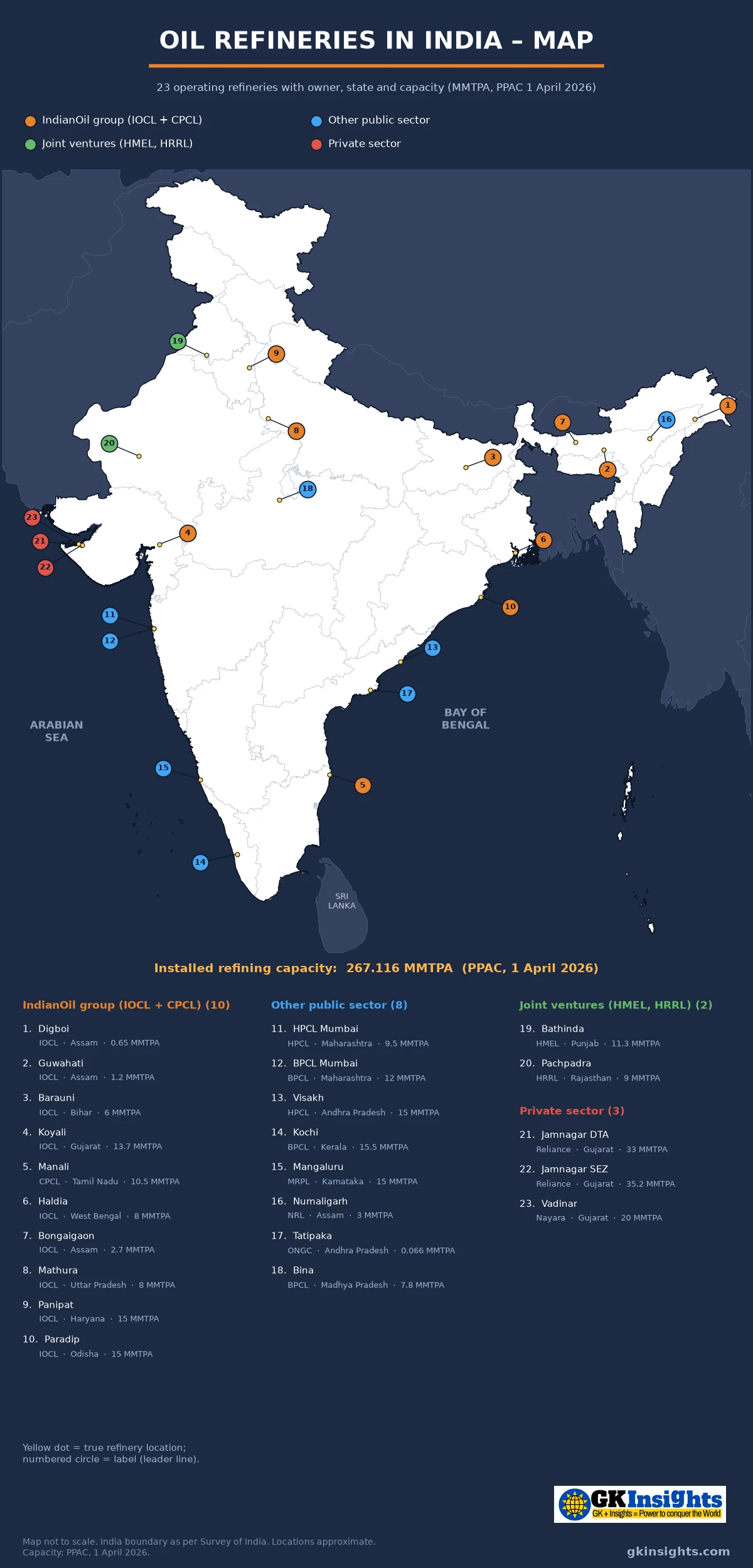
How to Read the Oil Refineries in India Map
The map marks all 23 refineries that have capacity on the PPAC list, in four colour groups by owner. The numbers are fixed and match the tables:
- IndianOil group (1–10) – the nine refineries of Indian Oil Corporation (IOCL) and the Manali refinery of its subsidiary Chennai Petroleum Corporation (CPCL)
- Other public sector (11–18) – refineries of BPCL, HPCL, MRPL, Numaligarh Refinery Ltd and ONGC
- Joint ventures (19–20) – the HPCL–Mittal refinery at Bathinda and the HPCL–Rajasthan Government refinery at Pachpadra
- Private sector (21–23) – Reliance Industries’ two refineries at Jamnagar and Nayara Energy’s refinery at Vadinar
Each refinery’s true location is a small yellow dot, and its numbered circle is joined to the dot by a short line. Where refineries sit very close together – the three on the Gulf of Kachchh near Jamnagar and the two at Mahul in Mumbai – the circles are pulled further apart, out into the sea. Positions are approximate and the map is not to scale. The CPCL refinery at Nagapattinam (Cauvery Basin) is not numbered because PPAC shows its capacity as zero; it is explained further down.
What an Oil Refinery Does
Crude oil as it comes out of the ground is of little direct use. A refinery heats it and separates it by boiling point in a distillation column: gases and LPG come off the top, then naphtha and petrol, then kerosene and aviation turbine fuel (ATF), then diesel, with heavy fuel oil and bitumen at the bottom. Secondary units such as fluid catalytic crackers, hydrocrackers and cokers then break the heavy fractions into lighter, more valuable products, and treating units remove sulphur so that fuels meet BS-VI norms.
Refinery capacity is given in million metric tonnes per annum (MMTPA) of crude oil processed. International reports often use barrels per day instead; as a rough guide, 1 MMTPA is about 20,000 barrels per day, so a 15 MMTPA refinery handles roughly 3 lakh barrels a day. A refinery’s capacity is not the same as its output in a given year: the amount of crude actually processed (throughput) can be above or below nameplate capacity.
Refineries are also compared by the Nelson Complexity Index, which measures how much secondary processing a refinery has relative to its distillation capacity. A higher index means the refinery can take cheaper, heavier crude and still turn out a larger share of petrol, diesel and petrochemical feedstock.
List of Oil Refineries in India with Capacity
The tables follow the map numbers. Capacity is PPAC’s installed capacity as on 1 April 2026. The year in the notes is the year of commissioning given by CHT (MoPNG) where it is available.
IndianOil Group Refineries (1–10)
| No. | Refinery | Owner | Place (district), state | Capacity (MMTPA) | Notes for exams |
|---|---|---|---|---|---|
| 1 | Digboi Refinery | IOCL | Digboi (Tinsukia), Assam | 0.65 | Commissioned 1901 by the Assam Oil Company; India’s oldest refinery, taken over by IOCL in 1981. Smallest IOCL unit. |
| 2 | Guwahati Refinery (Noonmati) | IOCL | Guwahati (Kamrup Metropolitan), Assam | 1.2 | Commissioned 1962; India’s first public sector refinery, built with Romanian collaboration. |
| 3 | Barauni Refinery | IOCL | Barauni (Begusarai), Bihar | 6 | Commissioned 1964; on the Ganga plain, linked by crude pipeline to the Haldia and Paradip coast. Expansion to 9 MMTPA under way. |
| 4 | Gujarat Refinery (Koyali) | IOCL | Koyali, Vadodara (Vadodara), Gujarat | 13.7 | Commissioned 1965 near Vadodara; IOCL calls it the Gujarat Refinery. Expansion to 18 MMTPA under way. |
| 5 | Manali Refinery | CPCL (IOCL subsidiary) | Manali, Chennai (Chennai), Tamil Nadu | 10.5 | Commissioned 1965; run by CPCL, a subsidiary of IOCL. PPAC lists the state as “Chennai”. |
| 6 | Haldia Refinery | IOCL | Haldia (Purba Medinipur), West Bengal | 8 | Commissioned 1975 near the mouth of the Hooghly. |
| 7 | Bongaigaon Refinery | IOCL | Dhaligaon (Chirang), Assam | 2.7 | At Dhaligaon near Bongaigaon town; earlier run by Bongaigaon Refinery and Petrochemicals Ltd, merged into IOCL. Sources give 1974 or 1979 as the start year. |
| 8 | Mathura Refinery | IOCL | Mathura (Mathura), Uttar Pradesh | 8 | Commissioned 1982; its emissions near the Taj Mahal are part of the history of the Taj Trapezium Zone. |
| 9 | Panipat Refinery | IOCL | Panipat (Panipat), Haryana | 15 | Commissioned 1998; being expanded from 15 to 25 MMTPA. |
| 10 | Paradip Refinery | IOCL | Paradip (Jagatsinghpur), Odisha | 15 | Commissioned 2016; IOCL’s newest refinery, on the Odisha coast. |
IOCL’s nine refineries together have 70.25 MMTPA. With CPCL’s Manali refinery the IndianOil group reaches 80.75 MMTPA, which makes it the largest refining group in the public sector.
Other Public Sector Refineries (11–18)
| No. | Refinery | Owner | Place (district), state | Capacity (MMTPA) | Notes for exams |
|---|---|---|---|---|---|
| 11 | Mumbai Refinery (HPCL) | HPCL | Mahul, Mumbai (Mumbai Suburban), Maharashtra | 9.5 | Commissioned 1954; HPCL’s Mumbai refinery sits next to BPCL’s at Mahul. |
| 12 | Mumbai Refinery (BPCL) | BPCL | Mahul, Mumbai (Mumbai Suburban), Maharashtra | 12 | Commissioned 1955; one of the two Mumbai refineries. |
| 13 | Visakh Refinery | HPCL | Visakhapatnam (Visakhapatnam), Andhra Pradesh | 15 | Commissioned 1957; capacity raised to 15 MMTPA under HPCL’s Visakh Refinery Modernisation Project. |
| 14 | Kochi Refinery | BPCL | Ambalamugal, Kochi (Ernakulam), Kerala | 15.5 | Commissioned 1963; at 15.5 MMTPA, the largest single public sector refinery on the PPAC list. |
| 15 | MRPL Refinery | MRPL (ONGC subsidiary) | Mangaluru (Dakshina Kannada), Karnataka | 15 | Commissioned 1996 (CHT); MRPL is a subsidiary of ONGC. |
| 16 | Numaligarh Refinery | NRL (Oil India subsidiary) | Numaligarh (Golaghat), Assam | 3 | Dedicated to the nation in July 1999, commercial production from October 2000; built under the Assam Accord. Oil India holds 69.63%. Expansion to 9 MMTPA is in progress. |
| 17 | Tatipaka mini-refinery | ONGC | Tatipaka (Konaseema), Andhra Pradesh | 0.066 | Commissioned 2001; a small ONGC unit in the Godavari delta that processes local crude. At 0.066 MMTPA, the smallest refinery on the list. |
| 18 | Bina Refinery | BPCL | Agasod, Bina (Sagar), Madhya Pradesh | 7.8 | Commissioned 2011 by Bharat Oman Refineries Ltd, now part of BPCL; inland, fed by a crude pipeline from Vadinar in Gujarat. Being expanded to 11 MMTPA. |
Joint Venture Refineries (19–20)
| No. | Refinery | Owner | Place (district), state | Capacity (MMTPA) | Notes for exams |
|---|---|---|---|---|---|
| 19 | Guru Gobind Singh Refinery | HMEL (HPCL-Mittal JV) | Phulokhari, Bathinda (Bathinda), Punjab | 11.3 | Guru Gobind Singh Refinery, commissioned 2012; joint venture of HPCL and Mittal Energy Investments, fed by a crude pipeline from Mundra. |
| 20 | Rajasthan Refinery | HRRL (HPCL 74%, Govt of Rajasthan 26%) | Pachpadra (Balotra), Rajasthan | 9 | Commercial operations from 22 June 2026; a refinery-cum-petrochemical complex. Designed for 7.5 MMTPA of imported crude and 1.5 MMTPA of Rajasthan crude. |
Private Sector Refineries (21–23)
| No. | Refinery | Owner | Place (district), state | Capacity (MMTPA) | Notes for exams |
|---|---|---|---|---|---|
| 21 | Jamnagar Refinery (DTA) | Reliance Industries | Motikhavdi, Jamnagar (Jamnagar), Gujarat | 33 | Reliance’s first Jamnagar refinery, commissioned 1999; serves the domestic tariff area (DTA). |
| 22 | Jamnagar Refinery (SEZ) | Reliance Industries | Motikhavdi, Jamnagar (Jamnagar), Gujarat | 35.2 | Commissioned 2008 inside a special economic zone and built largely for export markets. |
| 23 | Vadinar Refinery | Nayara Energy | Vadinar (Devbhumi Dwarka), Gujarat | 20 | Run by Nayara Energy, formerly Essar Oil; on the Gulf of Kachchh in Devbhumi Dwarka district. |
Together, the two Reliance refineries at Jamnagar have 68.2 MMTPA – about a quarter of India’s total and far more than any other site in the country. The question “Which is the largest oil refinery in India?” therefore has two correct-sounding answers. By site, it is Reliance’s Jamnagar complex. If each PPAC entry is counted separately, the Jamnagar SEZ refinery (35.2 MMTPA) is the largest single refinery, and BPCL’s Kochi refinery (15.5 MMTPA) is the largest in the public sector.
Refining Capacity of India: Key Numbers
PPAC puts India’s installed refining capacity at 267.116 MMTPA as on 1 April 2026. The Ministry of Petroleum and Natural Gas gives the long-term trend: about 62 MMTPA in 1998, which means capacity has more than quadrupled since the late 1990s, with private refineries at Jamnagar and Vadinar doing much of the growth.
| Owner group | Refineries (map nos.) | Capacity (MMTPA) | Approximate share |
|---|---|---|---|
| IndianOil group (IOCL + CPCL) | 10 (1–10) | 80.75 | 30% |
| Other public sector (BPCL, HPCL, MRPL, NRL, ONGC) | 8 (11–18) | 77.866 | 29% |
| Joint ventures (HMEL, HRRL) | 2 (19–20) | 20.3 | 8% |
| Private (Reliance, Nayara) | 3 (21–23) | 88.2 | 33% |
| Total | 23 | 267.116 | 100% |
Public sector companies together hold about 158.6 MMTPA, a little under 60% of the total. The Pachpadra refinery is a joint venture, but HPCL owns 74% of it, so it too is controlled by the public sector. By company, IOCL is the largest refiner with 70.25 MMTPA in its own nine refineries (80.75 MMTPA with CPCL), just ahead of Reliance with 68.2 MMTPA – but Reliance’s capacity is all at one site, which is why Jamnagar is the largest refining complex on the oil refineries in India map.
State-wise Oil Refineries in India
| State | Refineries (map nos.) | Count | Capacity (MMTPA) |
|---|---|---|---|
| Gujarat | Koyali (4), Jamnagar DTA (21), Jamnagar SEZ (22), Vadinar (23) | 4 | 101.9 |
| Assam | Digboi (1), Guwahati (2), Bongaigaon (7), Numaligarh (16) | 4 | 7.55 |
| Andhra Pradesh | Visakh (13), Tatipaka (17) | 2 | 15.066 |
| Maharashtra | HPCL Mumbai (11), BPCL Mumbai (12) | 2 | 21.5 |
| Kerala | Kochi (14) | 1 | 15.5 |
| Karnataka | Mangaluru (15) | 1 | 15 |
| Haryana | Panipat (9) | 1 | 15 |
| Odisha | Paradip (10) | 1 | 15 |
| Punjab | Bathinda (19) | 1 | 11.3 |
| Tamil Nadu | Manali (5) | 1 | 10.5 |
| Rajasthan | Pachpadra (20) | 1 | 9 |
| Uttar Pradesh | Mathura (8) | 1 | 8 |
| West Bengal | Haldia (6) | 1 | 8 |
| Madhya Pradesh | Bina (18) | 1 | 7.8 |
| Bihar | Barauni (3) | 1 | 6 |
Gujarat has about 38% of India’s refining capacity. Assam has the same number of refineries as Gujarat but only a small share of the capacity, because its four refineries were built to process crude from the oilfields of upper Assam and are small by modern standards.
Why Refineries Are Located Where They Are
Look at the oil refineries in India map again and three patterns stand out. Each one follows from a simple question: is it cheaper to move crude oil to the refinery, or the finished products to the market?
- Near oilfields: India’s first refineries were built close to its first oilfields. The four Assam refineries (1, 2, 7, 16) were set up to process Assam crude, Tatipaka (17) takes crude from the Krishna–Godavari area, and Pachpadra (20) is designed to take part of its crude from the Barmer basin in Rajasthan.
- On the coast: most of India’s crude is now imported, so the big refineries are at or near ports where tankers can unload: Jamnagar and Vadinar (21–23), Mumbai (11, 12), Mangaluru (15), Kochi (14), Chennai (5), Visakhapatnam (13), Paradip (10) and Haldia (6). Several of these use single point moorings offshore to take very large crude carriers.
- Near inland markets: Mathura (8), Panipat (9), Bathinda (19), Bina (18), Barauni (3) and Koyali (4) are close to big fuel-consuming regions of north and central India. Crude reaches them by pipeline from the coast – for example from the Gujarat coast to Mathura and Panipat, from Vadinar to Bina, from Mundra to Bathinda, and from Paradip and Haldia to Barauni. Moving crude by pipeline in bulk is cheaper than sending many different products over long distances.
This is the same market-versus-raw-material logic you meet with thermal power plants in India and other industries; for refineries, pipelines tilt the choice towards the market. The major ports in India map shows the ports that serve the coastal refineries.
Capacity Expansion and New Refinery Projects
Several existing refineries are being enlarged. The targets below are company figures; dates slip often, so learn the capacities rather than the deadlines.
| Refinery (map no.) | Owner | Present capacity (MMTPA) | Target capacity (MMTPA) | Status (Nov 2026) |
|---|---|---|---|---|
| Panipat (9) | IOCL | 15 | 25 | Under execution |
| Koyali (4) | IOCL | 13.7 | 18 | Under execution |
| Barauni (3) | IOCL | 6 | 9 | Under execution |
| Numaligarh (16) | NRL | 3 | 9 | Over 85% complete (NRL); crude pipeline from Paradip is part of the project |
| Bina (18) | BPCL | 7.8 | 11 | Under execution, with a petrochemical complex |
Two other projects come up in current affairs. The Cauvery Basin refinery of CPCL at Nagapattinam in Tamil Nadu, a 1 MMTPA unit commissioned in 1993, stopped operating in April 2019 so that a new 9 MMTPA refinery could be built on the site; PPAC shows its capacity as zero. In 2026 CPCL said the project is being reworked as a petrochemical-led complex, with IOCL taking a 75% stake, so its final shape is not yet settled. BPCL has also proposed a new greenfield refinery in Andhra Pradesh; it is at the approval stage and is not on the map.
The Numaligarh expansion is worth a separate note: to run at 9 MMTPA the refinery needs imported crude, so NRL is laying a crude oil pipeline of about 1,635 km from Paradip in Odisha to Numaligarh in Assam, through Odisha, Jharkhand, Bihar, West Bengal and Assam.
Strategic Petroleum Reserves
Refineries hold only a few weeks of crude. As a buffer against supply shocks, the government has built strategic petroleum reserves in underground rock caverns, through Indian Strategic Petroleum Reserves Ltd (ISPRL), a special purpose vehicle under the Ministry of Petroleum and Natural Gas. They are often confused with refineries because two of them are at refinery towns.
| Phase | Location | State | Capacity (million tonnes) |
|---|---|---|---|
| Phase I | Visakhapatnam | Andhra Pradesh | 1.33 |
| Phase I | Mangaluru | Karnataka | 1.5 |
| Phase I | Padur | Karnataka | 2.5 |
| Phase II (planned) | Chandikhol | Odisha | 4 |
| Phase II (planned) | Padur II | Karnataka | 2.5 |
Phase I totals 5.33 million tonnes. Phase II, planned with private participation, would add 6.5 million tonnes. Details are on the Ministry of Petroleum and Natural Gas page on strategic crude oil storage.
Exam Traps on Oil Refineries in India
These are the mix-ups that come up again and again in Prelims-style questions:
- Oldest refinery: Digboi (1901), set up by the Assam Oil Company, not by IOCL. IOCL took it over only in 1981. Guwahati (1962) is the first public sector refinery – the two are often swapped.
- Largest refinery: by site, Reliance’s Jamnagar complex (DTA + SEZ, 68.2 MMTPA). Among public sector refineries, Kochi (15.5 MMTPA). Panipat, Paradip, Visakh and Mangaluru are tied at 15 MMTPA, so a question that says “Panipat is the largest PSU refinery” is wrong today.
- Largest refiner: by company, IOCL (70.25 MMTPA in its own refineries). Do not confuse company and site.
- Smallest: ONGC’s Tatipaka unit (0.066 MMTPA), not Digboi (0.65 MMTPA).
- Two Mumbai refineries: both at Mahul – one HPCL (9.5) and one BPCL (12). They are separate refineries.
- Vadinar vs Jamnagar: Vadinar is Nayara Energy (formerly Essar Oil) in Devbhumi Dwarka district; Jamnagar is Reliance. All three are on the Gulf of Kachchh.
- Bathinda refinery: owned by HMEL (HPCL–Mittal), not by IOCL; it is named after Guru Gobind Singh.
- Bina: in Madhya Pradesh (Sagar district), not Bihar; it was built by Bharat Oman Refineries and is now BPCL’s.
- Manali: the CPCL refinery in Chennai, not the hill town in Himachal Pradesh.
- Rajasthan’s refinery: at Pachpadra in Balotra district (carved out of Barmer). It is India’s newest refinery, in commercial operation from June 2026.
- Numaligarh: majority-owned by Oil India (69.63%), with the Assam Government holding 26% – not a BPCL refinery any more.
- Assam vs Gujarat: both have four refineries on the PPAC list; Gujarat has about 38% of capacity, Assam under 3%.
Oil Refineries in India: Quick Revision Table
| Asked as | Answer |
|---|---|
| Oldest refinery in India | Digboi, Assam (1901) |
| First public sector refinery | Guwahati, Assam (1962) |
| Largest refining site | Jamnagar, Gujarat (Reliance; DTA + SEZ) |
| Largest public sector refinery | Kochi, Kerala (BPCL, 15.5 MMTPA) |
| Smallest refinery | Tatipaka, Andhra Pradesh (ONGC, 0.066 MMTPA) |
| Newest refinery | Pachpadra, Rajasthan (HRRL, commercial operations June 2026) |
| IOCL’s newest refinery | Paradip, Odisha (2016) |
| State with most capacity | Gujarat (about 101.9 MMTPA) |
| States with four refineries each | Gujarat and Assam |
| Installed capacity (1 April 2026) | 267.116 MMTPA (PPAC) |
UPSC Practice Points on Oil Refineries in India
These points sum up the facts most likely to be asked in Prelims and State PSC papers. Read them with the oil refineries in India map open beside you.
- Installed capacity: 267.116 MMTPA in 23 refineries as on 1 April 2026 (PPAC); about 62 MMTPA in 1998 (MoPNG).
- Owners: public sector about 158.6 MMTPA (IOCL group 80.75), joint ventures 20.3, private 88.2.
- Coastal refineries depend on imported crude; inland ones (Mathura, Panipat, Bathinda, Bina, Barauni) get crude by pipeline from the coast.
- Assam’s four refineries were built for Assam crude; Numaligarh’s expansion to 9 MMTPA adds a crude pipeline from Paradip.
- Strategic petroleum reserves (ISPRL): Visakhapatnam, Mangaluru and Padur in Phase I (5.33 million tonnes); Chandikhol and Padur II planned in Phase II.
- Revise with the minerals in India map (for oilfields) and the major ports in India map.
FAQs on Oil Refineries in India Map
How many oil refineries are there in India?
PPAC lists 24 refinery entries, of which 23 have capacity and are working. The 24th, CPCL’s Cauvery Basin refinery at Nagapattinam, is shown at zero capacity because it stopped operating in 2019 for a planned rebuild. Total installed capacity is 267.116 MMTPA as on 1 April 2026.
Which is the largest oil refinery in India?
Reliance Industries’ Jamnagar complex in Gujarat, with two refineries (DTA 33 MMTPA and SEZ 35.2 MMTPA) totalling 68.2 MMTPA. Among public sector refineries, BPCL’s Kochi refinery is the largest at 15.5 MMTPA.
Which is the oldest oil refinery in India?
The Digboi refinery in Tinsukia district, Assam, commissioned in 1901 by the Assam Oil Company. Indian Oil Corporation took it over in 1981. Its capacity is 0.65 MMTPA.
Which state has the most oil refining capacity in India?
Gujarat, with about 101.9 MMTPA from Koyali, the two Reliance refineries at Jamnagar and Nayara’s Vadinar refinery – about 38% of India’s total.
Which company has the largest refining capacity in India?
Indian Oil Corporation, with 70.25 MMTPA in its nine refineries, or 80.75 MMTPA including its subsidiary CPCL. Reliance Industries is second with 68.2 MMTPA, all at Jamnagar.
What is the newest oil refinery in India?
The HPCL Rajasthan Refinery at Pachpadra in Balotra district, Rajasthan, a 9 MMTPA refinery-cum-petrochemical complex that began commercial operations on 22 June 2026. HPCL holds 74% and the Government of Rajasthan 26%.
What does MMTPA mean?
Million metric tonnes per annum – the amount of crude oil a refinery is designed to process in a year. One MMTPA is roughly 20,000 barrels per day.
What do the numbers on the oil refineries in India map show?
They mark 23 refineries in four owner groups: 1–10 the IndianOil group (IOCL and CPCL), 11–18 other public sector companies, 19–20 joint ventures and 21–23 private refineries. The same numbers are used in the tables.
Also Check:
– Minerals in India Map
– Thermal Power Plants in India Map
– Hydro Power Plants in India Map
– Major Ports in India Map
– National Highways and Expressways of India Map
– Major Airports in India Map
– Straits Near India Map