
This post covers the major airports in India with a numbered map: the six busiest metro hubs, the other main international airports, the new airports opened since 2023, and four domestic airports that keep turning up in exams because of where they are. Each airport has a number on the map, and the same number is used in every table below.
Airport questions in UPSC and State PSC papers are rarely about runways or terminals. They ask you to place an airport on the map, match it with the person it is named after, or say which state it is in. Recent openings such as Navi Mumbai, Noida (Jewar) and Bhogapuram are also current-affairs material. Traffic figures are from the Airports Authority of India (AAI) for 2025-26, and counts of international airports are given with their sources, because official lists differ slightly.
Major Airports in India Map
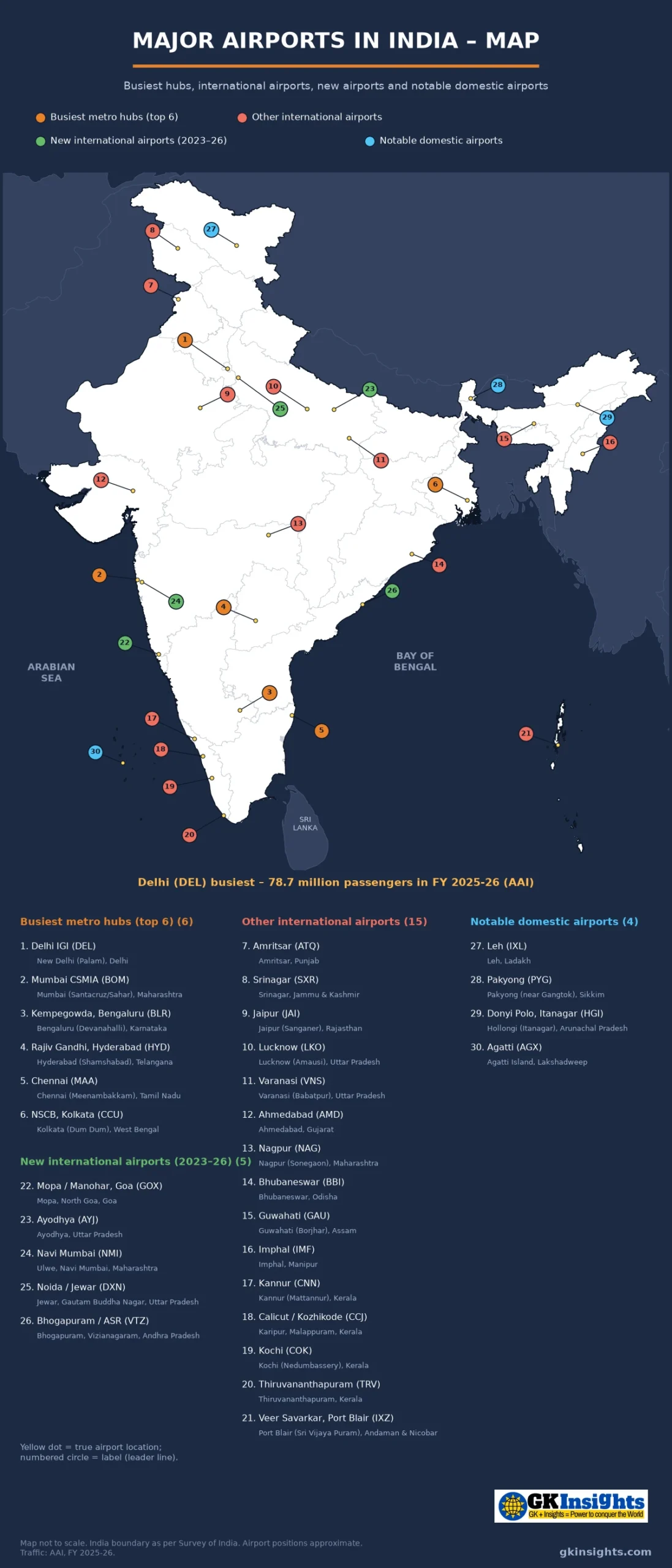
How to Read the Major Airports in India Map
The map marks 30 airports in four colour groups. The numbers are fixed and match the tables:
- Busiest metro hubs (1–6) – Delhi, Mumbai, Bengaluru, Hyderabad, Chennai and Kolkata, the top six by passengers in 2025-26
- Other international airports (7–21) – a spread of state capitals and regional centres from Amritsar and Srinagar in the north to Thiruvananthapuram in the south and Port Blair in the Bay of Bengal
- New international airports (22–26) – Mopa (Goa), Ayodhya, Navi Mumbai, Noida (Jewar) and Bhogapuram (Visakhapatnam), all opened between 2023 and 2026; four are greenfield, while Ayodhya grew out of an older airstrip
- Notable domestic airports (27–30) – Leh, Pakyong, Itanagar (Hollongi) and Agatti, chosen for their location in the high Himalaya, the North-East hills and the Lakshadweep islands
The true position of each airport is a small yellow dot, and its numbered circle is joined to it by a short line. Where airports are very close – Delhi and Noida, Mumbai and Navi Mumbai, and the four Kerala airports – the circles are moved further apart. Positions are approximate and the map is not to scale. The map shows only 30 of India’s airports; several others that matter for exams are listed further down in the section on other airports.
How Airports in India Are Classified
Before learning the major airports in India one by one, get the categories clear; questions often test the labels. Every one of the major airports in India falls into one of the groups below.
The Airports Authority of India (AAI) is a statutory body set up under the Airports Authority of India Act, 1994. It came into being on 1 April 1995 by merging the International Airports Authority of India and the National Airports Authority. AAI runs most airports in the country and also provides air navigation services over Indian airspace. The Ministry of Civil Aviation makes policy, and the Directorate General of Civil Aviation (DGCA) is the regulator that licenses aerodromes.
Airports are grouped in two different ways, and the two are often mixed up:
- By the kind of flights allowed: international airports (designated for international flights, with immigration and customs), customs airports (where customs facilities exist for limited international operations) and domestic airports.
- By who owns or runs them: airports run directly by AAI; AAI airports leased to private operators under public-private partnership (PPP); joint-venture (JV) airports such as Delhi, Mumbai, Bengaluru and Hyderabad, where a private company runs the airport with AAI or a state body as a partner; and airports built by state governments or private companies, such as Mopa, Navi Mumbai and Noida.
- Civil enclaves: some airports are defence airfields with a civil terminal – Srinagar, Leh and Pune with the Indian Air Force, and Port Blair and Dabolim with the Navy.
How Many International Airports Are There in India?
The honest answer is about 36–37, depending on the list and its date. The dashboard on the Ministry of Civil Aviation website gives 165 operational airports, of which 36 are international (including JV airports), 11 are customs airports and 118 are domestic. A PIB backgrounder of July 2026 also gives 165 operational airports as of 15 July 2026, up from 74 in 2014.
AAI’s monthly traffic report for September 2026 (see AAI traffic news) lists 37 airports under its international headings and 10 under customs. One reason for the difference is timing: the Union Cabinet approved the declaration of Madurai as an international airport in March 2026 (PIB), and Noida, which started domestic flights in June 2026, is placed under the international heading although it had not yet handled international passengers by September 2026. Lists prepared on different dates therefore differ by one or two airports. In an answer, write “about 36–37 international airports” and name your source.
| AAI traffic-report group (Sept 2026) | Number | Examples |
|---|---|---|
| International airports run by AAI | 19 | Chennai, Kolkata, Amritsar, Varanasi, Srinagar, Port Blair, Madurai, Ayodhya, Kushinagar |
| PPP international airports | 6 | Ahmedabad, Jaipur, Lucknow, Guwahati, Mangaluru, Thiruvananthapuram |
| JV international airports | 7 | Delhi, Mumbai, Bengaluru, Hyderabad, Kochi, Kannur, Nagpur |
| State government / private international airports | 5 | Mopa (Goa), Navi Mumbai, Noida, Shirdi, Visakhapatnam (Bhogapuram) |
| Customs airports | 10 | Pune, Chandigarh, Indore, Patna, Bhopal, Bagdogra, Agartala, Vadodara, Aurangabad, Gaya |
“International” is a designation, not a measure of traffic: Ayodhya, Imphal and Kushinagar recorded no international passengers in 2025-26, while Pune, a customs airport, handled more passengers than most international airports.
Busiest Airports in India (AAI, 2025-26)
According to AAI’s traffic report for March 2026, which gives the full year April 2025 – March 2026, all Indian airports together handled 420.09 million passengers, up 1.9% on the previous year. Of these, 339.45 million were domestic and 80.64 million international. The busiest airports in India are listed below with their map numbers.
| Rank | Airport | Map no. | Passengers 2025-26 (million) | Change on 2024-25 |
|---|---|---|---|---|
| 1 | Delhi (Indira Gandhi International) | 1 | 78.70 | −0.7% |
| 2 | Mumbai (Chhatrapati Shivaji Maharaj International) | 2 | 55.29 | +0.3% |
| 3 | Bengaluru (Kempegowda International) | 3 | 44.47 | +6.2% |
| 4 | Hyderabad (Rajiv Gandhi International) | 4 | 30.48 | +3.4% |
| 5 | Chennai | 5 | 23.02 | +2.7% |
| 6 | Kolkata (Netaji Subhas Chandra Bose International) | 6 | 21.10 | −3.3% |
| 7 | Ahmedabad (Sardar Vallabhbhai Patel International) | 12 | 13.82 | +2.9% |
| 8 | Kochi (Cochin International) | 19 | 11.30 | +1.5% |
| 9 | Pune | not numbered | 11.01 | +5.2% |
| 10 | Guwahati (Lokpriya Gopinath Bordoloi International) | 15 | 6.62 | +7.5% |
The six metro hubs handled about 253 million passengers, roughly three-fifths of the national total. Delhi stayed far ahead even though its traffic dipped slightly, and Kolkata also fell; AAI’s report gives figures, not reasons, so do not write a cause unless a source states one. Guwahati is the busiest airport in the North-East.
In Goa, the old Dabolim airport (6.13 million, down 15.4%) and the new Mopa airport (5.38 million, up 15.8%) were 11th and 14th; traffic is shifting to Mopa.
Busiest Metro Hubs on the Map (1–6)
The six busiest airports in India lead the major airports in India by passengers and serve the largest metropolitan regions. Four of them – Delhi, Mumbai, Bengaluru and Hyderabad – are run by joint-venture companies, while Chennai and Kolkata are run directly by AAI.
| No. | Airport (IATA) | City / State or UT | AAI group | Notes for exams |
|---|---|---|---|---|
| 1 | Indira Gandhi International (DEL) | New Delhi, Delhi | JV | Busiest airport in India: 78.7 million passengers in 2025-26; named after former Prime Minister Indira Gandhi |
| 2 | Chhatrapati Shivaji Maharaj International (BOM) | Mumbai, Maharashtra | JV | Second busiest; Mumbai now has a second airport at Navi Mumbai (24) |
| 3 | Kempegowda International (BLR) | Bengaluru (Devanahalli), Karnataka | JV | Third busiest; named after Kempe Gowda, the founder of Bengaluru |
| 4 | Rajiv Gandhi International (HYD) | Hyderabad (Shamshabad), Telangana | JV | Fourth busiest; replaced the old Begumpet airport for scheduled flights |
| 5 | Chennai International (MAA) | Chennai (Meenambakkam), Tamil Nadu | AAI | Largest AAI-run airport by passengers; main gateway of Tamil Nadu |
| 6 | Netaji Subhas Chandra Bose International (CCU) | Kolkata (Dum Dum), West Bengal | AAI | Main hub of eastern India; named after Subhas Chandra Bose |
Questions often give an airport’s formal name and ask for the city, or the reverse. Among the major airports in India, these six also carry most international traffic.
Other International Airports in India on the Map (7–21)
These 15 international airports in India include state capitals, pilgrimage cities and border airports; several share airfields with the armed forces.
| No. | Airport (IATA) | City / State or UT | AAI group | Notes for exams |
|---|---|---|---|---|
| 7 | Sri Guru Ram Das Ji International (ATQ) | Amritsar, Punjab | AAI | Named after the fourth Sikh Guru; close to the Pakistan border |
| 8 | Srinagar International (SXR) | Srinagar, Jammu & Kashmir | AAI | Civil enclave at an Indian Air Force base; small international traffic |
| 9 | Jaipur International (JAI) | Jaipur (Sanganer), Rajasthan | PPP | Main airport of Rajasthan |
| 10 | Chaudhary Charan Singh International (LKO) | Lucknow (Amausi), Uttar Pradesh | PPP | Named after former Prime Minister Charan Singh |
| 11 | Lal Bahadur Shastri International (VNS) | Varanasi (Babatpur), Uttar Pradesh | AAI | Named after former Prime Minister Lal Bahadur Shastri |
| 12 | Sardar Vallabhbhai Patel International (AMD) | Ahmedabad, Gujarat | PPP | Seventh busiest in 2025-26 (13.8 million) |
| 13 | Dr Babasaheb Ambedkar International (NAG) | Nagpur, Maharashtra | JV | Near the geographical centre of India |
| 14 | Biju Patnaik International (BBI) | Bhubaneswar, Odisha | AAI | Named after former Odisha Chief Minister Biju Patnaik |
| 15 | Lokpriya Gopinath Bordoloi International (GAU) | Guwahati, Assam | PPP | Busiest airport in the North-East; named after the first Chief Minister of Assam |
| 16 | Bir Tikendrajit International (IMF) | Imphal, Manipur | AAI | Named after a Manipuri prince of the 1891 Anglo-Manipur war; on the international list with almost no international traffic |
| 17 | Kannur International (CNN) | Kannur (Mattannur), Kerala | JV | Opened in December 2018; Kerala’s newest airport |
| 18 | Calicut International (CCJ) | Karipur (Malappuram district), Kerala | AAI | Table-top runway on a plateau, like Mangaluru |
| 19 | Cochin International (COK) | Kochi (Nedumbassery), Kerala | JV | India’s first airport built under a PPP model (1999); world’s first fully solar-powered airport (2015), as stated by CIAL |
| 20 | Thiruvananthapuram International (TRV) | Thiruvananthapuram, Kerala | PPP | Southernmost of the mainland airports on the map |
| 21 | Veer Savarkar International (IXZ) | Port Blair (Sri Vijaya Puram), Andaman & Nicobar | AAI | Civil enclave at a naval air station; the gateway to the islands |
The six PPP airports (Ahmedabad, Jaipur, Lucknow, Guwahati, Mangaluru and Thiruvananthapuram) are AAI airports leased to a private operator. In 2025-26, Delhi alone handled 21.5 million international passengers, more than a quarter of India’s total, while some airports on the list, such as Imphal and Port Blair, handled almost none.
Kerala is a good example of how geography shapes the international airports in India. Four airports – Kannur (17), Kozhikode (18), Kochi (19) and Thiruvananthapuram (20) – sit along a narrow coastal state, largely because of the strong travel links between Kerala and the Gulf countries. Port Blair (21) is the main airport of the Andaman and Nicobar Islands.
Greenfield Airports in India and Other New Airports (22–26)
A greenfield airport is built on a new site, while a brownfield project expands or upgrades an existing airport. The Government of India’s Greenfield Airports Policy (2008) sets out how such airports are approved. Four of the five new airports on this map – Mopa, Navi Mumbai, Noida and Bhogapuram – are greenfield airports in India built by state-backed or private companies. Ayodhya is the exception: AAI built it by expanding the old Faizabad airstrip, so it is a brownfield project, grouped here because it opened as a new international airport in December 2023. Mopa, Navi Mumbai and Noida are second airports for busy regions, and Bhogapuram has fully replaced an old airport.
| No. | Airport (IATA) | City / State or UT | AAI group | Notes for exams |
|---|---|---|---|---|
| 22 | Manohar International (GOX) | Mopa (North Goa), Goa | State govt / private | Commercial flights from 5 January 2023 (PIB); Goa’s second airport |
| 23 | Maharishi Valmiki International (AYJ) | Ayodhya, Uttar Pradesh | AAI | Inaugurated 30 December 2023 |
| 24 | Navi Mumbai International (NMI) | Ulwe (Navi Mumbai), Maharashtra | State govt / private | Commercial flights from 25 December 2025; Mumbai’s second airport |
| 25 | Noida International (DXN) | Jewar (Gautam Buddha Nagar), Uttar Pradesh | State govt / private | Commercial flights from 15 June 2026; domestic only so far |
| 26 | Alluri Sitarama Raju International (VTZ) | Bhogapuram (Vizianagaram district), Andhra Pradesh | State govt / private | Commercial flights from 17 August 2026; replaced the old Visakhapatnam airport |
Notes on the Greenfield Airports
- Mopa (22): in its first full years Mopa has grown fast while Dabolim has lost traffic (see the busiest airports table).
- Ayodhya (23): named after Maharishi Valmiki, author of the Ramayana; an AAI expansion of the earlier airstrip, on AAI’s international list but with only domestic passengers so far.
- Navi Mumbai (24): inaugurated on 8 October 2025, about 25 km from the existing Mumbai airport across Thane Creek. It is run by Navi Mumbai International Airport Ltd, a company of the Adani group and CIDCO (the Maharashtra planning body). AAI’s monthly figures show international passengers from 2026.
- Noida (25): about 45 km from Delhi’s airport, in Gautam Buddha Nagar district. A PIB release of March 2026 says it is a PPP project of Yamuna International Airport Pvt Ltd, a subsidiary of Zurich Airport International AG, with a 3,900 m runway and a first-phase capacity of 12 million passengers a year. The Uttar Pradesh Cabinet approved a proposal in October 2026 to rename it; the name in official use remains Noida International Airport until the Centre approves the change.
- Bhogapuram (26): developed by a GMR group company, it took over all scheduled flights from the old Visakhapatnam airport at the INS Dega naval base and kept the code VTZ. Traffic figures for 2025-26 under “Visakhapatnam” therefore belong to the old airport.
Uttar Pradesh has two of these new airports (Ayodhya and Noida), one reason it now leads the state-wise count of international airports.
Notable Domestic Airports on the Map (27–30)
These four are not among the major airports in India by traffic. They are on the map because their position – high mountains, a hill state, a frontier capital and a coral island – makes them common exam questions.
| No. | Airport (IATA) | City / State or UT | AAI group | Notes for exams |
|---|---|---|---|---|
| 27 | Kushok Bakula Rimpochee Airport (IXL) | Leh, Ladakh | AAI (civil enclave) | At 3,256 m, the highest commercial airport in India; shares the airfield with the Indian Air Force; about 1.07 million passengers in 2025-26 |
| 28 | Pakyong Airport (PYG) | Pakyong (about 31 km south of Gangtok), Sikkim | AAI | Sikkim’s only airport, at 1,416 m; inaugurated September 2018 and opened under UDAN; AAI shows no passenger traffic in 2025-26 or April–September 2026 |
| 29 | Donyi Polo Airport (HGI) | Hollongi (Itanagar), Arunachal Pradesh | AAI | First greenfield airport of Arunachal Pradesh, inaugurated 19 November 2022; about 0.2 million passengers in 2025-26 |
| 30 | Agatti Airport (AGX) | Agatti Island, Lakshadweep | AAI | The only airport in Lakshadweep; short runway on a coral island; traffic up 16.4% in 2025-26 |
Leh matters most in winter, when the mountain passes on the roads to Ladakh are closed. Pakyong was cut into a hillside, and poor visibility has repeatedly interrupted its flights; the AAI figures above suggest scheduled flights have not been running there recently.
Agatti sits on one of the coral atolls of Lakshadweep, and Port Blair (21) serves the Andaman Islands. They are the main air links to India’s two island groups, which is why they are often asked together with the straits and channels near India.
Other Airports in India to Know (Not Numbered)
The map numbers only 30 major airports in India so that it stays readable. These other airports appear in questions often enough to be worth a line each:
| Airport | State | Why it matters |
|---|---|---|
| Dabolim (GOI) | Goa | Goa’s older airport, a civil enclave at a naval air station; 11th busiest in 2025-26 |
| Pune (PNQ) | Maharashtra | Ninth busiest in 2025-26 (11.0 million); a customs airport at an Air Force base |
| Madurai (IXM) | Tamil Nadu | Declared an international airport in March 2026 (PIB) |
| Mangaluru (IXE) | Karnataka | PPP international airport with a table-top runway |
| Kushinagar (KBK) | Uttar Pradesh | International airport for the Buddhist circuit near the site of the Buddha’s Mahaparinirvana |
| Bagdogra (IXB) | West Bengal | Customs airport near Siliguri; main air gateway to Darjeeling and, with Pakyong idle, to Sikkim |
| Khajuraho (HJR) | Madhya Pradesh | Domestic airport serving a UNESCO World Heritage Site |
State-wise International Airports in India
Counting the 37 airports under the international headings of AAI’s September 2026 report gives this state-wise picture. Many older guides say Kerala has the most international airports; that is no longer true on AAI’s list.
| State / UT | Number | Airports |
|---|---|---|
| Uttar Pradesh | 5 | Lucknow, Varanasi, Kushinagar, Ayodhya, Noida |
| Kerala | 4 | Thiruvananthapuram, Kochi, Kozhikode, Kannur |
| Tamil Nadu | 4 | Chennai, Coimbatore, Tiruchirappalli, Madurai |
| Maharashtra | 4 | Mumbai, Navi Mumbai, Nagpur, Shirdi |
| Gujarat | 3 | Ahmedabad, Surat, Rajkot |
| Andhra Pradesh | 3 | Visakhapatnam (Bhogapuram), Vijayawada, Tirupati |
| Goa | 2 | Dabolim, Mopa |
| Karnataka | 2 | Bengaluru, Mangaluru |
| One each | 10 | Delhi, Telangana (Hyderabad), West Bengal (Kolkata), Punjab (Amritsar), J&K (Srinagar), Rajasthan (Jaipur), Odisha (Bhubaneswar), Assam (Guwahati), Manipur (Imphal), Andaman & Nicobar (Port Blair) |
On the current AAI list, Uttar Pradesh has the most. The Ministry’s dashboard total is 36, so one of these may not yet be counted there; read the options carefully.
UDAN and Regional Air Connectivity
Beyond the major airports in India, many smaller airports came into use through the Regional Connectivity Scheme – UDAN (Ude Desh ka Aam Nagrik), launched in October 2016 to make short regional flights affordable, with viability gap funding for airlines. A PIB backgrounder of July 2026 says 679 routes were operating across 95 airports, heliports and water aerodromes (15 July 2026), with over 1.68 crore passengers flown under the scheme.
The Union Cabinet then approved a Modified UDAN scheme, launched on 4 July 2026, for FY 2026-27 to FY 2035-36 with an outlay of Rs 28,840 crore (PIB). It aims to develop 100 new airports from unserved airstrips and 200 helipads. Pakyong (28) and several North-East airports were opened or kept running with UDAN support, which is why the scheme appears in questions on hill and island connectivity.
Geography Behind the Major Airports in India
Read the major airports in India map as a geography map, not just a list. The busiest airports in India serve the six largest urban regions, and a few other patterns are worth writing in an answer:
- Shared airfields: in border areas and on islands – Srinagar, Leh, Port Blair, and earlier Visakhapatnam – civil flights use defence airfields.
- Relief and weather: table-top runways (Kozhikode, Mangaluru), high altitude (Leh) and hill weather (Pakyong) limit operations. Use the plateaus of India map and mountain ranges of India posts to see the relief around them.
- Remote regions: for the North-East, Ladakh and the islands, air links matter more than in the plains because roads are long or cut off. Compare with the major ports in India map, which shows the sea gateways.
Exam Traps on the Major Airports in India Map
These are the points where answers most often go wrong. Check each one against the numbered map.
- Number of international airports: do not memorise one fixed number. The Ministry’s dashboard gives 36 (including JV airports); AAI’s September 2026 report lists 37 under international headings. Say about 36–37 and give the source.
- Busiest airport: Delhi (1), then Mumbai (2) and Bengaluru (3) on AAI’s 2025-26 figures. Pune, ninth busiest, is only a customs airport, and Hyderabad, not Chennai, is fourth.
- State with most international airports: Uttar Pradesh (5) on the current AAI list, not Kerala. Kerala, Tamil Nadu and Maharashtra have four each.
- Noida vs Delhi: Noida International (25) is at Jewar in Uttar Pradesh, not in Delhi. Do not use the proposed new name as if it were final.
- Visakhapatnam: since 17 August 2026 the city’s airport is at Bhogapuram (26) in Vizianagaram district; the code VTZ moved with it.
- Port Blair: the city is now officially Sri Vijaya Puram, but the airport’s name remains Veer Savarkar International.
- Designation vs traffic: an airport can be on the international list with no international flights (Ayodhya, Imphal, Kushinagar in 2025-26). Questions on “international airports” mean the designation.
- Greenfield or not: Mopa, Navi Mumbai, Noida and Bhogapuram are greenfield; Ayodhya was built by expanding an existing airstrip.
- First PPP airport: Kochi (19), opened in 1999.
Airport-wise Facts for Revision
Read these one-line facts on the major airports in India along with the map.
| Fact | Airport (map no.) |
|---|---|
| Busiest airport in India, 78.7 million passengers (2025-26) | Delhi IGI (1) |
| Table-top runway in Kerala | Kozhikode (18) |
| Goa’s second airport (2023) | Mopa (22) |
| Named after the author of the Ramayana | Ayodhya (23) |
| Mumbai’s second airport (2025) | Navi Mumbai (24) |
| Highest commercial airport in India (3,256 m) | Leh (27) |
| Sikkim’s only airport | Pakyong (28) |
| First greenfield airport of Arunachal Pradesh | Donyi Polo, Itanagar (29) |
| Only airport in Lakshadweep | Agatti (30) |
UPSC Practice Points on Major Airports in India
These points sum up the facts most likely to be asked about the major airports in India in Prelims and State PSC papers.
- AAI: statutory body under the Airports Authority of India Act, 1994; came into being on 1 April 1995.
- Operational airports: 165 (July 2026), up from 74 in 2014 (PIB). International: about 36–37; customs: 10–11, depending on the list.
- All-India traffic 2025-26: 420.09 million passengers (+1.9%); 339.45 million domestic, 80.64 million international (AAI).
- Top six busiest airports in India: Delhi, Mumbai, Bengaluru, Hyderabad, Chennai, Kolkata; then Ahmedabad, Kochi, Pune and Guwahati.
- Greenfield airports in India opened 2023–26: Mopa (Jan 2023), Navi Mumbai (Dec 2025), Noida (Jun 2026), Bhogapuram (Aug 2026); Ayodhya (Dec 2023) is an expanded airstrip.
- Leh: highest commercial airport (3,256 m). Agatti: only airport in Lakshadweep. Pakyong: only airport in Sikkim.
- UDAN launched October 2016; Modified UDAN (July 2026) for FY 2026-27 to FY 2035-36, Rs 28,840 crore, 100 new airports and 200 helipads.
- Revise with the major ports in India map and islands of India map.
FAQs on Major Airports in India Map
Which are the major airports in India?
By passengers in 2025-26 (AAI), the major airports in India are Delhi, Mumbai, Bengaluru, Hyderabad, Chennai and Kolkata, followed by Ahmedabad, Kochi, Pune and Guwahati. New airports at Navi Mumbai, Noida (Jewar), Mopa (Goa) and Bhogapuram (Visakhapatnam) are also important for current affairs.
How many international airports are there in India?
About 36–37. The Ministry of Civil Aviation dashboard gives 36 international airports including joint-venture airports, while AAI’s September 2026 traffic report lists 37 airports under its international headings, after Madurai was declared international in March 2026.
Which is the busiest airport in India?
Indira Gandhi International Airport, Delhi. It handled about 78.7 million passengers in 2025-26 according to AAI, well ahead of Mumbai (55.3 million) and Bengaluru (44.5 million).
Which is the highest commercial airport in India?
Kushok Bakula Rimpochee Airport at Leh, Ladakh, at about 3,256 m above sea level. It shares its airfield with the Indian Air Force.
Which state has the most international airports in India?
On AAI’s September 2026 list, Uttar Pradesh has the most, with five: Lucknow, Varanasi, Kushinagar, Ayodhya and Noida. Kerala, Tamil Nadu and Maharashtra have four each.
What is a greenfield airport?
A greenfield airport is built on a new site rather than by expanding an existing airport. Recent greenfield airports in India include Mopa in Goa, Navi Mumbai, Noida at Jewar and Bhogapuram near Visakhapatnam. Ayodhya, also opened recently, was built by expanding an older airstrip.
What do the numbers on the major airports in India map show?
They mark 30 airports in four groups: 1–6 are the busiest metro hubs, 7–21 other international airports, 22–26 new international airports opened since 2023, and 27–30 notable domestic airports (Leh, Pakyong, Itanagar and Agatti). The same numbers are used in the tables.
Also Check:
– Major Ports in India Map
– Islands of India Map
– Straits and Channels Near India Map
– Coral Reefs in India Map
– Important Mountain Passes in India Map
– Plateaus of India Map
– National Parks in India Map
– UNESCO World Heritage Sites in India Map
– Biodiversity Hotspots in India Map