
This post explains the Ashokan edicts map of India with 21 numbered sites where the inscriptions of the Mauryan emperor Ashoka have been found. The sites are grouped into Major Rock Edicts, Minor Rock Edicts and Pillar Edicts. For each site you will learn its state and district and what makes it important, as needed for UPSC and State PSC exams.
Ashoka’s edicts are the oldest deciphered written records of Indian history that come directly from a ruler. They tell us about his empire, his officials and his idea of dhamma. This Ashokan edicts map covers the sites in present-day India and lists the sites now in Pakistan, Afghanistan and Nepal separately.
Ashokan Edicts Map of India
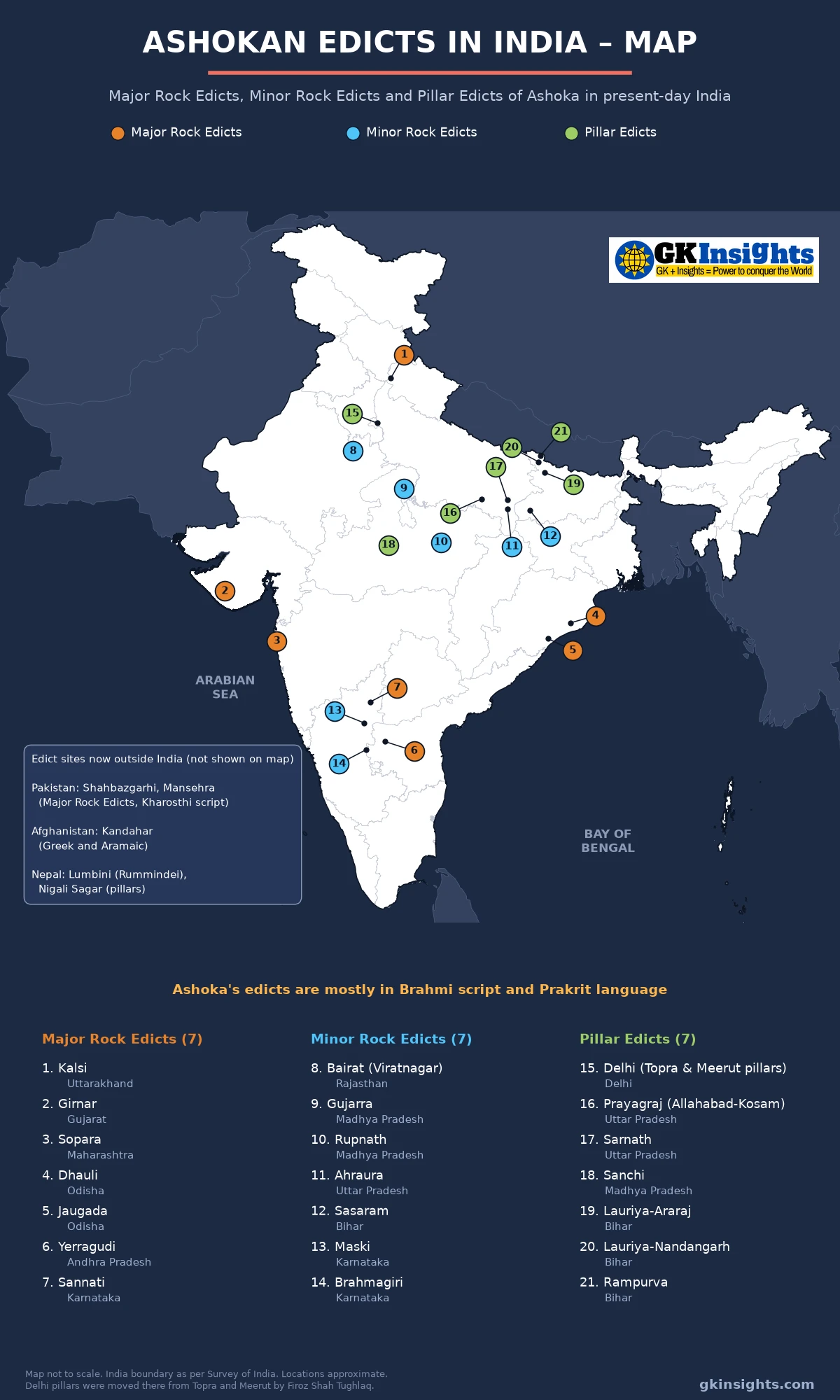
How to Read the Ashokan Edicts Map
Each site on the Ashokan edicts map has a number and a colour. The colour shows the type of inscription: Major Rock Edicts (1–7), Minor Rock Edicts (8–14) and Pillar Edicts (15–21). The tables below use the same numbers as the Ashokan edicts map.
Some places have more than one type of inscription. For example, Yerragudi has both Major and Minor Rock Edicts. On the Ashokan edicts map each place is shown under its best-known type. Sites now outside India are listed in a box on the map and are not plotted. Some sites are very close to each other, such as Lauriya-Araraj, Lauriya-Nandangarh and Rampurva in north Bihar, and Ahraura, Sarnath and Sasaram, so read their numbers carefully. Locations are approximate and the map is not to scale.
Who Was Ashoka?
Ashoka was the third ruler of the Mauryan dynasty. He was the son of Bindusara and the grandson of Chandragupta Maurya, who founded the empire in about 321 BCE. As per NCERT Class 12, Themes in Indian History Part 1, Chapter 2 (Kings, Farmers and Towns), Ashoka ruled from about 272/268 BCE to 231 BCE and is “arguably the most famous ruler of early India”. His capital was Pataliputra (near present-day Patna).
NCERT names five major political centres of the empire, all mentioned in Asokan inscriptions: the capital Pataliputra and the provincial centres of Taxila, Ujjayini, Tosali and Suvarnagiri. Ashoka conquered Kalinga (coastal Odisha) eight years after he became king. The suffering caused by this war changed his attitude, and he turned to spreading dhamma.
What Are the Ashokan Edicts?
The Ashokan edicts are messages of Ashoka to his subjects and officials, carved on stone. NCERT says Ashoka was the first ruler who inscribed his messages on stone surfaces, both natural rocks and polished pillars. He used them to proclaim what he understood to be dhamma. NCERT calls the inscriptions of Ashoka “amongst the most valuable sources” for the history of the Mauryan Empire.
In most edicts the king does not use his name. He calls himself Devanampiya (“beloved of the gods”) and Piyadassi (“pleasant to behold”). Only a few inscriptions also use the name Asoka. By matching content, style, language and script, scholars concluded that all these inscriptions were issued by the same ruler.
The edicts are usually divided into four groups: 14 Major Rock Edicts (with two Separate Kalinga Edicts), Minor Rock Edicts, seven Pillar Edicts and Minor Pillar Inscriptions. The first three are the three colours on the Ashokan edicts map.
Major Rock Edicts on the Ashokan Edicts Map (1–7)
The 14 Major Rock Edicts are long texts carved on big rocks. They are found near the edges of the empire, often near trade routes and towns. In India, they are found at seven places on the Ashokan edicts map. Outside India, they are found at Shahbazgarhi and Mansehra in Pakistan, and parts of them in Greek at Kandahar in Afghanistan.
| No. | Site | State (district) | What is found here | Notes for exams |
|---|---|---|---|---|
| 1 | Kalsi | Uttarakhand (Dehradun) | All 14 Major Rock Edicts on a single rock | Northernmost Major Rock Edict site in India; near the meeting of the Yamuna and the Tons; an elephant is drawn on the rock |
| 2 | Girnar | Gujarat (Junagadh) | All 14 Major Rock Edicts | The same rock also has the Sanskrit inscription of the Shaka ruler Rudradaman (2nd century CE) about the Sudarshana lake |
| 3 | Sopara | Maharashtra (Palghar) | Fragments of Major Rock Edicts VIII and IX | Ancient port on the west coast near Mumbai; the only Major Rock Edict site in Maharashtra |
| 4 | Dhauli | Odisha (Khordha) | Major Rock Edicts I–X and XIV, plus the two Separate Kalinga Edicts | Near Bhubaneswar, close to ancient Tosali; an elephant carved out of the rock above the edicts |
| 5 | Jaugada | Odisha (Ganjam) | Major Rock Edicts I–X and XIV, plus the two Separate Kalinga Edicts | In the conquered land of Kalinga; on the Rushikulya river |
| 6 | Yerragudi (Erragudi) | Andhra Pradesh (Kurnool) | All 14 Major Rock Edicts and also Minor Rock Edicts | One of the few sites with both major and minor rock edicts; near Gooty |
| 7 | Sannati | Karnataka (Kalaburagi) | Parts of Major Rock Edicts XII and XIV and the Separate Edicts | On the Bhima river; found in 1989 on a stone slab in a temple; an important Buddhist site |
The Separate Kalinga Edicts
At Dhauli (4) and Jaugada (5) on the Ashokan edicts map, in the conquered land of Kalinga, Major Rock Edicts XI, XII and XIII are left out. In their place are two Separate Edicts (also called the Kalinga Edicts). They are addressed to the officers (mahamattas) at Tosali and Samapa. In them Ashoka says “all men are my children” and asks the officers to be fair and avoid harsh punishment.
NCERT points out something interesting: the edict about the anguish of the king after the Kalinga war (Edict XIII) is missing in present-day Odisha. In other words, it has not been found in the region that was conquered. Historians still debate why.
Content of the 14 Major Rock Edicts
| Edict | Main content |
|---|---|
| I | Ban on the killing of animals for sacrifice and on certain festive gatherings |
| II | Medical care for people and animals; names the southern neighbours: Cholas, Pandyas, Satiyaputras and Keralaputras, and Tamraparni (Sri Lanka) |
| III | Officials (rajuka, pradeshika, yukta) to tour every five years; generosity to Brahmanas and shramanas |
| IV | The sound of the drum (bherighosha) replaced by the sound of dhamma (dhammaghosha) |
| V | Appointment of dhamma mahamattas in the 13th year of his reign |
| VI | The king is ready to hear the affairs of the people at any time (the “pativedaka” or reporter edict) |
| VII | Tolerance among all sects |
| VIII | Dhamma yatras (tours) in place of hunting trips; visit to Bodh Gaya (Sambodhi) |
| IX | Useless ceremonies criticised; dhamma ceremonies praised |
| X | The king seeks fame only through dhamma |
| XI | Explanation of dhamma |
| XII | Respect for all sects; restraint in speech |
| XIII | Kalinga war and Ashoka’s remorse; conquest by dhamma; names five Greek kings |
| XIV | Purpose of writing the edicts |
NCERT Class 12 quotes Edict XIII: when the king had been ruling for eight years, the Kalingas were conquered; “one hundred and fifty thousand men were deported, a hundred thousand were killed, and many more died.” After that, the king turned to an intense study of dhamma. Edict XIII also names five Greek (Yona) kings: Antiochus II of Syria, Ptolemy II of Egypt, Antigonus of Macedonia, Magas of Cyrene and Alexander of Epirus (or Corinth).
Minor Rock Edicts on the Ashokan Edicts Map (8–14)
The Minor Rock Edicts are shorter and more personal. In them Ashoka says he has been a lay follower (upasaka) of the Buddha for more than two and a half years, and that he became more devoted after joining the Sangha. They are found mostly in central India and the south, in Karnataka, Andhra Pradesh and Madhya Pradesh. The Minor Rock Edict sites on the Ashokan edicts map are:
| No. | Site | State (district) | What is found here | Notes for exams |
|---|---|---|---|---|
| 8 | Bairat (Viratnagar) | Rajasthan (formerly Jaipur district; now Kotputli-Behror) | Minor Rock Edict I; the Bhabru (Calcutta-Bairat) edict found nearby | The Bhabru edict shows Ashoka’s faith in the Buddha, Dhamma and Sangha and lists Buddhist texts; it is now in Kolkata |
| 9 | Gujarra | Madhya Pradesh (Datia) | Minor Rock Edict I | One of the few edicts that use the name Asoka |
| 10 | Rupnath | Madhya Pradesh (Katni) | Minor Rock Edict I | On the Kaimur hills; asks that the message be carved on rocks and pillars |
| 11 | Ahraura | Uttar Pradesh (Mirzapur) | Minor Rock Edict I | Mentions relics of the Buddha; close to Sarnath |
| 12 | Sasaram | Bihar (Rohtas) | Minor Rock Edict I | Only Minor Rock Edict site in Bihar; NCERT map calls it Sahasram |
| 13 | Maski | Karnataka (Raichur) | Minor Rock Edict I | First edict found with the name “Devanampiya Asoka” (found in 1915); this confirmed that Piyadassi was Ashoka |
| 14 | Brahmagiri | Karnataka (Chitradurga) | Minor Rock Edicts I and II | Near the nearby sites of Siddapur and Jatinga-Rameshwara; in the region of Suvarnagiri |
Other Minor Rock Edict sites, shown on the NCERT map but not numbered on our Ashokan edicts map, are Bahapur (Delhi), Palkigundu and Gavimath (Koppal), Nittur and Udegolam (Ballari), Rajula Mandagiri (Kurnool), Jatinga-Rameshwara and Siddapur (Chitradurga), and Panguraria in Madhya Pradesh.
Edicts That Name Ashoka
Most edicts use only the titles Devanampiya and Piyadassi. The personal name Asoka appears in only a few Minor Rock Edicts: Maski (Karnataka), Gujarra (Madhya Pradesh), and also Nittur and Udegolam (Karnataka). The Maski find in 1915 was very important, because it proved that the king Piyadassi of the edicts was the Ashoka of the Buddhist texts.
Pillar Edicts on the Ashokan Edicts Map (15–21)
Ashoka also set up tall polished pillars of sandstone, mostly from the Chunar quarries near Varanasi. The pillars have animal capitals such as lions and a bull. Seven Pillar Edicts are carved on some of them. The pillars are mostly in the Ganga plains, in Bihar, Uttar Pradesh and Delhi. Some pillars carry only short minor inscriptions. The pillar sites on the Ashokan edicts map are:
| No. | Site | State (district) | What is found here | Notes for exams |
|---|---|---|---|---|
| 15 | Delhi (Delhi-Topra and Delhi-Meerut pillars) | Delhi | Delhi-Topra: all seven Pillar Edicts; Delhi-Meerut: Pillar Edicts I–VI | Both pillars were moved to Delhi by Firoz Shah Tughlaq in the 14th century; Delhi-Topra stands at Feroz Shah Kotla |
| 16 | Prayagraj (Allahabad-Kosam pillar) | Uttar Pradesh (Prayagraj) | Pillar Edicts I–VI, the Queen’s Edict and the Schism Edict | Probably brought from Kaushambi (Kosam); also has Samudragupta’s Prayag Prashasti and an inscription of Jahangir |
| 17 | Sarnath | Uttar Pradesh (Varanasi) | Schism Edict (minor pillar inscription) | The lion capital of this pillar is India’s National Emblem |
| 18 | Sanchi | Madhya Pradesh (Raisen) | Schism Edict (minor pillar inscription) | Part of the Buddhist monuments at Sanchi, a UNESCO World Heritage Site |
| 19 | Lauriya-Araraj | Bihar (East Champaran) | Pillar Edicts I–VI | Pillar without its capital |
| 20 | Lauriya-Nandangarh | Bihar (West Champaran) | Pillar Edicts I–VI | Pillar still standing with its lion capital |
| 21 | Rampurva | Bihar (West Champaran) | Pillar Edicts I–VI | Two pillars: a lion capital and a bull capital (the bull capital is at Rashtrapati Bhavan) |
Only the Delhi-Topra pillar has all seven Pillar Edicts. Pillar Edict VII is found only here. It sums up Ashoka’s work for dhamma, such as planting banyan trees and mango groves, digging wells and building rest houses along roads. NCERT’s Map 2 marks Topra and Meerut as the original places of the two Delhi pillars.
Content of the Seven Pillar Edicts
| Pillar Edict | Main content |
|---|---|
| I | Protection of people according to dhamma |
| II | What dhamma is: few sins, many good deeds, kindness, truth and purity |
| III | Avoid sins like cruelty, anger and pride |
| IV | Duties and powers of the rajukas (officers) |
| V | List of animals and birds that must not be killed |
| VI | Welfare of the people as the aim of dhamma |
| VII | Summary of Ashoka’s work for dhamma; only on the Delhi-Topra pillar |
Minor Pillar Inscriptions
- Schism Edict: warns monks and nuns who try to divide the Buddhist Sangha. Found on the pillars at Sarnath (17), Sanchi (18) and Prayagraj (16).
- Queen’s Edict: on the Prayagraj pillar (16); it records the gifts of Kaluvaki (Karuvaki), the second queen and the mother of Tivara.
- Rummindei (Lumbini) pillar: in Nepal; records Ashoka’s visit to the birthplace of the Buddha in the 20th year of his reign. He made the village of Lumbini free of the bali tax and reduced its share of produce (bhaga) to one-eighth.
- Nigali Sagar pillar: in Nepal; records that Ashoka enlarged the stupa of the Konakamana Buddha (a Buddha of the past).
Scripts and Languages of Ashokan Edicts
NCERT explains the languages and scripts of the Ashokan edicts as follows:
| Region | Language | Script |
|---|---|---|
| Most of India (all sites on the Ashokan edicts map) | Prakrit | Brahmi |
| North-west (Shahbazgarhi, Mansehra in Pakistan) | Prakrit | Kharosthi |
| Afghanistan (Kandahar, Laghman) | Greek and Aramaic | Greek and Aramaic |
All 21 sites on the Ashokan edicts map use Brahmi. Brahmi was written from left to right. NCERT says most scripts used to write modern Indian languages are derived from Brahmi. Kharosthi, used in the north-west, was written from right to left. The Kandahar bilingual rock inscription (found in 1958) has the same message in Greek and Aramaic.
James Prinsep and the Decipherment of Brahmi
The edicts could not be read for centuries. James Prinsep, an officer in the mint of the East India Company in Calcutta and Secretary of the Asiatic Society of Bengal, deciphered Brahmi and Kharosthi in the 1830s. He read Asokan Brahmi in 1837–38; NCERT gives the year as 1838, while many exam books say 1837. He found that most inscriptions mentioned a king called Piyadassi.
Kharosthi was read with the help of Indo-Greek coins that had kings’ names in both Greek and Kharosthi, and Prinsep identified its language as Prakrit. The link between Piyadassi and Ashoka was finally confirmed by the Maski edict in 1915. This is why every site on the Ashokan edicts map can now be read.
Ashoka’s Dhamma in the Edicts
The message of dhamma is the common thread that links all the sites on the Ashokan edicts map.
According to NCERT, Ashoka’s dhamma included respect towards elders, generosity towards Brahmanas and those who renounced worldly life, treating slaves and servants kindly, and respect for religions and traditions other than one’s own. NCERT says its principles were simple and virtually universally applicable.
- Dhamma mahamattas: special officers appointed to spread the message of dhamma (Major Rock Edict V).
- Welfare work: medical care for people and animals, wells, shade trees and rest houses (Major Rock Edict II, Pillar Edict VII).
- Non-violence: limits on killing animals (Major Rock Edict I, Pillar Edict V).
- Tolerance: respect for all sects and restraint in speech (Major Rock Edicts VII and XII).
- Conquest by dhamma (dhamma vijaya): preferred to conquest by war (Major Rock Edict XIII).
Dhamma was not the same as Buddhism. Ashoka was personally a Buddhist, as the Minor Rock Edicts show, but his dhamma was a moral code for everyone. The Buddha and the Sangha are mentioned mainly in the Minor Rock Edicts and minor pillar inscriptions.
Ashokan Edict Sites Outside India
These sites are not marked on the Ashokan edicts map above, which uses India’s official outline, but they are listed in a box on the map. NCERT says the same message was engraved everywhere, from the North West Frontier Province of Pakistan to Andhra Pradesh, Odisha and Uttarakhand.
| Site | Country | Type | Language / script |
|---|---|---|---|
| Shahbazgarhi | Pakistan (Khyber Pakhtunkhwa, Mardan) | Major Rock Edicts I–XIV | Prakrit in Kharosthi |
| Mansehra | Pakistan (Khyber Pakhtunkhwa) | Major Rock Edicts I–XIV | Prakrit in Kharosthi |
| Kandahar | Afghanistan | Bilingual rock inscription; parts of Major Rock Edicts XII and XIII | Greek and Aramaic |
| Taxila and Laghman | Pakistan; Afghanistan | Short inscriptions | Aramaic |
| Lumbini (Rummindei) | Nepal | Minor pillar inscription | Prakrit in Brahmi |
| Nigali Sagar | Nepal | Minor pillar inscription | Prakrit in Brahmi |
Site-wise Facts: Quick Revision Table
Use this table with the Ashokan edicts map for quick revision. The numbers in brackets match the Ashokan edicts map; sites without a number are outside India.
| Fact | Site |
|---|---|
| All seven Pillar Edicts | Delhi-Topra (15) |
| Name “Asoka” in the edict | Maski (13), Gujarra (9) |
| Separate Kalinga Edicts | Dhauli (4), Jaugada (5) |
| Rudradaman’s inscription on the same rock | Girnar (2) |
| Queen’s Edict, Samudragupta’s Prayag Prashasti | Prayagraj (16) |
| Lion capital used as National Emblem | Sarnath (17) |
| Bhabru edict on Buddhist texts | Bairat (8) |
| Major and Minor Rock Edicts at one place | Yerragudi (6) |
| Lion capital still on the pillar | Lauriya-Nandangarh (20) |
| Bull capital | Rampurva (21) |
| Kharosthi script | Shahbazgarhi, Mansehra |
| Greek and Aramaic | Kandahar |
| Birthplace of the Buddha, tax relief | Lumbini (Rummindei) |
You can see that the edict sites lie along the routes and centres of the empire. The Mauryas came long after the Harappan cities; see our Harappan sites map and the posts on Neolithic sites in India, Mesolithic sites and Palaeolithic sites for earlier periods. Sanchi, with its Ashokan pillar, is one of the UNESCO World Heritage Sites in India (see the UNESCO page on the Buddhist Monuments at Sanchi). The Archaeological Survey of India (ASI) protects most of the edict sites in India.
UPSC Practice Points on Ashokan Edicts Map
Read these points along with the Ashokan edicts map. They cover facts often asked in UPSC and State PSC papers.
- Ashoka ruled from about 272/268 BCE to 231 BCE (NCERT) and conquered Kalinga in the eighth year of his reign.
- In the edicts Ashoka calls himself Devanampiya Piyadassi. The name Asoka appears in the Minor Rock Edicts at Maski and Gujarra (and also Nittur and Udegolam).
- There are 14 Major Rock Edicts. The Kalinga war is described in Major Rock Edict XIII.
- At Dhauli and Jaugada in Odisha, Edicts XI–XIII are replaced by two Separate Kalinga Edicts.
- Major Rock Edict II names the Cholas, Pandyas, Satiyaputras, Keralaputras and Tamraparni.
- There are seven Pillar Edicts; only the Delhi-Topra pillar has all seven.
- The Schism Edict is on the pillars at Sarnath, Sanchi and Prayagraj; the Queen’s Edict is only on the Prayagraj pillar.
- The Rummindei pillar in Lumbini records Ashoka’s visit to the Buddha’s birthplace and a cut in the land tax.
- Most edicts are in Prakrit in the Brahmi script; those in the north-west are in Kharosthi, and those in Afghanistan in Greek and Aramaic.
- James Prinsep deciphered Asokan Brahmi in 1837–38 (NCERT: 1838).
- Girnar in Gujarat has both Ashoka’s Major Rock Edicts and the inscription of Rudradaman.
- The rivers of India map helps place the sites: Kalsi near the Yamuna, Jaugada on the Rushikulya, Sannati on the Bhima and Prayagraj on the Ganga.
FAQs on Ashokan Edicts Map
How many Ashokan edict sites are shown on the Ashokan edicts map?
The Ashokan edicts map above shows 21 sites in present-day India: seven Major Rock Edict sites, seven Minor Rock Edict sites and seven Pillar Edict sites. Sites in Pakistan, Afghanistan and Nepal are listed separately.
What are the Major Rock Edicts of Ashoka?
The Major Rock Edicts are a set of 14 edicts carved on large rocks. In India they are found at Kalsi, Girnar, Sopara, Dhauli, Jaugada, Yerragudi and Sannati. Outside India they are found at Shahbazgarhi and Mansehra (Pakistan), and parts in Greek at Kandahar (Afghanistan).
Which Ashokan edict describes the Kalinga war?
Major Rock Edict XIII describes the Kalinga war. It says 150,000 people were deported, 100,000 were killed and many more died, and it records Ashoka’s remorse.
In which inscriptions is the name Ashoka mentioned?
The name Asoka is mentioned in a few Minor Rock Edicts, mainly at Maski in Karnataka and Gujarra in Madhya Pradesh, and also at Nittur and Udegolam in Karnataka. Other edicts use the titles Devanampiya and Piyadassi.
Which pillar has all seven Pillar Edicts of Ashoka?
The Delhi-Topra pillar, brought from Topra in Haryana to Delhi by Firoz Shah Tughlaq, is the only pillar with all seven Pillar Edicts.
Who deciphered the Brahmi script of Ashoka’s edicts?
James Prinsep, an officer of the East India Company’s mint, deciphered Asokan Brahmi in 1837–38. NCERT gives the year 1838.
Where are the Separate Kalinga Edicts found?
The two Separate Kalinga Edicts are found at Dhauli in Khordha district and Jaugada in Ganjam district of Odisha. They replace Major Rock Edicts XI, XII and XIII at these sites.
Also Check:
– Harappan Sites in India – Map
– Neolithic Sites in India – Map
– Mesolithic Sites in India – Map
– Palaeolithic Sites in India – Map
– UNESCO World Heritage Sites in India Map