
This post gives the thermal power plants in India map with 34 major coal, lignite and gas-based power stations, numbered and grouped by fuel. You will also learn how a thermal plant works, its types, the largest plants, installed capacity, UMPPs and emission norms for UPSC and State PSC exams.
Thermal power is still the backbone of India’s electricity. Study the thermal power plants in India map along with the coalfields, rivers and ports, and the location of each plant will make sense.
Thermal Power Plants in India Map
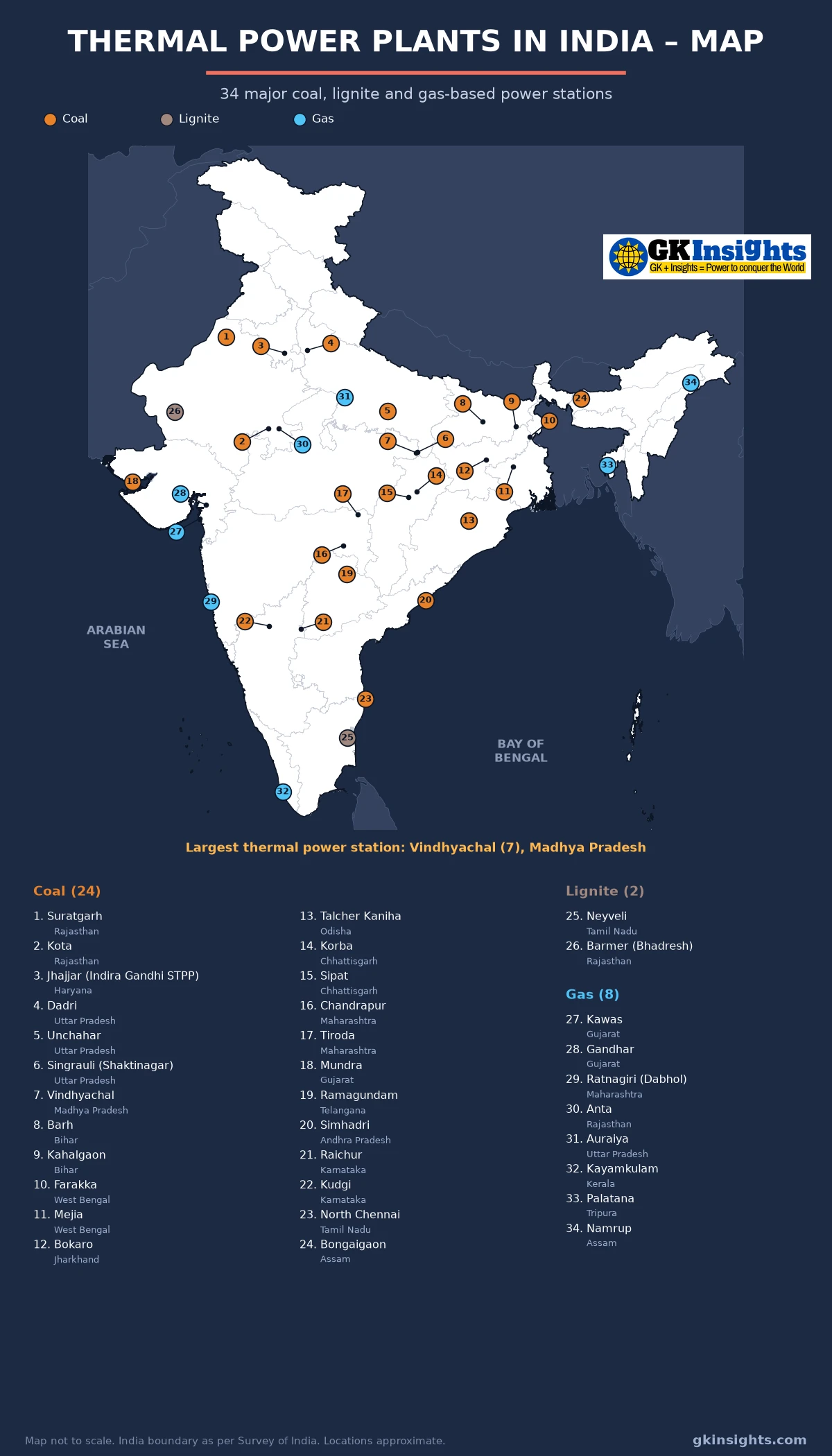
On the thermal power plants in India map above, orange dots are coal-based plants (1 to 24), brown dots are lignite-based plants (25 and 26) and blue dots are gas-based plants (27 to 34). Vindhyachal (7) in Madhya Pradesh, the largest thermal power station in India, is highlighted. Locations are approximate and the map is not to scale.
Look at the pattern on the thermal power plants in India map. Most coal plants sit in a belt from Uttar Pradesh and Bihar through Jharkhand, Odisha and Chhattisgarh. This is where India’s big coalfields are. Other plants sit on the coast, where imported coal or gas arrives by ship, or near big cities that need power.
What is a Thermal Power Plant?
A thermal power plant makes electricity from heat. It burns a fuel such as coal, lignite, gas or diesel. The heat turns water into high-pressure steam, and the steam spins a turbine. The turbine turns a generator, and the generator produces electricity.
So the energy changes form step by step: fuel becomes heat, heat becomes motion and motion becomes electricity. Every plant on the thermal power plants in India map works on this idea.
How a Coal-Based Thermal Power Plant Works
- Boiler: Coal is crushed into a fine powder and burnt in a furnace. The heat turns water in the boiler tubes into very hot, high-pressure steam.
- Turbine and generator: The steam spins the turbine, which turns the generator to produce electricity for the grid.
- Condenser and cooling tower: The used steam is cooled back into water and pumped to the boiler again. The cooling water gives its heat to the air in the cooling tower or is taken from a river, canal or the sea.
- Chimney and ash handling: Flue gases pass through electrostatic precipitators that catch fly ash, and then leave through a tall chimney. Ash is stored in ash ponds or used for cement and bricks.
This closed loop of water and steam is called the Rankine cycle. Modern supercritical and ultra-supercritical units work at higher pressure and temperature, so they burn less coal per unit of power.
How a Gas-Based Combined Cycle Plant Works
Most gas plants in India are combined cycle plants. Natural gas is burnt in a gas turbine, which drives a generator. The hot exhaust gas from the turbine is then used in a heat recovery boiler to make steam, which runs a second steam turbine. Using the heat twice makes these plants more efficient, and they can start quickly to meet peak demand. The blue dots on the thermal power plants in India map are such plants.
Types of Thermal Power Plants in India
| Type | Fuel | Where found | Example |
|---|---|---|---|
| Coal-based | Coal, mostly Indian; some coastal plants use imported coal | Near coalfields (pithead), on the coast or near cities | Vindhyachal, Talcher Kaniha, Mundra |
| Lignite-based | Lignite (brown coal), a low-grade, moist coal | Next to lignite mines | Neyveli (Tamil Nadu), Barmer (Rajasthan) |
| Gas-based | Natural gas or imported LNG; some can use naphtha | Along gas pipelines and near LNG terminals | Kawas, Gandhar, Ratnagiri (Dabhol) |
| Oil/diesel-based | Diesel or fuel oil | Islands and remote areas off the main grid | Diesel sets in Andaman and Nicobar Islands and Lakshadweep |
Coal plants are the largest group by far, which is why 24 of the 34 dots on the thermal power plants in India map are coal plants. Lignite is found mainly in Tamil Nadu, Rajasthan and Gujarat. Gas plants are limited by the supply and price of gas. Diesel is costly and used only on a small scale.
Note on nuclear power: A nuclear power plant also makes steam to run a turbine, so in a strict scientific sense it is a thermal plant. But in India’s official data, nuclear power is counted separately from thermal power and is treated as non-fossil energy. Nuclear plants are therefore not shown on the thermal power plants in India map. See our post on Nuclear Power Plants in India – Map and List. Hydro plants, which use falling water, are covered in Hydro Power Plants in India – Map and List.
Coal-Based Plants on the Thermal Power Plants in India Map (1–24)
The table below lists the 24 coal-based stations on the thermal power plants in India map, from north to south and then the North-East. Capacities are installed capacities from the operators’ websites. Where two plants share a site, this is noted in the key fact.
| No. | Plant | State | Fuel | Operator | Capacity (MW) | Key fact |
|---|---|---|---|---|---|---|
| 1 | Suratgarh | Rajasthan | Coal | RVUNL (Rajasthan state) | 2,820 | Two stations at one site in Sri Ganganagar district: six 250 MW units and two 660 MW supercritical units |
| 2 | Kota | Rajasthan | Coal | RVUNL (Rajasthan state) | 1,240 | On the bank of the Chambal river in Kota city |
| 3 | Jhajjar (Indira Gandhi STPP) | Haryana | Coal | Aravali Power Company (NTPC joint venture with Haryana and Delhi) | 1,500 | Three 500 MW units supplying Haryana and Delhi |
| 4 | Dadri | Uttar Pradesh | Coal (also gas) | NTPC | 1,840 (coal) + 830 (gas) | Near Delhi in Gautam Buddh Nagar district; has both coal and gas units |
| 5 | Unchahar (Feroze Gandhi) | Uttar Pradesh | Coal | NTPC | 1,550 | In Raebareli district; built by the Uttar Pradesh state board and later taken over by NTPC |
| 6 | Singrauli (Shaktinagar) | Uttar Pradesh | Coal | NTPC | 2,000 | NTPC’s first power station; its first unit began generation on 13 February 1982 |
| 7 | Vindhyachal | Madhya Pradesh | Coal | NTPC | 4,760 | Largest thermal power station in India; in Singrauli district near the Singrauli coalfield |
| 8 | Barh | Bihar | Coal | NTPC | 3,300 | Five 660 MW units on the bank of the Ganga in Patna district |
| 9 | Kahalgaon | Bihar | Coal | NTPC | 2,340 | On the Ganga in Bhagalpur district |
| 10 | Farakka | West Bengal | Coal | NTPC | 2,100 | In Murshidabad district, near the Farakka Barrage on the Ganga |
| 11 | Mejia | West Bengal | Coal | Damodar Valley Corporation (DVC) | 2,340 | Largest station of DVC, in Bankura district |
| 12 | Bokaro | Jharkhand | Coal | Damodar Valley Corporation (DVC) | 500 | The new 500 MW Bokaro ‘A’ unit (commercial operation 2017) in the Damodar valley coal belt |
| 13 | Talcher Kaniha | Odisha | Coal | NTPC | 3,000 | Six 500 MW units; pithead plant on the Talcher coalfield in Angul district |
| 14 | Korba | Chhattisgarh | Coal | NTPC | 2,600 | Pithead plant on the Korba coalfield; the Korba area has several other state and private plants too |
| 15 | Sipat | Chhattisgarh | Coal | NTPC | 2,980 | In Bilaspur district; three 660 MW supercritical units and two 500 MW units |
| 16 | Chandrapur | Maharashtra | Coal | Mahagenco (Maharashtra state) | 2,920 | Largest station of Mahagenco, in the Wardha valley coal belt |
| 17 | Tiroda | Maharashtra | Coal | Adani Power | 3,300 | Five 660 MW supercritical units in Gondia district; largest thermal plant in Maharashtra |
| 18 | Mundra | Gujarat | Coal (mainly imported) | Adani Power; Tata Power (UMPP) | 4,620 (Adani) + 4,150 (Tata UMPP) | Two large coastal plants in Kutch district; Tata’s plant was India’s first Ultra Mega Power Project |
| 19 | Ramagundam | Telangana | Coal | NTPC | 2,600 | On the Godavari in Peddapalli district; NTPC’s 1,600 MW Telangana plant and a 100 MW floating solar plant are at the same site |
| 20 | Simhadri | Andhra Pradesh | Coal | NTPC | 2,000 | Coastal plant near Visakhapatnam with four 500 MW units; a 25 MW floating solar plant runs on its reservoir |
| 21 | Raichur | Karnataka | Coal | KPCL (Karnataka state) | 1,720 | Near the Krishna river in Raichur district |
| 22 | Kudgi | Karnataka | Coal | NTPC | 2,400 | Three 800 MW units in Vijayapura district; NTPC’s first 800 MW unit was commissioned here in December 2016 |
| 23 | North Chennai | Tamil Nadu | Coal | TNPGCL (Tamil Nadu state) | About 2,630 (three stages) | Coastal plant near Ennore in three stages; Stage III is a single 800 MW supercritical unit |
| 24 | Bongaigaon | Assam | Coal | NTPC | 750 | At Salakati in Kokrajhar district; the only coal-based station in the North-East region |
Notice that NTPC runs 14 of the 24 coal plants on the thermal power plants in India map, and Jhajjar is an NTPC joint venture. NTPC is India’s largest power company and runs 27 coal stations with 54,750 MW of capacity on its own, as per its official list of coal stations.
Lignite and Gas Plants on the Thermal Power Plants in India Map (25–34)
Lignite-Based Plants
| No. | Plant | State | Fuel | Operator | Capacity (MW) | Key fact |
|---|---|---|---|---|---|---|
| 25 | Neyveli | Tamil Nadu | Lignite | NLC India | About 3,390 (all units) | Largest lignite-based power complex in India, fed by the Neyveli lignite mines in Cuddalore district |
| 26 | Barmer (Bhadresh) | Rajasthan | Lignite | JSW Energy (formerly Raj WestPower) | 1,080 | Eight 135 MW units using lignite from the Kapurdi and Jalipa mines |
Lignite has a lot of moisture and gives less heat than coal, so it is burnt right next to the mine. That is why both lignite plants on the thermal power plants in India map sit on lignite fields.
Gas-Based Plants
| No. | Plant | State | Fuel | Operator | Capacity (MW) | Key fact |
|---|---|---|---|---|---|---|
| 27 | Kawas | Gujarat | Gas | NTPC | 656 | Combined cycle plant in Surat district |
| 28 | Gandhar (Jhanor) | Gujarat | Gas | NTPC | 657 | In Bharuch district near the Gandhar gas field |
| 29 | Ratnagiri (Dabhol) | Maharashtra | Gas (LNG) | Ratnagiri Gas and Power Pvt Ltd (NTPC group) | 1,967 | Largest gas plant on this map; it took over the old Dabhol project and runs on imported LNG |
| 30 | Anta | Rajasthan | Gas | NTPC | 419 | NTPC’s first gas-based combined cycle plant (1989), in Baran district |
| 31 | Auraiya | Uttar Pradesh | Gas | NTPC | 663 | In Auraiya district, supplied by the Hazira–Vijaipur–Jagdishpur gas pipeline |
| 32 | Kayamkulam | Kerala | Naphtha / gas | NTPC (Rajiv Gandhi CCPP) | 360 | Built to run on naphtha, later fitted for LNG; mostly idle since 2017 because its fuel is costly |
| 33 | Palatana | Tripura | Gas | ONGC Tripura Power Company | 726.6 | Two 363.3 MW blocks in Gomati district; largest gas plant in the North-East |
| 34 | Namrup | Assam | Gas | APGCL (Assam state) | About 139 (41 + 98.4) | In Dibrugarh district; APGCL calls it the first gas-based power station in South-East Asia |
On the thermal power plants in India map, the gas plants follow the gas supply. Kawas and Gandhar are near Gujarat’s gas fields and LNG terminals, Anta and Auraiya lie along the HVJ pipeline, and Palatana and Namrup use gas from Tripura and Upper Assam.
State-wise List of Thermal Power Plants in India Map
This state-wise list groups all 34 plants on the thermal power plants in India map. The numbers in brackets are the numbers used on the map.
| State | Plants on the map |
|---|---|
| Uttar Pradesh | Dadri (4), Unchahar (5), Singrauli (6), Auraiya (31) |
| Rajasthan | Suratgarh (1), Kota (2), Barmer (26), Anta (30) |
| Gujarat | Mundra (18), Kawas (27), Gandhar (28) |
| Maharashtra | Chandrapur (16), Tiroda (17), Ratnagiri (29) |
| Bihar | Barh (8), Kahalgaon (9) |
| West Bengal | Farakka (10), Mejia (11) |
| Chhattisgarh | Korba (14), Sipat (15) |
| Karnataka | Raichur (21), Kudgi (22) |
| Tamil Nadu | North Chennai (23), Neyveli (25) |
| Assam | Bongaigaon (24), Namrup (34) |
| Haryana | Jhajjar (3) |
| Madhya Pradesh | Vindhyachal (7) |
| Jharkhand | Bokaro (12) |
| Odisha | Talcher Kaniha (13) |
| Telangana | Ramagundam (19) |
| Andhra Pradesh | Simhadri (20) |
| Kerala | Kayamkulam (32) |
| Tripura | Palatana (33) |
Uttar Pradesh and Rajasthan have the most plants on the thermal power plants in India map, with four each. This list counts only the mapped plants, not every plant in each state.
Largest Plants and Records on the Thermal Power Plants in India Map
| Record | Plant | Detail |
|---|---|---|
| Largest thermal power station in India | Vindhyachal, Madhya Pradesh | 4,760 MW (NTPC) |
| Largest private thermal power plant | Adani Mundra, Gujarat | 4,620 MW, coastal plant using mostly imported coal |
| First Ultra Mega Power Project | Tata Power Mundra, Gujarat | 4,150 MW, five 830 MW supercritical units |
| First 800 MW unit of NTPC | Kudgi, Karnataka | Commissioned in December 2016 |
| Largest lignite-based complex | Neyveli, Tamil Nadu | About 3,390 MW (NLC India) |
| Largest gas plant on the map | Ratnagiri (Dabhol), Maharashtra | 1,967 MW |
Among other big plants not on the map, NTPC’s Rihand (3,000 MW) in Uttar Pradesh sits close to Singrauli and Vindhyachal. Reliance Power’s Sasan UMPP (3,960 MW) is also in Singrauli district of Madhya Pradesh. This small area has so much capacity that it is often called the energy capital of India, and it shows up as a cluster on the thermal power plants in India map.
Installed Thermal Power Capacity of India
The Central Electricity Authority (CEA) publishes India’s installed capacity every month. The figures below are from the CEA installed capacity report as on 30 September 2026. The thermal power plants in India map shows only major stations, but these figures cover every plant.
| Source | Installed capacity (MW) | Share of total |
|---|---|---|
| Coal | 2,25,067.51 | about 40.3% |
| Lignite | 6,370 | about 1.1% |
| Gas | 19,144.01 | about 3.4% |
| Diesel | 288.34 | about 0.05% |
| Total thermal | 2,50,869.87 | about 44.9% |
| Nuclear | 8,780 | about 1.6% |
| Hydro (large) | 52,064.66 | about 9.3% |
| Renewable energy sources (solar, wind, small hydro, biomass) | 2,47,181.87 | about 44.2% |
| All India total | 5,58,896.39 | 100% |
- Thermal power is less than half of India’s installed capacity now. Non-fossil sources make up about 55% of capacity.
- But thermal plants still produce most of the electricity, because solar and wind work only when the sun shines or the wind blows. The Ministry of Power told Parliament in July 2026 that coal and lignite plants supplied 69.54% of the electricity from April to June 2026.
- Coal capacity is split almost equally between central, state and private plants (about 75,000, 77,000 and 73,000 MW).
- India added 9,470 MW of thermal capacity in 2025–26.
- CEA leaves out plants shut for a long time, mostly gas plants without fuel.
Ultra Mega Power Projects (UMPPs)
The Ministry of Power launched the Ultra Mega Power Projects scheme in 2005–06. Each UMPP was to be a very large coal plant of about 4,000 MW or more, using supercritical technology, at a coal mine (pithead) or on the coast (for imported coal).
- Projects were given to private companies through tariff-based competitive bidding, on a build-own-operate basis.
- Power Finance Corporation (PFC) was the nodal agency, and CEA was the technical partner.
- Four UMPPs were awarded: Mundra (Gujarat), Sasan (Madhya Pradesh), Krishnapatnam (Andhra Pradesh) and Tilaiya (Jharkhand).
- Only two are running today: Mundra of Tata Power (4,150 MW) and Sasan of Reliance Power (3,960 MW, with its own coal mines).
- The government has since decided not to take up new UMPPs, and other planned projects are being closed.
Environmental Issues of Thermal Power Plants
- Air pollution: Burning coal releases particulate matter (fine dust), sulphur dioxide (SO2), nitrogen oxides (NOx) and mercury. These harm health and cause acid rain.
- Climate change: Coal plants are the largest single source of carbon dioxide emissions in India.
- Fly ash: Indian coal has high ash content. The ash has to be stored in ash ponds or used for cement, bricks and road building.
- Water use: Plants need a lot of water for cooling, and warm discharge water harms river life.
Emission Norms and FGD
In December 2015, the Ministry of Environment, Forest and Climate Change (MoEFCC) set new emission limits for coal plants for particulate matter, SO2, NOx, mercury and water use. To cut SO2, plants have to fit Flue Gas Desulphurisation (FGD) units, which use limestone to remove sulphur from the flue gas. The deadlines were extended many times.
In July 2025, the rules were changed to a three-category system:
| Category | Which plants | SO2 rule |
|---|---|---|
| A | Within 10 km of the National Capital Region or cities with a population of over 10 lakh | Must meet SO2 norms by 31 December 2027 |
| B | Within 10 km of critically polluted areas or non-attainment cities | Decided case by case; deadline 31 December 2028 |
| C | All other plants | SO2 norms do not apply, but chimney height norms must be met by 31 December 2029 |
Plants that miss the deadline pay environmental compensation per unit of power. Under CEA rules of 2023, coal plants must also be able to run down to 40% of capacity so that more solar and wind power can enter the grid.
UPSC Practice Points on Thermal Power Plants in India Map
Read these points along with the thermal power plants in India map.
- Singrauli, Vindhyachal, Rihand and Sasan are all in the Singrauli coal belt on the Uttar Pradesh–Madhya Pradesh border.
- Kawas and Gandhar (Gujarat), Anta (Rajasthan) and Auraiya (Uttar Pradesh) are NTPC gas plants.
- Barh, Kahalgaon and Farakka stand on the Ganga, and Ramagundam stands on the Godavari.
- Pithead plants (Korba, Talcher Kaniha, Singrauli) avoid carrying coal; coastal plants (Mundra, Simhadri, North Chennai) can use imported coal and sea water.
FAQs on Thermal Power Plants in India Map
Which is the largest thermal power plant in India?
Vindhyachal Super Thermal Power Station of NTPC in Singrauli district, Madhya Pradesh, is the largest thermal power plant in India, with an installed capacity of 4,760 MW.
Which is the largest private thermal power plant in India?
Adani Power’s Mundra plant in Kutch, Gujarat, with 4,620 MW, is the largest private thermal power plant in India. It is number 18 on the thermal power plants in India map.
Which was the first power station of NTPC?
Singrauli Super Thermal Power Station in Uttar Pradesh was NTPC’s first power station. Its first unit began generation on 13 February 1982.
What is an Ultra Mega Power Project?
An Ultra Mega Power Project is a very large coal plant of about 4,000 MW or more using supercritical technology, awarded through competitive bidding. Mundra (Gujarat) and Sasan (Madhya Pradesh) are the two UMPPs in operation.
What is the share of thermal power in India’s installed capacity?
As on 30 September 2026, thermal power (coal, lignite, gas and diesel) had an installed capacity of 2,50,869.87 MW, about 44.9% of India’s total capacity of 5,58,896.39 MW, as per CEA.
What is FGD in thermal power plants?
FGD means Flue Gas Desulphurisation. It is a system that removes sulphur dioxide from the flue gas of coal plants, usually by using limestone, before the gas leaves the chimney.
Also Check:
– Nuclear Power Plants in India – Map and List
– Hydro Power Plants in India – Map and List
– Major Dams in India – Map and List
– Major Ports in India – Map and List
– Soil Types in India – Map