
India has 45 places on the UNESCO World Heritage List: 37 cultural, 7 natural and 1 mixed. They range from the Harappan city of Dholavira and the rock shelters of Bhimbetka to Mughal monuments, colonial railway stations, Himalayan national parks and the mangroves of the Sundarbans. This post gives a UNESCO World Heritage Sites in India map, a state-wise list of all 45 sites with the year each was inscribed, type-wise lists, the first and the newest sites, serial and transnational sites, and the facts that are asked most often in UPSC Prelims, State PSC and other competitive exams.
UNESCO World Heritage Sites in India Map
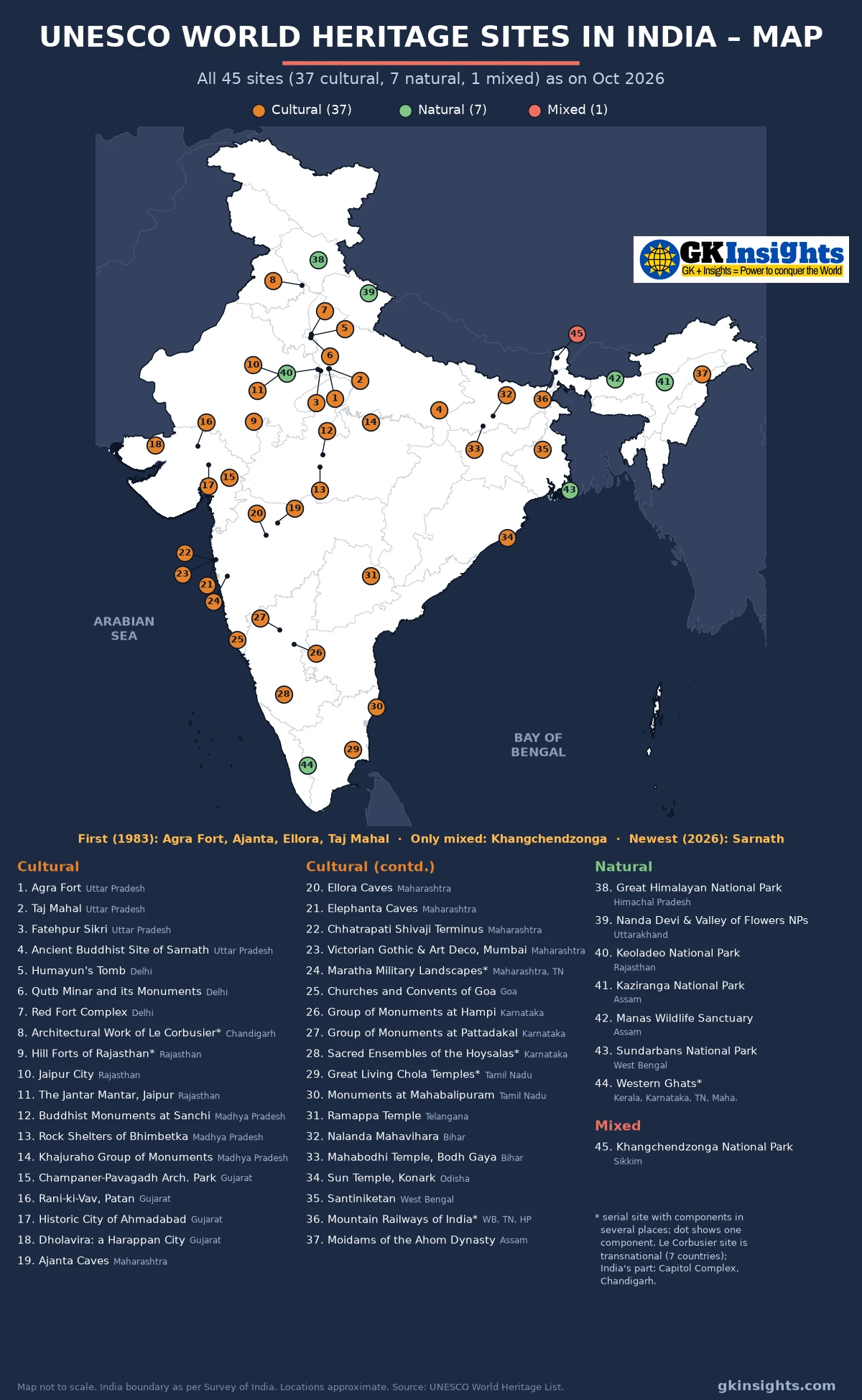
The map above marks all 45 World Heritage properties of India, coloured as cultural, natural or mixed. Serial sites with parts in several places, such as the Western Ghats, are shown with one dot.
What is a UNESCO World Heritage Site?
A World Heritage Site is a cultural or natural place that the World Heritage Committee has judged to have “Outstanding Universal Value”, which means its importance goes beyond national borders and it is treated as part of the shared heritage of humanity. The list is kept under the Convention concerning the Protection of the World Cultural and Natural Heritage, adopted by UNESCO in 1972 and usually called the World Heritage Convention. India ratified the Convention on 14 November 1977.
Sites are of three types. Cultural sites are monuments, groups of buildings or sites made by people. Natural sites are areas of natural beauty, geology, ecology or biodiversity. Mixed sites meet at least one cultural and one natural criterion.
How a Site Gets Inscribed
- Tentative List: a country first puts a place on its Tentative List, an inventory of sites it plans to nominate. India has 81 sites on its Tentative List, according to the UNESCO India page.
- Nomination: the country prepares a nomination dossier showing why the site has Outstanding Universal Value and how it is protected and managed.
- Evaluation: two Advisory Bodies named in the Convention evaluate the nomination. ICOMOS (International Council on Monuments and Sites) evaluates cultural and mixed sites, and IUCN (International Union for Conservation of Nature) evaluates natural sites. A third Advisory Body, ICCROM, advises on the conservation of cultural property.
- Decision: the World Heritage Committee, made up of 21 States Parties elected by the General Assembly of the Convention, meets once a year and decides whether to inscribe the site.
To be inscribed, a site must meet at least one of ten selection criteria. Criteria (i) to (vi) are cultural and criteria (vii) to (x) are natural.
List of UNESCO World Heritage Sites in India (State-wise)
The table below lists all 45 sites by state, with the year of inscription as given on the official UNESCO World Heritage page for India. Where two or three years are given, the property was extended later.
| No. | Site | State / UT | Year | Type |
|---|---|---|---|---|
| 1 | Kaziranga National Park | Assam | 1985 | Natural |
| 2 | Manas Wildlife Sanctuary | Assam | 1985 | Natural |
| 3 | Moidams – the Mound-Burial System of the Ahom Dynasty (Charaideo) | Assam | 2024 | Cultural |
| 4 | Mahabodhi Temple Complex at Bodh Gaya | Bihar | 2002 | Cultural |
| 5 | Archaeological Site of Nalanda Mahavihara at Nalanda | Bihar | 2016 | Cultural |
| 6 | The Architectural Work of Le Corbusier (Capitol Complex, Chandigarh) | Chandigarh | 2016 | Cultural |
| 7 | Humayun’s Tomb, Delhi | Delhi | 1993 | Cultural |
| 8 | Qutb Minar and its Monuments, Delhi | Delhi | 1993 | Cultural |
| 9 | Red Fort Complex | Delhi | 2007 | Cultural |
| 10 | Churches and Convents of Goa | Goa | 1986 | Cultural |
| 11 | Champaner-Pavagadh Archaeological Park | Gujarat | 2004 | Cultural |
| 12 | Rani-ki-Vav (the Queen’s Stepwell) at Patan | Gujarat | 2014 | Cultural |
| 13 | Historic City of Ahmadabad | Gujarat | 2017 | Cultural |
| 14 | Dholavira: a Harappan City | Gujarat | 2021 | Cultural |
| 15 | Great Himalayan National Park Conservation Area | Himachal Pradesh | 2014 | Natural |
| 16 | Group of Monuments at Hampi | Karnataka | 1986 | Cultural |
| 17 | Group of Monuments at Pattadakal | Karnataka | 1987 | Cultural |
| 18 | Sacred Ensembles of the Hoysalas | Karnataka | 2023 | Cultural |
| 19 | Khajuraho Group of Monuments | Madhya Pradesh | 1986 | Cultural |
| 20 | Buddhist Monuments at Sanchi | Madhya Pradesh | 1989 | Cultural |
| 21 | Rock Shelters of Bhimbetka | Madhya Pradesh | 2003 | Cultural |
| 22 | Ajanta Caves | Maharashtra | 1983 | Cultural |
| 23 | Ellora Caves | Maharashtra | 1983 | Cultural |
| 24 | Elephanta Caves | Maharashtra | 1987 | Cultural |
| 25 | Chhatrapati Shivaji Terminus (formerly Victoria Terminus) | Maharashtra | 2004 | Cultural |
| 26 | Victorian Gothic and Art Deco Ensembles of Mumbai | Maharashtra | 2018 | Cultural |
| 27 | Maratha Military Landscapes of India | Maharashtra and Tamil Nadu | 2025 | Cultural |
| 28 | Sun Temple, Konark | Odisha | 1984 | Cultural |
| 29 | Keoladeo National Park | Rajasthan | 1985 | Natural |
| 30 | The Jantar Mantar, Jaipur | Rajasthan | 2010 | Cultural |
| 31 | Hill Forts of Rajasthan | Rajasthan | 2013 | Cultural |
| 32 | Jaipur City, Rajasthan | Rajasthan | 2019 | Cultural |
| 33 | Khangchendzonga National Park | Sikkim | 2016 | Mixed |
| 34 | Group of Monuments at Mahabalipuram | Tamil Nadu | 1984 | Cultural |
| 35 | Great Living Chola Temples | Tamil Nadu | 1987, 2004 | Cultural |
| 36 | Kakatiya Rudreshwara (Ramappa) Temple | Telangana | 2021 | Cultural |
| 37 | Agra Fort | Uttar Pradesh | 1983 | Cultural |
| 38 | Taj Mahal | Uttar Pradesh | 1983 | Cultural |
| 39 | Fatehpur Sikri | Uttar Pradesh | 1986 | Cultural |
| 40 | Ancient Buddhist Site of Sarnath | Uttar Pradesh | 2026 | Cultural |
| 41 | Nanda Devi and Valley of Flowers National Parks | Uttarakhand | 1988, 2005 | Natural |
| 42 | Sundarbans National Park | West Bengal | 1987 | Natural |
| 43 | Santiniketan | West Bengal | 2023 | Cultural |
| 44 | Mountain Railways of India | West Bengal, Tamil Nadu and Himachal Pradesh | 1999, 2005, 2008 | Cultural |
| 45 | Western Ghats | Maharashtra, Karnataka, Kerala and Tamil Nadu | 2012 | Natural |
State with the Most World Heritage Sites
Maharashtra has the most World Heritage Sites in India. Five sites lie fully in the state (Ajanta, Ellora, Elephanta, Chhatrapati Shivaji Terminus and the Victorian Gothic and Art Deco Ensembles of Mumbai), 11 of the 12 forts of the Maratha Military Landscapes are in Maharashtra, and part of the Western Ghats property lies in the state.
| State / UT | Sites (counting each property once, by its main state) |
|---|---|
| Maharashtra | 6 (with the Maratha Military Landscapes), plus a share of the Western Ghats |
| Uttar Pradesh | 4 (Agra Fort, Taj Mahal, Fatehpur Sikri, Sarnath) |
| Rajasthan | 4 (Keoladeo, Jantar Mantar, Hill Forts, Jaipur City) |
| Gujarat | 4 (Champaner-Pavagadh, Rani-ki-Vav, Ahmadabad, Dholavira) |
| Madhya Pradesh, Karnataka, Delhi, Assam | 3 each |
| Tamil Nadu | 2 (Mahabalipuram, Chola Temples), plus parts of three serial sites |
| Bihar, West Bengal | 2 each (West Bengal also has the Darjeeling Himalayan Railway) |
Type-wise List of World Heritage Sites in India
Natural Sites (7)
- Kaziranga National Park, Assam (1985)
- Keoladeo National Park, Rajasthan (1985)
- Manas Wildlife Sanctuary, Assam (1985)
- Sundarbans National Park, West Bengal (1987)
- Nanda Devi and Valley of Flowers National Parks, Uttarakhand (1988, 2005)
- Western Ghats (2012)
- Great Himalayan National Park Conservation Area, Himachal Pradesh (2014)
Most of these natural sites are also national parks or tiger reserves, so read them with the national parks of India and the tiger reserves of India. Keoladeo is also a Ramsar wetland, listed in the Ramsar sites of India, and the Sundarbans is covered in the mangrove forest sites post.
Mixed Site (1)
Khangchendzonga National Park, Sikkim (2016) is India’s only mixed site. It was inscribed under cultural criteria (iii) and (vi) and natural criteria (vii) and (x). It covers about a quarter of the area of Sikkim, and Mount Khangchendzonga is sacred to the people of the region.
Cultural Sites (37)
The cultural sites cover every period of Indian history. A simple way to study them is by theme:
| Theme | Sites |
|---|---|
| Prehistoric and Harappan | Rock Shelters of Bhimbetka, Dholavira |
| Buddhist | Sanchi, Mahabodhi Temple at Bodh Gaya, Nalanda Mahavihara, Sarnath, Ajanta (caves) |
| Rock-cut caves | Ajanta, Ellora, Elephanta |
| Hindu and Jain temples | Mahabalipuram, Konark Sun Temple, Khajuraho, Pattadakal, Great Living Chola Temples, Ramappa Temple, Hoysala temples, Hampi |
| Sultanate and Mughal | Qutb Minar, Humayun’s Tomb, Red Fort, Agra Fort, Taj Mahal, Fatehpur Sikri, Champaner-Pavagadh |
| Forts and royal cities | Hill Forts of Rajasthan, Maratha Military Landscapes, Jaipur City, Jantar Mantar, Moidams of the Ahom kings |
| Stepwells and historic cities | Rani-ki-Vav, Historic City of Ahmadabad |
| Colonial and modern | Churches and Convents of Goa, Chhatrapati Shivaji Terminus, Mountain Railways of India, Victorian Gothic and Art Deco Ensembles of Mumbai, Capitol Complex Chandigarh (Le Corbusier), Santiniketan |
For the prehistoric background of Bhimbetka, see the major Mesolithic sites of India and the Palaeolithic sites of India.
First and Latest World Heritage Sites in India
India’s first four World Heritage Sites were inscribed in 1983: Agra Fort, Ajanta Caves, Ellora Caves and the Taj Mahal. All four are cultural. The first natural sites came in 1985: Kaziranga, Keoladeo and Manas.
| Year | Site | State | Note |
|---|---|---|---|
| 2021 | Dholavira: a Harappan City | Gujarat | Harappan city in the Rann of Kutch |
| 2021 | Kakatiya Rudreshwara (Ramappa) Temple | Telangana | Kakatiya-period temple |
| 2023 | Santiniketan | West Bengal | Linked with Rabindranath Tagore |
| 2023 | Sacred Ensembles of the Hoysalas | Karnataka | Three temples: Belur, Halebidu and Somanathapura |
| 2024 | Moidams – the Mound-Burial System of the Ahom Dynasty | Assam | 43rd site; inscribed at the 46th session of the Committee in New Delhi |
| 2025 | Maratha Military Landscapes of India | Maharashtra and Tamil Nadu | 44th site; 12 forts |
| 2026 | Ancient Buddhist Site of Sarnath | Uttar Pradesh | 45th and newest site; inscribed at the 48th session in Busan, Republic of Korea |
The Moidams were inscribed in July 2024 at the 46th session of the World Heritage Committee, held at Bharat Mandapam in New Delhi. This was the first time India hosted a session of the Committee. According to PIB, the Moidams are the first cultural site from the North-East on the list. Sarnath was inscribed on 25 July 2026 at the 48th session in Busan under criteria (iii) and (vi). It is the place where the Buddha is believed to have given his first sermon, and the property has two parts: the Chaukhandi Stupa and the Archaeological Remains of Sarnath.
Serial and Transnational Sites
A serial site is a single World Heritage property made up of several separate parts. India has several of them:
- Maratha Military Landscapes of India (2025): 12 forts – Salher, Shivneri, Lohagad, Khanderi, Raigad, Rajgad, Pratapgad, Suvarnadurg, Panhala, Vijaydurg and Sindhudurg in Maharashtra, and Gingee in Tamil Nadu.
- Hill Forts of Rajasthan (2013): six forts – Chittorgarh, Kumbhalgarh, Ranthambore, Gagron, Amber and Jaisalmer.
- Great Living Chola Temples: the Brihadisvara Temple at Thanjavur, the Brihadisvara Temple at Gangaikondacholapuram and the Airavatesvara Temple at Darasuram, all in Tamil Nadu. The property was inscribed in 1987 and extended in 2004.
- Sacred Ensembles of the Hoysalas (2023): the Channakeshava Temple at Belur, the Hoysalesvara Temple at Halebidu and the Keshava Temple at Somanathapura, Karnataka.
- Mountain Railways of India: the Darjeeling Himalayan Railway (1999), the Nilgiri Mountain Railway (added in 2005) and the Kalka-Shimla Railway (added in 2008).
- Western Ghats (2012): 39 component parts in seven sub-clusters, spread over Maharashtra, Karnataka, Kerala and Tamil Nadu.
- Nanda Devi and Valley of Flowers National Parks: Nanda Devi National Park was inscribed in 1988 and the property was extended in 2005 to include the Valley of Flowers.
- Ancient Buddhist Site of Sarnath (2026): two parts, the Chaukhandi Stupa and the Archaeological Remains of Sarnath.
The Architectural Work of Le Corbusier (2016) is India’s only transnational World Heritage property. It is shared by seven countries: Argentina, Belgium, France, Germany, India, Japan and Switzerland. India’s part is the Capitol Complex in Chandigarh.
Indian Sites on the List of World Heritage in Danger
The World Heritage Committee can place a site on the List of World Heritage in Danger when serious threats affect its value. Two Indian sites have been on this list in the past:
- Manas Wildlife Sanctuary, Assam: on the danger list from 1992 to 2011.
- Group of Monuments at Hampi, Karnataka: on the danger list from 1999 to 2006.
Both were later removed from the danger list.
FAQs on UNESCO World Heritage Sites in India
How many UNESCO World Heritage Sites are there in India?
India has 45 UNESCO World Heritage Sites as of October 2026: 37 cultural, 7 natural and 1 mixed. The 45th is the Ancient Buddhist Site of Sarnath, inscribed in 2026.
Which was the first UNESCO World Heritage Site in India?
India’s first four sites were inscribed together in 1983: Agra Fort, Ajanta Caves, Ellora Caves and the Taj Mahal.
Which is the latest UNESCO World Heritage Site in India?
The latest is the Ancient Buddhist Site of Sarnath in Uttar Pradesh, inscribed in July 2026 at the 48th session of the World Heritage Committee in Busan, Republic of Korea.
Which state has the most World Heritage Sites in India?
Maharashtra has the most. It has five sites of its own plus most forts of the Maratha Military Landscapes.
Which is the only mixed World Heritage Site in India?
Khangchendzonga National Park in Sikkim, inscribed in 2016, is the only mixed site in India.
Which Indian sites were on the List of World Heritage in Danger?
Manas Wildlife Sanctuary was on the danger list from 1992 to 2011, and the Group of Monuments at Hampi from 1999 to 2006.
Also Check:
– National Parks in India – Map and List
– Wildlife Sanctuaries in India – Map and List
– Biosphere Reserves in India – Map and List
– Ramsar Sites in India
– Major Mesolithic Sites in India – Map