
India has more than 570 wildlife sanctuaries, according to the protected area data kept by the Wildlife Institute of India. They are the most common type of protected area in the country, and together they cover a far larger area than the national parks. This post gives a wildlife sanctuaries in India map, a state-wise list of important sanctuaries with what each one is known for, and the facts that are asked most often in UPSC Prelims, State PSC and other competitive exams.
Wildlife Sanctuaries in India Map
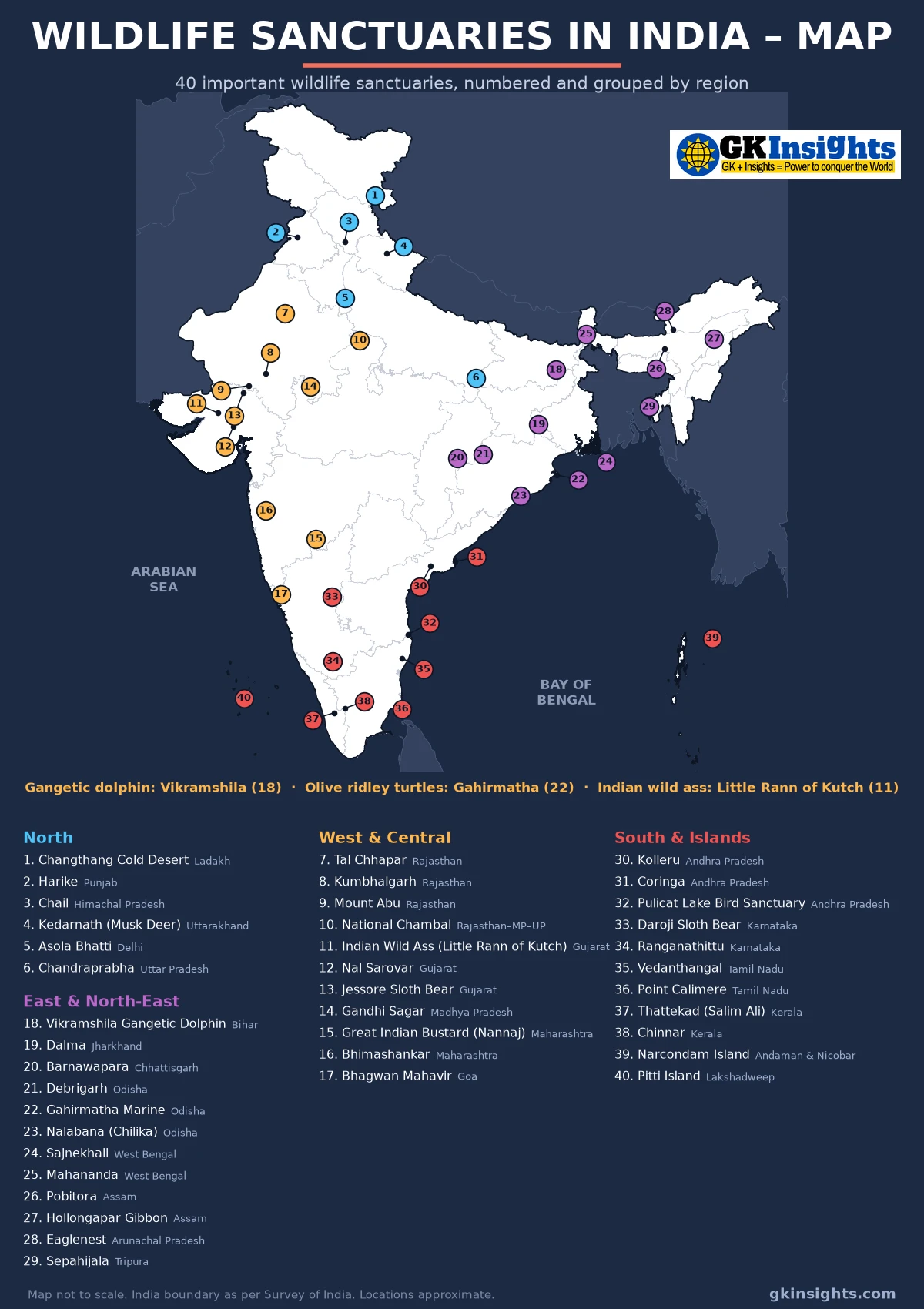
The map above marks 40 important wildlife sanctuaries of India, from the Changthang Cold Desert Sanctuary in Ladakh to Pitti Island in Lakshadweep and Narcondam Island in the Andaman Sea. Many of them protect one special animal or bird, so learn each sanctuary together with its state and the species it is known for.
What is a Wildlife Sanctuary?
A wildlife sanctuary is an area declared under Section 18 of the Wildlife (Protection) Act, 1972 because it has ecological, faunal, floral, geomorphological or natural importance. It is set up to protect, breed and develop wildlife and its environment. The state government usually declares a sanctuary, and the Central Government can also declare one under Section 38 of the Act.
Some human activities, such as regulated grazing or the collection of minor forest produce, may be allowed inside a sanctuary with the permission of the Chief Wildlife Warden. This is the main difference from a national park, where such rights are not allowed.
Wildlife Sanctuary vs National Park
| Point | Wildlife Sanctuary | National Park |
|---|---|---|
| Section of the Wildlife (Protection) Act, 1972 | Section 18 | Section 35 |
| Level of protection | Lower | Higher |
| Grazing and other rights of people | May be regulated and permitted | Not permitted |
| Change of status | Can be upgraded to a national park | Cannot be downgraded to a sanctuary |
| Change of boundaries | Needs the recommendation of the National Board for Wildlife | Needs the recommendation of the National Board for Wildlife |
| Examples | Pobitora (Assam), Vikramshila (Bihar), Nal Sarovar (Gujarat) | Kaziranga (Assam), Jim Corbett (Uttarakhand), Gir (Gujarat) |
List of Important Wildlife Sanctuaries in India (State-wise)
North India
| Sanctuary | State / UT | Known for |
|---|---|---|
| Changthang Cold Desert Sanctuary | Ladakh | High-altitude cold desert with Tso Moriri lake; kiang (Tibetan wild ass) and black-necked crane |
| Harike Wildlife Sanctuary | Punjab | Wetland at the meeting point of the Beas and Sutlej rivers; Ramsar site with many migratory birds |
| Chail Wildlife Sanctuary | Himachal Pradesh | Cheer pheasant and other Himalayan birds near Shimla |
| Kedarnath Wildlife Sanctuary | Uttarakhand | Also called the Kedarnath Musk Deer Sanctuary; protects the Himalayan musk deer |
| Asola Bhatti Wildlife Sanctuary | Delhi | On the southern ridge of the Aravalli hills in Delhi |
| Chandraprabha Wildlife Sanctuary | Uttar Pradesh | Near Varanasi; Asiatic lions were brought here in the 1950s as a second home, but they did not survive |
West and Central India
| Sanctuary | State | Known for |
|---|---|---|
| Tal Chhapar Sanctuary | Rajasthan | Blackbuck in the open grassland of Churu district |
| Kumbhalgarh Wildlife Sanctuary | Rajasthan | Aravalli forest around Kumbhalgarh Fort; wolf, leopard and sloth bear |
| Mount Abu Wildlife Sanctuary | Rajasthan | Aravalli hills with Guru Shikhar, the highest peak of the range |
| National Chambal Sanctuary | Rajasthan, Madhya Pradesh and Uttar Pradesh | Tri-state river sanctuary for the gharial, red-crowned roof turtle and Ganges river dolphin |
| Indian Wild Ass Sanctuary | Gujarat | Little Rann of Kutch; the last home of the Indian wild ass (khur) |
| Nal Sarovar Bird Sanctuary | Gujarat | Large wetland near Ahmedabad; Ramsar site with flamingos and other winter birds |
| Jessore Sloth Bear Sanctuary | Gujarat | Sloth bear in Banaskantha district |
| Gandhi Sagar Wildlife Sanctuary | Madhya Pradesh | Second home for cheetahs in India after Kuno; cheetahs were released here in 2025 |
| Great Indian Bustard Sanctuary (Nannaj) | Maharashtra | Grasslands of Solapur and Ahmednagar for the great Indian bustard |
| Bhimashankar Wildlife Sanctuary | Maharashtra | Indian giant squirrel (shekru), the state animal of Maharashtra |
| Bhagwan Mahavir Wildlife Sanctuary | Goa | Largest protected area of Goa, in the Western Ghats; Dudhsagar Falls lies in this area |
East and North-East India
| Sanctuary | State | Known for |
|---|---|---|
| Vikramshila Gangetic Dolphin Sanctuary | Bihar | Stretch of the Ganga between Sultanganj and Kahalgaon; protected area for the Gangetic river dolphin |
| Dalma Wildlife Sanctuary | Jharkhand | Elephants in the hills near Jamshedpur |
| Barnawapara Wildlife Sanctuary | Chhattisgarh | Dry deciduous forest with leopard, gaur and sloth bear |
| Debrigarh Wildlife Sanctuary | Odisha | On the banks of the Hirakud reservoir |
| Gahirmatha Marine Sanctuary | Odisha | Mass nesting (arribada) of olive ridley sea turtles |
| Nalabana Bird Sanctuary | Odisha | Island in Chilika Lake where migratory birds gather in winter |
| Sajnekhali Wildlife Sanctuary | West Bengal | Part of the Sundarbans mangroves; rich bird life |
| Mahananda Wildlife Sanctuary | West Bengal | Foothills of the Darjeeling Himalaya near Siliguri; elephants and gaur |
| Pobitora Wildlife Sanctuary | Assam | Highest density of the one-horned rhinoceros in the world |
| Hollongapar Gibbon Sanctuary | Assam | Hoolock gibbon, the only ape found in India |
| Eaglenest Wildlife Sanctuary | Arunachal Pradesh | Bird watching; the Bugun liocichla was discovered here in 2006 |
| Sepahijala Wildlife Sanctuary | Tripura | Clouded leopard and Phayre’s leaf monkey (spectacled monkey) |
South India and the Islands
| Sanctuary | State / UT | Known for |
|---|---|---|
| Kolleru Wildlife Sanctuary | Andhra Pradesh | Freshwater lake between the Godavari and Krishna deltas; Ramsar site |
| Coringa Wildlife Sanctuary | Andhra Pradesh | Mangrove forests of the Godavari delta |
| Pulicat Lake Bird Sanctuary | Andhra Pradesh | Brackish water lagoon on the Andhra Pradesh–Tamil Nadu border; flamingos |
| Daroji Sloth Bear Sanctuary | Karnataka | Sloth bear in the rocky hills near Hampi |
| Ranganathittu Bird Sanctuary | Karnataka | Islets in the Kaveri near Srirangapatna; Ramsar site |
| Vedanthangal Bird Sanctuary | Tamil Nadu | One of the oldest bird sanctuaries in India; local villagers protected the nesting birds for generations |
| Point Calimere Wildlife and Bird Sanctuary | Tamil Nadu | Blackbuck and flamingos on the Coromandel coast; Ramsar site |
| Thattekad Bird Sanctuary | Kerala | Named after the ornithologist Dr. Salim Ali; the first bird sanctuary of Kerala |
| Chinnar Wildlife Sanctuary | Kerala | Grizzled giant squirrel in the rain shadow region of the Western Ghats |
| Narcondam Island Wildlife Sanctuary | Andaman and Nicobar Islands | Volcanic island; the only home of the Narcondam hornbill |
| Pitti Island Bird Sanctuary | Lakshadweep | Small uninhabited islet protected for nesting sea birds such as terns |
Important Facts About Wildlife Sanctuaries in India
| Question | Answer |
|---|---|
| Law under which sanctuaries are declared | Section 18 of the Wildlife (Protection) Act, 1972 |
| Largest wildlife sanctuary in India | Kutch Desert Wildlife Sanctuary in the Great Rann of Kutch, Gujarat (about 7,500 sq km) |
| State or UT with the most sanctuaries | Andaman and Nicobar Islands, most of them small island sanctuaries |
| Sanctuary for the Gangetic river dolphin | Vikramshila Gangetic Dolphin Sanctuary, Bihar |
| Sanctuary for the Indian wild ass | Indian Wild Ass Sanctuary, Little Rann of Kutch, Gujarat |
| Nesting site of olive ridley turtles | Gahirmatha Marine Sanctuary, Odisha |
| Sanctuary for the hoolock gibbon | Hollongapar Gibbon Sanctuary, Assam |
| Highest density of one-horned rhino | Pobitora Wildlife Sanctuary, Assam |
| Second home for cheetahs after Kuno | Gandhi Sagar Wildlife Sanctuary, Madhya Pradesh |
| Tri-state sanctuary for the gharial | National Chambal Sanctuary (Rajasthan, Madhya Pradesh, Uttar Pradesh) |
UPSC often asks which animal a sanctuary protects or in which state it lies. Questions also link sanctuaries with Ramsar sites, as at Harike, Nal Sarovar, Kolleru, Ranganathittu and Point Calimere, so read this list together with the list of Ramsar sites.
Other Types of Protected Areas in India
- National Parks: declared under Section 35 of the Wildlife (Protection) Act, 1972, with stricter protection than sanctuaries.
- Conservation Reserves: added by the 2002 amendment of the Act; declared by the state government on government land next to national parks and sanctuaries, after consulting local communities.
- Community Reserves: also added in 2002; declared on community or private land where the community or the owner volunteers to protect wildlife.
- Tiger Reserves: notified under Section 38V of the Act on the advice of the National Tiger Conservation Authority. A tiger reserve usually includes one or more national parks or sanctuaries as its core area.
- Eco-Sensitive Zones: areas around national parks and sanctuaries notified by the Ministry of Environment, Forest and Climate Change under the Environment (Protection) Act, 1986, to act as a buffer.
FAQs on Wildlife Sanctuaries in India
How many wildlife sanctuaries are there in India?
India has more than 570 wildlife sanctuaries, according to the protected area data of the Wildlife Institute of India. The number changes as states declare new sanctuaries or upgrade old ones to national parks or tiger reserves.
Which is the largest wildlife sanctuary in India?
The Kutch Desert Wildlife Sanctuary in the Great Rann of Kutch, Gujarat, is the largest wildlife sanctuary in India, with an area of about 7,500 sq km.
Under which law are wildlife sanctuaries declared in India?
Wildlife sanctuaries are declared under Section 18 of the Wildlife (Protection) Act, 1972, usually by the state government.
What is the difference between a wildlife sanctuary and a national park?
A national park has stricter protection, and grazing and other rights of people are not allowed in it. In a wildlife sanctuary, some activities such as regulated grazing may be allowed. A sanctuary can be upgraded to a national park, but a national park cannot be downgraded to a sanctuary.
Which sanctuary is famous for the Gangetic river dolphin?
The Vikramshila Gangetic Dolphin Sanctuary in Bhagalpur district of Bihar protects the Gangetic river dolphin along a stretch of the Ganga.
Where is the Indian Wild Ass Sanctuary?
The Indian Wild Ass Sanctuary is in the Little Rann of Kutch in Gujarat. It is the last home of the Indian wild ass, also called the khur.
Also Check:
– National Parks in India – Map and List
– Tiger Reserves in India – Map and List
– Ramsar Sites in India
– Biosphere Reserves in India
– Mangrove Forest Sites in India