
Map of Neolithic Sites in India
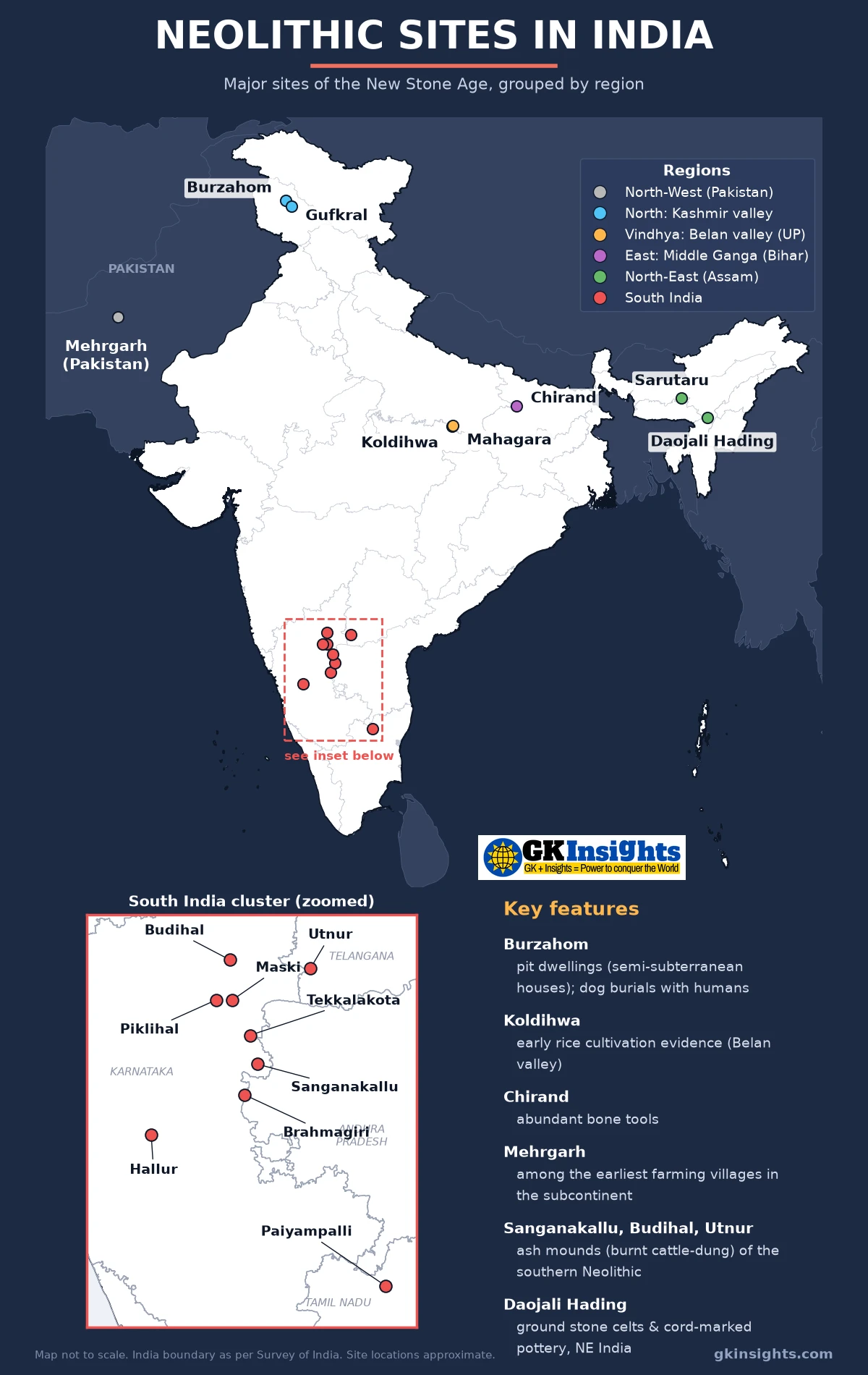
The map above shows the major Neolithic sites in India, from Burzahom and Gufkral in Kashmir to Utnur and Paiyampalli in the south. Mehrgarh, now in Pakistan, is included because it is one of the earliest known farming villages of the subcontinent. Neolithic sites are found in the north-west, in Kashmir, in the Ganga valley, in north-east India and in the southern Deccan.
Division of Ancient Indian History
History of Ancient India has been divided by the historians into 3 periods:
– Pre-Historic Period (2 Million BC – 2,500 BC)
– Proto-Historic Period (2,500 BC – 600 BC)
– Historical Period (600 BC Onwards)
Pre-Historic Period is further sub-divided into 3 Ages:
– Palaeolithic Age
– Mesolithic Age
– Neolithic Age
Features of the Neolithic Age
- People began growing crops and rearing animals, which led to settled village life.
- Stone tools were ground and polished to give a fine cutting edge (polished celts and axes).
- Mortars and pestles were used for grinding grain. Some tools were made of bone.
- Pottery was made for storing and cooking food.
- Houses ranged from pit dwellings (Burzahom) to mud and mud-brick houses.
List of Neolithic Sites in India
Evidences of Neolithic Sites are found in various parts of the subcontinent as following:
- Mehrgarh (Balochistan, Pakistan)
- Burzahom (Jammu & Kashmir)
- Gufkral (Jammu & Kashmir)
- Koldihwa (Uttar Pradesh)
- Mahagara (Uttar Pradesh)
- Chirand (Bihar)
- Daojali Hading (Assam)
- Sarutaru (Assam)
- Brahmagiri (Karnataka)
- Maski (Karnataka)
- Piklihal (Karnataka)
- Sanganakallu (Karnataka)
- Tekkalakota (Karnataka)
- Hallur (Karnataka)
- Budihal (Karnataka)
- Utnur (Telangana)
- Paiyampalli (Tamil Nadu)
Region-wise Table of Neolithic Sites in India
| Region | Site | State / District | Key Features |
|---|---|---|---|
| North-West | Mehrgarh | Balochistan, Pakistan (near the Bolan Pass) | One of the earliest farming villages; wheat, barley, sheep, goat, cattle |
| Kashmir | Burzahom | Srinagar district, J&K | Pit dwellings; burials with animals, including wild dogs; wheat and lentil |
| Kashmir | Gufkral | Pulwama district, J&K (near Tral) | Pit dwellings cut into karewa deposits; wheat and lentil |
| Ganga valley | Koldihwa | Prayagraj district, UP (Belan valley) | Early evidence of rice |
| Ganga valley | Mahagara | Prayagraj district, UP (Belan valley) | Rice; cattle pen with hoof marks |
| Ganga valley | Chirand | Saran district, Bihar | Bone and antler tools; wheat, barley, green gram |
| North-East | Daojali Hading | Dima Hasao district, Assam | Cord-marked pottery; shouldered celts; jadeite; fossil-wood tools |
| North-East | Sarutaru | Kamrup district, Assam | Ground stone celts; cord-impressed handmade pottery |
| South | Brahmagiri | Chitradurga district, Karnataka | Excavated by Mortimer Wheeler (1947) |
| South | Maski | Raichur district, Karnataka | Neolithic site in the Raichur Doab |
| South | Piklihal | Raichur district, Karnataka | Excavated by F.R. Allchin |
| South | Sanganakallu | Ballari district, Karnataka | Ashmounds; rock art of humped cattle |
| South | Tekkalakota | Ballari district, Karnataka | Neolithic–Chalcolithic settlement |
| South | Hallur | Haveri district, Karnataka (Tungabhadra valley) | Millet; cattle, sheep, goat, pig |
| South | Budihal | Yadgir district, Karnataka | Ashmound, cattle pen and a community butchering floor |
| South | Utnur | Mahbubnagar district, Telangana | Ashmound; cattle pen with hoof impressions |
| South | Paiyampalli | Vellore region, Tamil Nadu | Black gram, millet; cattle, sheep, pig |
Details of some Major Neolithic Sites in India
Mehrgarh (Pakistan)
– Location: On the Kachhi plain of Balochistan, near the Bolan Pass.
– Significance: One of the earliest known villages of the subcontinent where people grew crops and reared animals.
– Findings: Remains of wheat and barley; bones of sheep, goat and cattle. Square or rectangular mud-brick houses with several compartments.
Burzahom (Jammu & Kashmir)
– Location: Srinagar district, about 16 km north-east of Srinagar.
– Significance: Excavated by the Archaeological Survey of India; known for pit dwellings.
– Findings: Pit dwellings with post holes for a roof, hearths near the pits, bone tools, and burials in which animals, including wild dogs, were buried along with people.
Gufkral (Jammu & Kashmir)
– Location: Near Tral in Pulwama district.
– Significance: The name means “cave of the potter” (guf = cave, kral = potter).
– Findings: Dwelling pits cut into the karewa deposits, storage pits and hearths; remains of wheat and lentil.
Koldihwa and Mahagara (Uttar Pradesh)
– Location: On opposite banks of the Belan river in Prayagraj district.
– Significance: Among the early sites of rice cultivation in India, excavated by the University of Allahabad.
– Findings: Rice at both sites. At Mahagara, a cattle pen with hoof marks on the clay surface was found next to the village.
Chirand (Bihar)
– Location: Saran district, near the confluence of the Ghaghara and the Ganga.
– Significance: Known for its rich bone and antler tool industry.
– Findings: Bone tools such as needles, awls and arrowheads; wheat, barley and green gram; bones of buffalo and ox.
Daojali Hading and Sarutaru (Assam)
– Location: Daojali Hading in Dima Hasao district; Sarutaru in Kamrup district, about 25 km south-east of Guwahati.
– Significance: Daojali Hading was the first stratified Neolithic site found in north-east India.
– Findings: Shouldered celts and cord-marked pottery at both sites. Daojali Hading also yielded mortars and pestles, jadeite and tools of fossil wood.
Southern Neolithic Sites (Karnataka, Telangana, Tamil Nadu)
– Location: Brahmagiri, Maski, Piklihal, Sanganakallu, Tekkalakota, Hallur and Budihal in Karnataka; Utnur in Telangana; Paiyampalli in Tamil Nadu.
– Significance: People here were mainly cattle keepers. Many sites have ashmounds, formed by burning heaps of cattle dung.
– Findings: At Utnur, F.R. Allchin found evidence of cattle pens with hoof impressions. Budihal has an ashmound and a community butchering floor. Hallur and Paiyampalli yielded millet and bones of domesticated animals.
Most Neolithic sites in India lie in river valleys or on hills close to them, such as the Jhelum valley in Kashmir, the Belan and the Ganga in the north, and the Tungabhadra and Krishna basins in the south. This information on the Neolithic Age, its sites and the map is useful for UPSC and other competitive exams.
FAQs on Neolithic Sites in India
Which are the major Neolithic sites in India?
Major Neolithic sites in India include Burzahom and Gufkral (Kashmir), Koldihwa and Mahagara (Uttar Pradesh), Chirand (Bihar), Daojali Hading and Sarutaru (Assam), Brahmagiri, Maski, Piklihal, Sanganakallu, Tekkalakota, Hallur and Budihal (Karnataka), Utnur (Telangana) and Paiyampalli (Tamil Nadu). Mehrgarh lies in present-day Pakistan.
Which Neolithic site is known for pit dwellings?
Burzahom in Srinagar district of Jammu and Kashmir is known for pit dwellings. Pit dwellings have also been found at Gufkral in Pulwama district.
Which Neolithic sites show early evidence of rice?
Koldihwa and Mahagara in the Belan valley of Prayagraj district, Uttar Pradesh.
What are ashmounds?
Ashmounds are mounds formed by burning accumulated cattle dung. They are found at Southern Neolithic sites such as Utnur, Budihal and Sanganakallu.
Also Check:
– 11 Palaeolithic Sites in India – Map and List
– 12 Mesolithic Sites in India – Map and List
– Rivers in India – Map
– Mountain Ranges in India – Map
– Archaeological Survey of India Website [External]
2 thoughts on “Neolithic Sites in India: Map and List”