
Last updated: 24 October 2026
This Chapter on ‘Directive Principles of State Policy’ is a part of our Indian Polity Course for UPSC.
Directive Principles of State Policy (DPSP) are contained in Part IV of the Constitution, from Article 36 to Article 51. They are directions to the State on the social and economic goals it should work towards. Under Article 37, they cannot be enforced by any court, but they are fundamental in the governance of the country, and the State has a duty to apply them while making laws. This is the main difference between DPSP and the Fundamental Rights in Part III, which are enforceable.
Part IV at a Glance
- Part: IV
- Articles: 36 to 51
- Nature: Non-justiciable (not enforceable by courts)
- Addressed to: “The State”, which has the same meaning as in Part III (Article 36)
- Articles added later: 39A, 43A, 43B and 48A
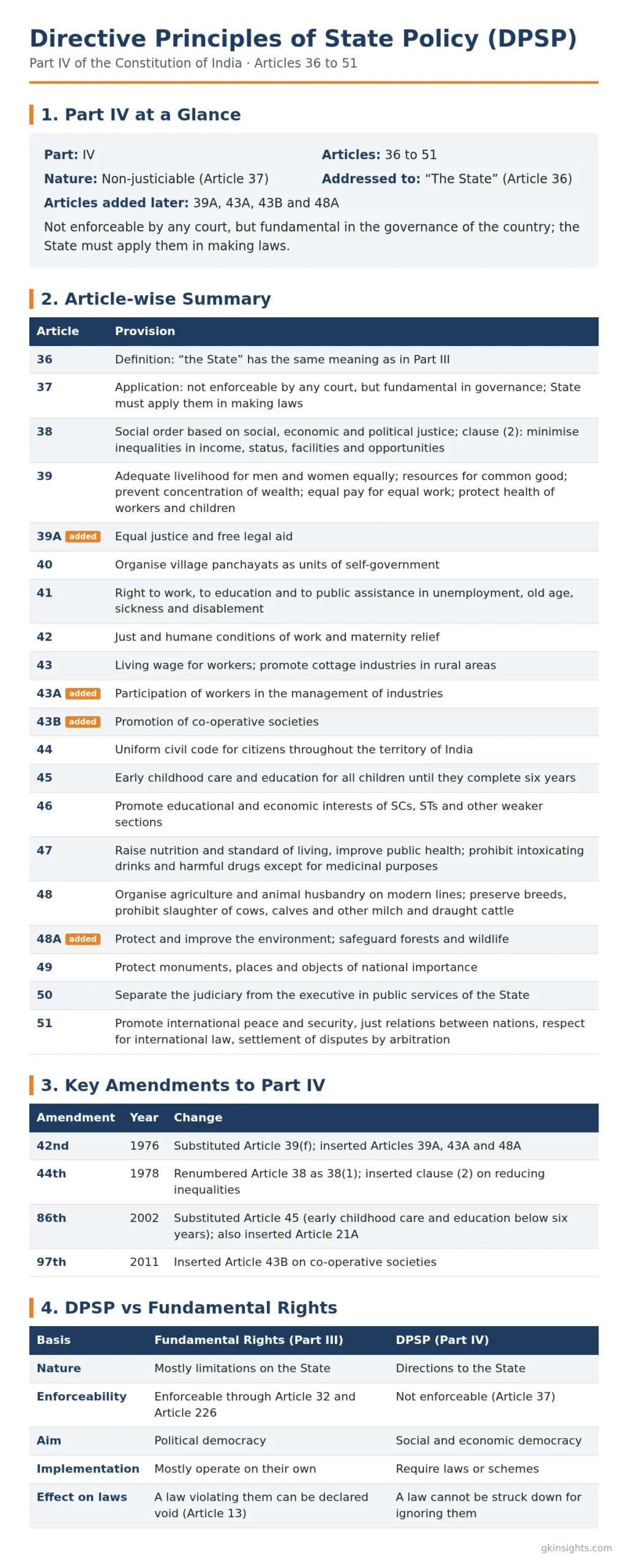
Article 36 and Article 37
- Article 36 (Definition): In Part IV, “the State” has the same meaning as in Part III. It covers the Government and Parliament of India, the Government and Legislature of each State, and local and other authorities.
- Article 37 (Application): The provisions of Part IV are not enforceable by any court. However, they are fundamental in the governance of the country, and the State must apply them in making laws.
Article-wise List of Directive Principles
| Article | Provision |
|---|---|
| 38 | Secure a social order based on social, economic and political justice. Clause (2): minimise inequalities in income, status, facilities and opportunities |
| 39 | Adequate means of livelihood for men and women equally; distribution of material resources for the common good; prevent concentration of wealth; equal pay for equal work; protect the health of workers and children |
| 39A | Equal justice and free legal aid |
| 40 | Organise village panchayats as units of self-government |
| 41 | Right to work, to education and to public assistance in unemployment, old age, sickness and disablement |
| 42 | Just and humane conditions of work and maternity relief |
| 43 | Living wage for workers; promote cottage industries in rural areas |
| 43A | Participation of workers in the management of industries |
| 43B | Promotion of co-operative societies |
| 44 | Uniform civil code for citizens throughout the territory of India |
| 45 | Early childhood care and education for all children until they complete six years |
| 46 | Promote the educational and economic interests of SCs, STs and other weaker sections |
| 47 | Raise the level of nutrition and standard of living, improve public health; prohibit intoxicating drinks and harmful drugs except for medicinal purposes |
| 48 | Organise agriculture and animal husbandry on modern lines; preserve breeds and prohibit slaughter of cows, calves and other milch and draught cattle |
| 48A | Protect and improve the environment and safeguard forests and wildlife |
| 49 | Protect monuments, places and objects of national importance |
| 50 | Separate the judiciary from the executive in the public services of the State |
| 51 | Promote international peace and security, just relations between nations, respect for international law, and settlement of disputes by arbitration |
Classification of DPSP
The Constitution does not classify the Directive Principles. For study purposes, they are usually grouped by their content as below. This grouping is a textbook convention and not part of the constitutional text.
| Group | Articles |
|---|---|
| Socialistic | 38, 39, 39A, 41, 42, 43, 43A, 47 |
| Gandhian | 40, 43 (cottage industries), 43B, 46, 47 (prohibition), 48 (cattle) |
| Liberal-intellectual | 44, 45, 48 (modern agriculture), 48A, 49, 50, 51 |
Articles 43, 47 and 48 appear in more than one group because different clauses fall under different heads.
Amendments to Part IV
| Amendment | Year | Change |
|---|---|---|
| 42nd | 1976 | Substituted Article 39(f); inserted Articles 39A, 43A and 48A |
| 44th | 1978 | Renumbered Article 38 as 38(1) and inserted clause (2) on reducing inequalities |
| 86th | 2002 | Substituted Article 45 (early childhood care and education below six years); the same Amendment inserted Article 21A |
| 97th | 2011 | Inserted Article 43B on co-operative societies |
DPSP vs Fundamental Rights
| Basis | Fundamental Rights (Part III) | DPSP (Part IV) |
|---|---|---|
| Nature | Mostly limitations on the State | Directions to the State |
| Enforceability | Enforceable through Article 32 and Article 226 | Not enforceable (Article 37) |
| Aim | Political democracy | Social and economic democracy |
| Implementation | Mostly operate on their own | Require laws or schemes |
| Effect on laws | A law violating them can be declared void (Article 13) | A law cannot be struck down for ignoring them |
Article 31C and the Relationship with Fundamental Rights
- Article 31C was inserted by the 25th Amendment Act, 1971. It protects laws that give effect to Article 39(b) and 39(c) from being challenged for violating Article 14 or Article 19.
- The 42nd Amendment extended this protection to all or any of the principles in Part IV.
- In Minerva Mills Ltd. vs Union of India (1980), the Supreme Court declared this extension invalid. As a result, the protection under Article 31C applies only to laws for Article 39(b) and 39(c).
- In Kesavananda Bharati vs State of Kerala (1973), the Supreme Court struck down the part of Article 31C that barred courts from examining whether a law actually gives effect to such a policy.
The position that emerges is that Fundamental Rights and DPSP are meant to be read together, and neither is placed above the other as a whole.
Related Provisions Elsewhere in the Constitution
- Article 40 (village panchayats): Panchayats were later given constitutional status under Part IX.
- Article 39A (free legal aid): The State is to provide free legal aid “by suitable legislation or schemes or in any other way”.
- Article 45 (early childhood education): The 86th Amendment also inserted Article 21A, which makes free and compulsory education for children aged six to fourteen a Fundamental Right.
- Article 48A (environment): Article 51A in Part IVA makes protecting the environment a duty of every citizen as well.
- Article 44 (uniform civil code): This remains a Directive Principle and is not enforceable by courts.
Summary
- DPSP are in Part IV, Articles 36 to 51.
- Article 37 makes them non-justiciable but fundamental in the governance of the country.
- The 42nd Amendment (1976) substituted 39(f) and added 39A, 43A and 48A. The 44th (1978) added 38(2), the 86th (2002) substituted Article 45 and the 97th (2011) added 43B.
- In Minerva Mills (1980), the Supreme Court struck down the extension of Article 31C to all of Part IV.
FAQs
Are Directive Principles of State Policy enforceable in court?
No. Article 37 says the provisions of Part IV are not enforceable by any court. They are, however, fundamental in the governance of the country, and the State has a duty to apply them in making laws.
Which Articles cover DPSP?
Articles 36 to 51 in Part IV of the Constitution. Article 36 defines “the State”, Article 37 explains how the principles apply, and Articles 38 to 51 contain the principles.
Which DPSP were added by the 42nd Amendment?
The 42nd Amendment Act, 1976 substituted Article 39(f) and inserted Articles 39A (equal justice and free legal aid), 43A (participation of workers in management) and 48A (environment, forests and wildlife).
Which Article of DPSP deals with the Uniform Civil Code?
Article 44. It says the State shall endeavour to secure a uniform civil code for citizens throughout the territory of India.
What is the difference between DPSP and Fundamental Rights?
Fundamental Rights are enforceable in court and mostly limit the powers of the State. DPSP are not enforceable and direct the State towards social and economic goals. Article 31C, as limited by the Minerva Mills judgment, deals with conflicts between the two.
Related Chapters
- Preamble of the Constitution
- Fundamental Rights
- Citizenship
- Union and its Territory
- Historical Background
References
- The Constitution of India (official text), Legislative Department, Ministry of Law and Justice: https://legislative.gov.in/constitution-of-india/
- Constitution of India, India Code: https://www.indiacode.nic.in/
- Supreme Court of India: https://www.sci.gov.in/
2 thoughts on “Directive Principles of State Policy (DPSP): Articles 36 to 51 for UPSC”